Acechange
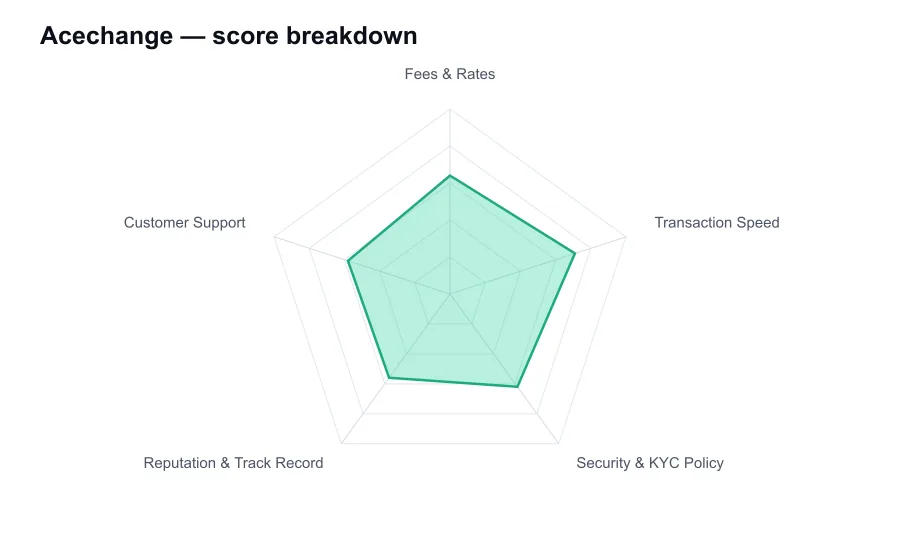
Acechange scores 6.3/10 overall in our independent review, measured against every other provider we've compared, strongest on Transaction Speed (7.1/10) and weakest on Reputation & Track Record (5.6/10).
Score: 6.3/10 How we score →| Best for | Not for |
|---|---|
| Simple non-custodial swap flow | No fully public percentage fee schedule |
Editorial independence: our scores and rankings are produced using the fixed criteria above and are not influenced by advertisers. This is an independent ranking site and is not operated by, or affiliated with, any provider we list.
Affiliate disclosure: some links on this page may earn us a commission at no extra cost to you. This does not affect our rankings.
Criteria Breakdown
| Criterion | Score | Notes |
|---|---|---|
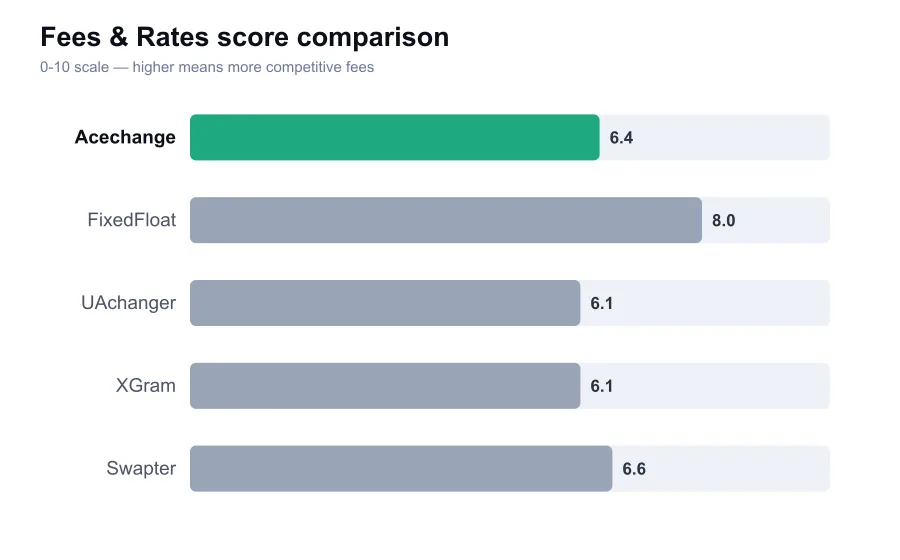
| Fees & Rates | 6.4 | Competitive quotes on major pairs, but no transparent flat fee schedule |
| Transaction Speed | 7.1 | Fast for routine swaps, subject to blockchain confirmations and liquidity |
| Security & KYC Policy | 6.2 | Non-custodial flow, but compliance checks can still pause a transaction |
| Reputation & Track Record | 5.6 | Limited public track record compared with major exchange brands |
| Customer Support | 5.8 | Online support only, with limited evidence of premium escalation options |
Acechange is a non-custodial instant crypto exchange, built for the person who wants to swap one coin for another without opening a trading account, studying an order book, or leaving assets on a platform. It belongs to the same broad market as ChangeNOW, SimpleSwap, StealthEX, and LetsExchange. That market is useful, but it demands caution. The convenience comes from routing liquidity through outside partners, which means the exchange experience can be smooth right up until a rate moves sharply or a compliance review interrupts the process.
The site presents a straightforward swap flow. Select the asset you are sending, select the asset you want to receive, enter a destination address, and pay the quoted amount. For a small, ordinary BTC to USDT or ETH to BTC conversion, that is refreshingly simple. There is no traditional wallet interface to secure, no margin menu, and no pressure to learn professional trading tools. Acechange is trying to make crypto conversion feel like a utility rather than a trading venue.
Its fee presentation is less satisfying than its interface. Acechange does not operate with the sort of public, permanently posted maker and taker schedule that a centralized exchange such as Kraken or Coinbase Advanced publishes. The cost is built into the quote, alongside network charges and the liquidity partner's spread. That is common among instant exchanges, but it means you have to judge the final output rather than hunt for one advertised percentage.
For liquid pairs, the quote can be competitive enough. A routine swap involving BTC, ETH, USDT, USDC, LTC, or SOL will often be priced within a reasonable convenience premium of the wider market. It is not the cheapest route for a trader who can use an exchange order book and wait for a limit order to fill. It can, however, beat the apparent simplicity of some competitors that show a very attractive first number and reveal a much weaker final rate after the deposit amount is entered.
The problem arrives with thinly traded assets and volatile markets. Spreads can widen quickly, especially where the service has to source liquidity from an external provider rather than internal inventory. A fixed rate, if offered for a particular pair, is the safer choice for someone sending a meaningful sum. A floating rate is fine for a small test transfer, but it leaves the customer carrying market movement during confirmations. That is a poor bargain during a fast Bitcoin or altcoin move.
Speed is generally determined by the blockchain you use and the partner fulfilling the swap, not solely by Acechange. Swaps on fast networks can finish in minutes after the deposit has enough confirmations. Bitcoin and Ethereum transactions are a different story. A low network fee, a congested mempool, or an asset requiring extra confirmations can turn a supposedly instant transaction into an hour or more of waiting.
Acechange does a decent job of making the basic stages intelligible. A transaction page normally lets the user see whether the deposit has arrived, whether the conversion is being processed, and whether the payout has been sent. That visibility matters. Too many small swap services provide little more than a transaction ID and an anxious customer wondering if anyone has seen the funds. Still, tracking is not the same as control. Once coins have been deposited, the customer is dependent on Acechange and its liquidity route.
The service markets a low-friction model, and routine swaps may not require account registration. That is attractive to privacy-minded users who do not want to submit identity documents simply to exchange crypto for crypto. It should not be mistaken for an unconditional no-KYC guarantee. Like virtually every serious instant exchange, Acechange can request verification where a transaction triggers fraud, sanctions, source-of-funds, or blockchain-risk controls.
That distinction is more important than the headline. If a swap is flagged after you have sent coins, the transaction may pause while the company asks for identification, a selfie, wallet evidence, or an explanation of funds. People who need certainty about privacy should not send money first and assume a review can never happen. Anyone with heightened privacy or regulatory exposure should use a route whose policy, jurisdiction, and legal protections they fully understand.
On security, the non-custodial model is a genuine positive. Acechange does not ask customers to hold a standing balance in a hosted wallet, so there is less exposure to the familiar risk of an exchange account being drained or frozen months later. The unavoidable risk is address accuracy. Crypto swaps are irreversible. Check the destination network, do not send tokens over an unsupported chain, and never copy a wallet address from a search advert or a message claiming to be support.
Acechange does not have the public history, licensing footprint, or independently verifiable security reporting that would put it in the same trust bracket as long-established regulated brokers. That does not make it automatically unsafe. It does mean a user should apply a smaller-exchange standard of care. Start with a modest transaction, preserve the order ID and screenshots, and do not use a little-known instant exchange as your primary route for a life-changing amount.
Its reputation is therefore mixed rather than disastrous. Users tend to judge services like this by whether a specific transaction lands, and successful small swaps can create a favorable impression very quickly. Complaints tend to center on delayed orders, rate differences after a floating exchange, or a compliance check that arrived unexpectedly. Those are industry-wide problems, but a mature company earns trust by handling them transparently and quickly, not by merely pointing at terms after the fact.
Customer support is available through the site's support channels, but this is not the kind of operation where I would expect phone support or a dedicated account manager. Response quality matters more than a chat widget. The useful test is whether an agent can identify the transaction stage, explain what is required, and give a realistic timeline. Generic replies are especially frustrating because the customer cannot simply cancel a completed blockchain deposit.
I would use Acechange for a small or medium-sized, straightforward coin-to-coin conversion where the displayed rate is good and the receiving wallet is already under my control. I would not use it as a replacement for a major exchange, nor would I choose it for an urgent, very large, or compliance-sensitive transfer. Acechange's appeal is simplicity, not institutional-grade certainty. Treat it as a practical swap tool, compare the quote with two competitors, and keep your expectations grounded.
Pros and Cons
| Pros | Cons |
|---|---|
| Simple non-custodial swap flow | — |
| No standing exchange balance required | — |
| Useful transaction status tracking | — |
| Low-friction access for routine crypto swaps | — |
Suitability
Does Acechange require KYC?
A routine crypto swap may not require account registration, but Acechange can request identity or source-of-funds documents if its risk controls flag a transaction.
How long does an Acechange swap take?
Fast-network swaps may complete within minutes after confirmation. Bitcoin, Ethereum congestion, low fees, or a compliance review can extend the process substantially.
Are Acechange fees shown separately?
Costs are generally reflected in the quoted exchange rate and network costs rather than a simple public maker and taker fee table.