XGram
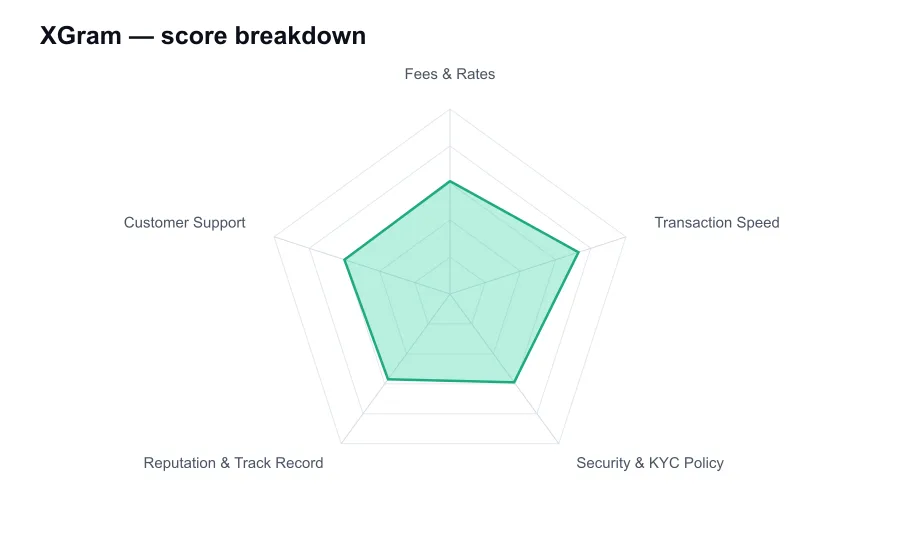
XGram scores 6.2/10 overall in our independent review, measured against every other provider we've compared, strongest on Transaction Speed (7.3/10) and weakest on Reputation & Track Record (5.7/10).
Score: 6.2/10 How we score →| Best for | Not for |
|---|---|
| Direct conversion-focused workflow | Rate may change on floating orders |
Editorial independence: our scores and rankings are produced using the fixed criteria above and are not influenced by advertisers. This is an independent ranking site and is not operated by, or affiliated with, any provider we list.
Affiliate disclosure: some links on this page may earn us a commission at no extra cost to you. This does not affect our rankings.
Criteria Breakdown
| Criterion | Score | Notes |
|---|---|---|
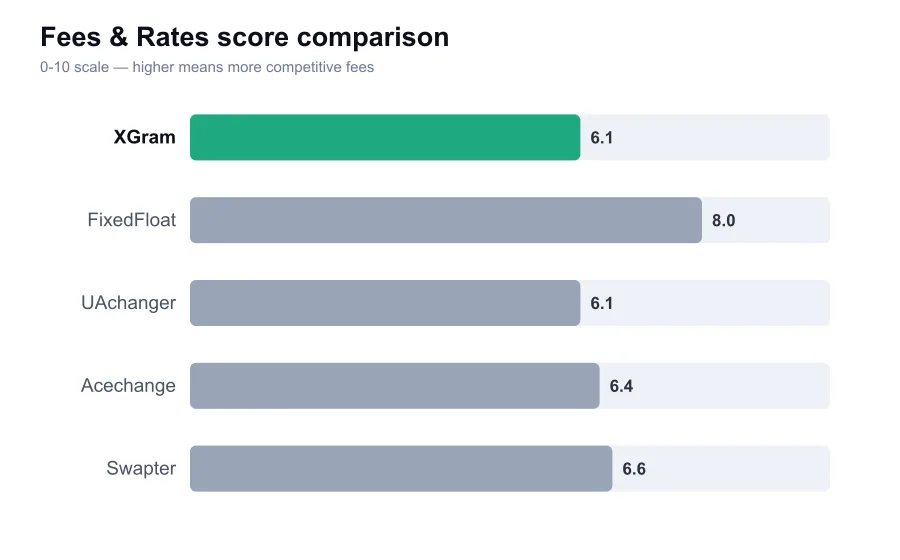
| Fees & Rates | 6.1 | Competitive quotes are possible, but spread-based pricing needs checking. |
| Transaction Speed | 7.3 | Clean crypto orders can be quick once confirmations arrive. |
| Security & KYC Policy | 5.9 | No standing custody helps, but user and AML risks remain. |
| Reputation & Track Record | 5.7 | Useful exchanger visibility, but limited institutional transparency. |
| Customer Support | 6.0 | Best suited to clear order-specific questions and evidence. |
XGram presents itself in the exchange-office segment rather than as a broad cryptocurrency marketplace. That makes it a service for conversion, not a financial home for your coins. Users are likely to encounter it while searching for a specific route between crypto, electronic money, cash-related options, or bank payment methods. It sits in a crowded field where the user experience can look similar across providers, so the real differences are rate discipline, reserves, support quality, and how an exception is handled.
The obvious attraction is speed of decision. You choose the direction, see an estimated receive amount, provide destination details, and create an order. Compared with a centralized exchange, that can feel refreshingly direct. There is no trading pair selection, no complex chart, and often no account dashboard to manage. For somebody cashing out a modest stablecoin amount, that is a better experience than forcing every transaction through a full brokerage-style platform.
XGram should nevertheless be approached as a quote-driven service. Its fee is generally experienced through the conversion rate, not through a clean public percentage that applies to every pair. That is workable, but it shifts responsibility to the customer. Do not ask whether the stated fee sounds low. Ask how many units you will actually receive, whether that number is fixed, and whether the stated network cost has already been reflected.
The difference matters most during fast markets. If you send Bitcoin or an Ethereum-based token during a price swing, the service may not receive sufficient confirmations until the market has already moved. A floating-rate order can then settle at a less favorable level than the calculator showed. If XGram offers a fixed-rate mechanism on the chosen direction, understand its time window and amount tolerance. An order can lose fixed-rate treatment if it arrives late or short.
For common stablecoins, chain choice may matter more than the exchanger's advertised spread. USDT on Tron often carries a different practical cost and processing profile from USDT on Ethereum. A user who chooses a cheap route without confirming that the receiving address supports that network can create a serious problem. XGram cannot remove the fundamental risks of blockchain finality. Send a test amount if you have any doubt, especially with a new wallet or new chain.
On raw processing speed, XGram has the potential to be quick in clean crypto orders. An exchanger does not need to match buyers and sellers in the way an order-book venue does. Once the deposit is validated and the outgoing asset is available, execution is operationally simple. But that potential is not the same as a guaranteed service level. Confirmation requirements, reserve management, maintenance, and manual fraud checks can all make a particular order slower.
I would be particularly careful with bank cards and third-party payment accounts. Those are the directions most likely to run into name matching, bank monitoring, payment limits, or recipient-side delays. A website can indicate that an exchange is processed, while the money is still passing through a payment rail outside its direct control. For a casual conversion that may be acceptable. For payroll, rent, a business invoice, or an emergency, it is the wrong risk profile.
Security is strongest where XGram's role stays limited. You send funds for a specific order and do not leave a standing balance with an unfamiliar company. That is better than treating a small exchanger as a wallet. However, operational security is shared with the user. You need to verify the order address, avoid copy-paste malware, keep the transaction hash, and refuse requests from impersonators on messaging apps. Exchange brands are routinely copied by scammers.
KYC is another area where users should be realistic. A service may allow a normal order without registration and still reserve the right to require documents when an AML system flags the transaction. That is common practice, not an unusual trap unique to XGram. It can still be a bad surprise for privacy-focused users. If your funds come from a complex source or your wallet has interacted with high-risk services, assume verification is possible and plan accordingly.
XGram's reputation should be viewed as functional rather than institutional. It may have visibility within exchanger monitoring communities and user-review ecosystems, but that is not equivalent to the public accountability of a heavily regulated exchange. The service has less of the corporate transparency, public audit material, and formal complaints infrastructure that conservative users may expect. That does not make every order unsafe. It does mean the burden of caution remains high.
This is why I would separate a positive exchange experience from a strong trust conclusion. Many small providers complete ordinary orders correctly because that is their business model. The difficult test is what happens when an amount differs, a transaction is flagged, a recipient bank delays a payment, or a network error complicates recovery. Before relying on XGram repeatedly, read how it describes those situations and look for specific, recent feedback about resolution rather than only speed.
Support can be adequate in an order-based model if the team is reachable and gives concrete answers. The useful questions are simple: Has the deposit been seen? How many confirmations are required? Is the payout sent? Is there a compliance issue? A support agent who answers those points clearly can resolve most anxiety. If you open a request, provide the full evidence package immediately instead of sending fragmented messages over several channels.
XGram is not the venue for passive investors or people who want regulated custody protections. It is a utility service. Used with a modest amount, a familiar direction, and realistic timing expectations, that can be perfectly sensible. Used as a shortcut around due diligence, it becomes a poor bet. The fact that the order process is simple should make you more careful, not less, because there may be fewer formal safeguards after you press send.
My final view is that XGram deserves consideration for routine, well-understood conversion routes but not unquestioning confidence. Its convenience and possible speed are genuine strengths. Pricing is less predictable than at a transparent fee-schedule exchange, and the smaller public reputation base limits how much risk I would accept. Start small, confirm the rate terms, avoid urgent fiat deadlines, and use a provider with deeper oversight if the amount would be painful to have delayed.
Pros and Cons
| Pros | Cons |
|---|---|
| Direct conversion-focused workflow | — |
| Potentially fast crypto settlement | — |
| No need to hold a platform balance | — |
| Useful for familiar stablecoin routes | — |
Suitability
Is XGram suitable for a large crypto cash-out?
It is wiser to test a small amount first. Large or urgent cash-outs deserve a provider with stronger public disclosure, defined escalation channels, and more established compliance processes.
Why can the XGram payout differ from the calculator?
A floating exchange rate can move while a deposit waits for confirmations. Check whether your selected order is fixed-rate, its deadline, and the allowed amount deviation.
What is the safest way to send funds to XGram?
Confirm the network and order address directly on the order page, send the exact amount, save the transaction hash, and do not use an address copied from chat messages.