FixedFloat
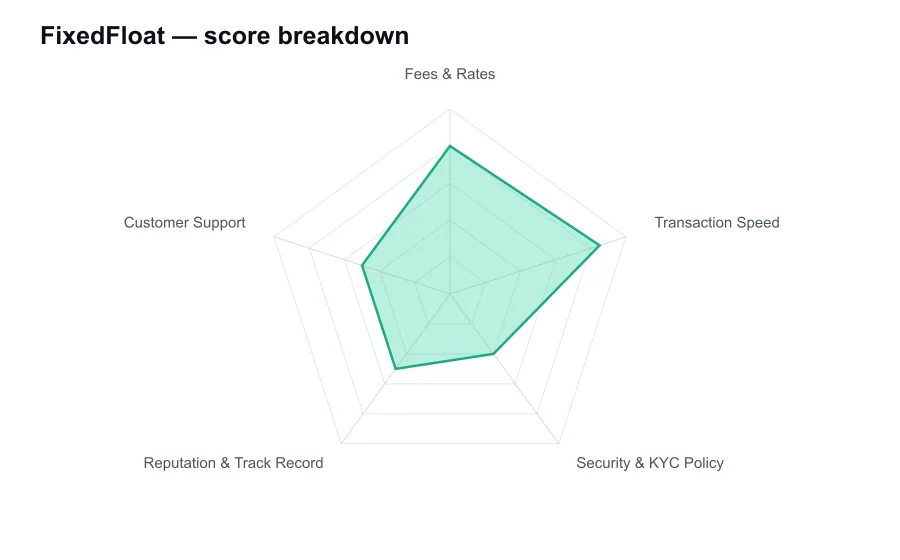
FixedFloat scores 6.2/10 overall in our independent review, measured against every other provider we've compared, strongest on Transaction Speed (8.5/10) and weakest on Security & KYC Policy (4.0/10).
Score: 6.2/10 How we score →| Best for | Not for |
|---|---|
| Clear floating and fixed-rate fee structure | Major 2024 security incident |
Editorial independence: our scores and rankings are produced using the fixed criteria above and are not influenced by advertisers. This is an independent ranking site and is not operated by, or affiliated with, any provider we list.
Affiliate disclosure: some links on this page may earn us a commission at no extra cost to you. This does not affect our rankings.
Criteria Breakdown
| Criterion | Score | Notes |
|---|---|---|
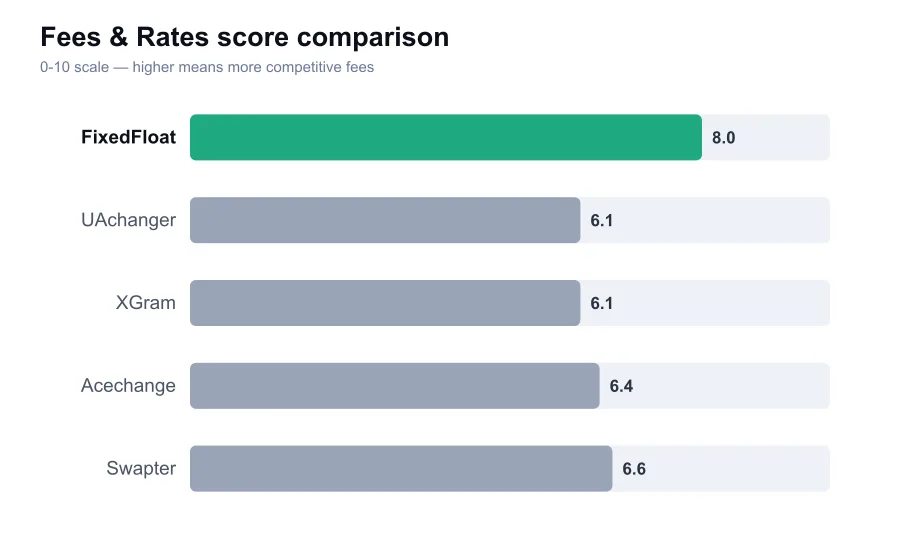
| Fees & Rates | 8.0 | Historically clear 0.5% floating and 1% fixed fees. |
| Transaction Speed | 8.5 | Fast automation and valuable Lightning Network support. |
| Security & KYC Policy | 4.0 | The 2024 security incident materially lowers confidence. |
| Reputation & Track Record | 5.0 | Strong technical history, damaged by a major breach. |
| Customer Support | 5.0 | Online support is functional but not deeply accountable. |
FixedFloat has long been one of the more technically distinctive instant exchanges. It built a following by serving users who wanted no-account swaps, Bitcoin Lightning support, and a genuinely clear choice between floating and fixed rates. At its best, it felt designed by people who understood how crypto moves between wallets, not by marketers trying to recreate a bank app.
Its core proposition is simple. You create an order, send the specified asset, and receive the selected payout asset at a destination address you control. There is no conventional trading dashboard, no standing portfolio page, and usually no identity registration for routine activity. That makes FixedFloat particularly attractive to self-custody users moving between Bitcoin, Litecoin, Ethereum, stablecoins, and other supported assets.
The fee presentation is unusually straightforward by instant-exchange standards. FixedFloat has historically advertised a 0.5 percent service fee on floating-rate exchanges and a 1 percent fee on fixed-rate exchanges, with network fees added separately. That is far easier to understand than the vague all-in pricing common on rival swap sites. The exact effective cost can still change with network conditions, liquidity, and the pair chosen.
Floating rate is the cheaper choice, but it passes market movement on to the customer. Fixed rate costs more because FixedFloat takes on that price risk. For a quick low-volatility stablecoin transfer, paying the extra half percent may be needless. For a BTC or ETH conversion during a sharp move, a fixed quote can be cheap insurance. This is one area where FixedFloat's product design has always made practical sense.
Lightning Network support is another real advantage. It can make small Bitcoin transfers dramatically faster and cheaper than waiting for on-chain confirmations, provided both wallets and the chosen route support it. That is not a feature to use casually if you do not understand Lightning invoices and liquidity, but technically competent Bitcoin users have good reason to value it. Few generic swap services have matched that focus.
For standard on-chain swaps, speed depends heavily on the deposit network. A confirmed Ethereum token transfer and a liquid payout can be quick. Bitcoin swaps may require multiple confirmations, particularly at higher amounts or during congestion. The service has historically been capable of fast automated settlement, but no instant exchanger can honestly guarantee a constant completion time across all chains and market conditions.
The major issue shaping any FixedFloat review is its February 2024 security incident. Blockchain investigators linked suspicious outflows of roughly $26 million in Bitcoin and Ether from addresses associated with the service. FixedFloat acknowledged abnormal activity and temporarily suspended operations while it investigated. That event is not a minor footnote. It directly challenges the confidence users should place in a service that processes funds in transit.
The existence of a breach does not automatically make a provider unusable forever. What matters is the quality of the response, the restoration of service, user treatment, and transparency around remediation. FixedFloat's public communications during that period were limited, which left users and observers wanting more. A security-first operation should explain the protective changes made after a major compromise, even if it cannot disclose every technical detail.
FixedFloat's non-custodial description also needs careful reading. Users do not maintain a long-term exchange balance, and that is preferable to leaving coins on a centralized platform. But the service does take custody during the exchange path. The 2024 incident shows why the difference between long-term custody and temporary custody is meaningful but not absolute. A swap can be exposed even if you never create an account.
The platform has traditionally allowed swaps without standard KYC. That is attractive to users who value privacy and want to avoid unnecessary data collection. It should not be mistaken for a guarantee of unrestricted service. AML screening can still be applied, and transactions associated with elevated risk can be delayed, rejected, or subjected to requests for information. Responsible users should not send coins with a questionable history expecting an automated outcome.
Reputation before the hack was strong within the privacy-minded and Bitcoin technical communities. FixedFloat had been operating since 2019, had a recognizable brand, and was repeatedly recommended for fast swaps and Lightning use. The hack lowered that reputation sharply. A service can earn goodwill over years and lose a large part of it in a single operational failure, especially where users have limited visibility into internal controls.
Support has never been FixedFloat's strongest selling point. The platform relies on online support channels rather than telephone service or a formal retail-style escalation process. For routine order questions, that is workable. For delayed deposits, AML holds, or incident-related concerns, users may find the communications too thin. If you need immediate, accountable human assistance, a regulated exchange with established support infrastructure is a better fit.
I still see value in FixedFloat's feature set. Its transparent rate options, broad crypto orientation, and Lightning capability are more substantive than the generic claims made by many instant-swap sites. But the security history changes how it should be used. This is a tool for carefully sized conversions, not a platform to trust blindly with a large amount because the interface looks familiar.
Use a test transaction, choose fixed rate only when its protection is worth the additional cost, and do not leave an order unattended during exceptional market conditions. Check whether the service is operating normally before initiating a transfer, because status can change quickly in this part of the market. The same caution applies to any service accessed through search results, since phishing clones remain a persistent danger.
FixedFloat remains technically interesting but reputationally damaged. I would recommend it to experienced users only after they have weighed the convenience of Lightning and transparent fees against the lasting implications of the 2024 breach. Newcomers have easier ways to buy or swap crypto. For advanced users, it can still be useful, but it no longer gets the benefit of the doubt.
Pros and Cons
| Pros | Cons |
|---|---|
| Clear floating and fixed-rate fee structure | — |
| Lightning Network support | — |
| No-account swap workflow | — |
| Strong fit for technically experienced users | — |
Suitability
What fees does FixedFloat charge?
FixedFloat has historically listed a 0.5 percent fee for floating-rate exchanges and 1 percent for fixed-rate exchanges, plus relevant blockchain network fees.
Does FixedFloat support Bitcoin Lightning?
Yes. Lightning support has been one of its standout features, allowing eligible Bitcoin swaps to avoid some on-chain confirmation delays and fees.
Was FixedFloat hacked?
In February 2024, suspicious outflows linked to FixedFloat totaled roughly $26 million, and the service temporarily suspended operations. This should factor into any risk assessment.