Coinmotion
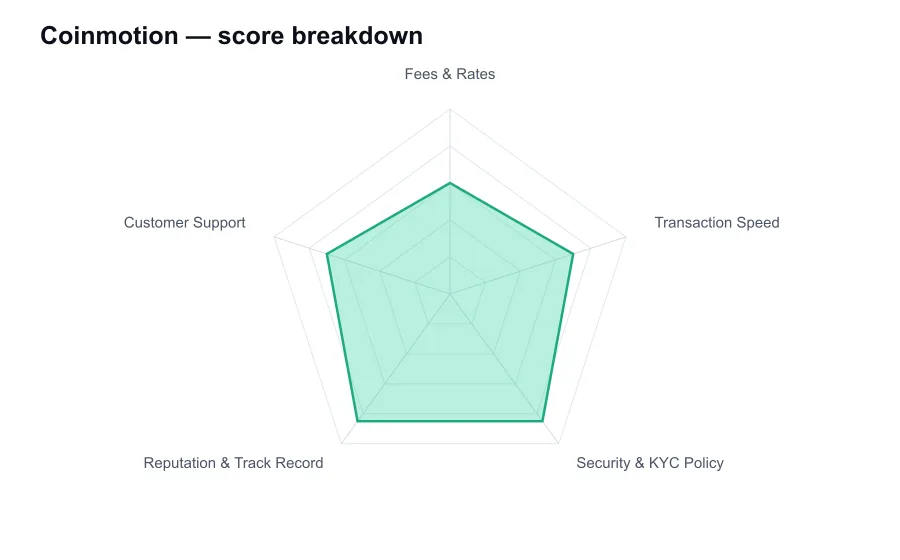
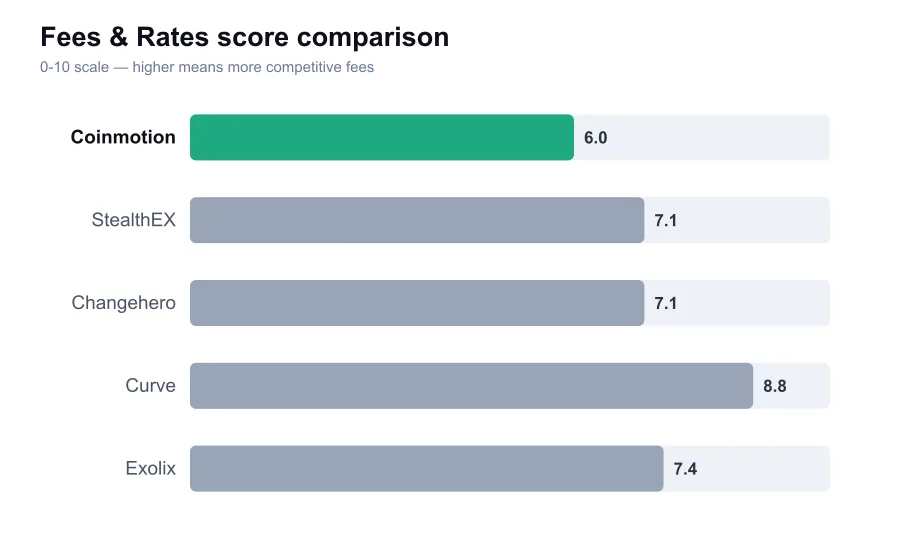
Coinmotion scores 7.4/10 overall in our independent review, measured against every other provider we've compared, strongest on Security & KYC Policy (8.5/10) and weakest on Fees & Rates (6.0/10).
Score: 7.4/10 How we score →| Best for | Not for |
|---|---|
| Established Finnish crypto broker since 2012 | Trading fees are high for active users |
Editorial independence: our scores and rankings are produced using the fixed criteria above and are not influenced by advertisers. This is an independent ranking site and is not operated by, or affiliated with, any provider we list.
Affiliate disclosure: some links on this page may earn us a commission at no extra cost to you. This does not affect our rankings.
Criteria Breakdown
| Criterion | Score | Notes |
|---|---|---|
| Fees & Rates | 6.0 | Published tiers, but small trades can cost about 2% |
| Transaction Speed | 7.0 | Fast internal trades and practical SEPA funding |
| Security & KYC Policy | 8.5 | Regulated broker with cold storage focused custody |
| Reputation & Track Record | 8.5 | Finnish operator active since 2012 |
| Customer Support | 7.0 | Documented support channels, reviews can take time |
Coinmotion is a Finnish cryptocurrency broker and custody service aimed at people who want a regulated European route into Bitcoin and a limited selection of other major assets. It is not trying to be Binance, and that is mostly a good thing. The service feels built for investors, families, and businesses that value bank transfer access, euro accounting, and a named company over an enormous altcoin catalogue or derivatives casino. Its tradeoff is obvious from the start, convenience and compliance cost more than a low fee global exchange.
The company has operated since 2012, originally under the name Prasos, which gives it a materially longer history than the latest wave of crypto apps. Coinmotion is based in Finland and has operated under Finnish anti money laundering supervision arrangements. That doesn't remove market risk or make crypto deposits insured in the way bank deposits are, but it does put the service in a different category from an anonymous offshore website. For a European buyer, corporate identity matters more than flashy app features.
Coinmotion's core offering is straightforward. Customers can buy, sell, hold, receive, and withdraw supported cryptocurrencies, fund an account in euros, and use recurring purchases. The selection has historically focused on major assets rather than hundreds of thinly traded tokens. That restraint is sensible for a broker serving conservative investors. It will frustrate traders hunting the newest narrative coin, but those traders are not Coinmotion's natural audience anyway.
The fee model is the first place where the broker identity becomes clear. Coinmotion uses tiered trading fees, with published rates that have commonly ranged from about 2 percent at the smallest volume tier down toward 0.8 percent for higher monthly volume. The exact tier and product should always be checked on the live price list, because fee schedules can change. Those rates are expensive beside Kraken Pro or Coinbase Advanced, where active users can often trade at fractions of a percent.
That said, judging Coinmotion only against an order book exchange misses what customers are buying. The quoted service includes a familiar euro on ramp, custody, compliance infrastructure, and an interface that doesn't ask a first time buyer to understand limit orders. For someone making a monthly Bitcoin purchase, paying a higher fee can be acceptable if it prevents operational mistakes. For someone making frequent trades or moving in and out of positions, it becomes a serious drag on returns. A 2 percent fee on entry and another 2 percent on exit is hard to ignore.
Bank transfer funding is usually the sensible way to use the platform. SEPA transfers are generally cheaper and more reliable than card funded crypto purchases across the industry. Processing time depends partly on the sending bank and compliance checks, but euro transfers commonly arrive on business day timelines. Internal trades are effectively immediate after funds are available. Crypto withdrawals then depend on Coinmotion's processing and the relevant blockchain, with Bitcoin confirmation times naturally varying with network conditions.
The app is not designed for rapid market timing. Prices are presented as broker quotes rather than the kind of deep order book experience that high frequency traders expect. During sharp market moves, any broker spread and quote refresh process becomes more relevant. If your strategy depends on shaving a few basis points from entries, use a liquid exchange with advanced order types. Coinmotion is for people who would rather set a recurring buy and get on with their day.
Security is one of the better reasons to consider the service. Coinmotion has long emphasized cold storage and custody controls, and it supports account protections such as two factor authentication. Its public positioning is far more credible than a platform whose only security claim is a padlock icon. Still, users need to do their part. Use a unique password, hardware backed two factor authentication where possible, and whitelist or verify withdrawal details with care.
The company has also offered a security focused vault style storage option, known as Coinmotion Wealth, for customers wanting a more deliberate custody setup. The exact access rules and fees should be read closely before using it. Delayed or multi approval withdrawal arrangements can be useful protection against account takeover, but they are not a substitute for understanding counterparty risk. Coins held by any broker are not under your direct control in the same way as coins on a self managed hardware wallet.
KYC is mandatory in practice, as it should be for a regulated euro broker. Expect identity verification and potentially questions about source of funds, especially at larger volumes. Some crypto purists will view that as a disadvantage. I don't. For the customer who needs to move money between a European bank account and crypto without playing jurisdictional games, clear KYC is a feature. The irritation lies in occasional manual reviews, which can slow transactions at inconvenient moments.
Coinmotion's reputation is strong in its home market and respectable across Nordic and European retail crypto circles. Its age, visible leadership, and established operating presence give it credibility that many smaller brokers cannot imitate. The record is not flawless, because no financial platform has perfect customer sentiment. Some users object to verification delays, limited assets, and pricing. Those criticisms are fair, but they are the predictable drawbacks of the business model rather than signs of an opaque operation.
Support is generally closer to a traditional financial service than an offshore exchange. Coinmotion provides written help materials and customer support channels, and it has a clearer escalation path than providers that rely solely on chat groups. Response quality can vary, particularly during volatile markets or account reviews. Customers who submit clean documents and describe a problem precisely will likely have an easier time than those treating support as an instant trading desk.
There are a few limitations that should be faced plainly. Coinmotion is not the cheapest place to trade, not the broadest token venue, and not the right choice for perpetual futures, sophisticated charting, or deep liquidity across obscure pairs. It also cannot eliminate the normal risks of holding volatile crypto. Its value is structure, not excitement. If you want the most coins and the lowest headline price, competitors will look more appealing.
For a Finnish or European investor who wants recurring Bitcoin exposure, transparent euro banking, and a provider that has been around long enough to experience several market cycles, Coinmotion makes a persuasive case. I would use it for deliberate purchases, not for active speculation. The platform's fee premium is real, but so is the reassurance of dealing with an identifiable Nordic business. That is a trade many cautious buyers will gladly make.
Pros and Cons
| Pros | Cons |
|---|---|
| Established Finnish crypto broker since 2012 | — |
| Clear euro and SEPA focused experience | — |
| Cold storage focused custody options | — |
| Straightforward recurring purchase tools | — |
Suitability
What does Coinmotion charge for trading?
Coinmotion uses volume based trading tiers. Published rates have commonly started around 2 percent for low volume customers and decline for larger monthly volume. Check its current fee page before trading.
Does Coinmotion require identity verification?
Yes. Coinmotion is a regulated euro focused broker, so identity verification is required. Larger activity may also trigger source of funds questions.
Is Coinmotion suitable for day trading?
Not really. Its broker pricing and simple interface suit investing better than high turnover trading. Active traders will usually find lower fees and more order tools elsewhere.
Can I withdraw crypto from Coinmotion?
Yes, supported assets can be withdrawn to an external wallet. Network fees, withdrawal procedures, and blockchain confirmation times apply.