Liquity
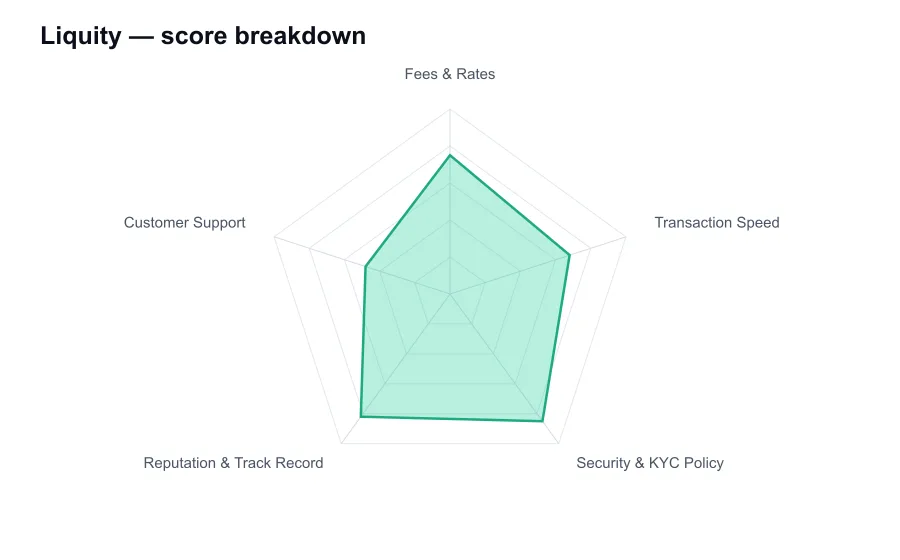
Liquity scores 7.5/10 overall in our independent review, measured against every other provider we've compared, strongest on Security & KYC Policy (8.5/10) and weakest on Customer Support (4.8/10).
Score: 7.5/10 How we score →| Best for | Not for |
|---|---|
| Permissionless self-custody borrowing | Not a conventional crypto exchange |
Editorial independence: our scores and rankings are produced using the fixed criteria above and are not influenced by advertisers. This is an independent ranking site and is not operated by, or affiliated with, any provider we list.
Affiliate disclosure: some links on this page may earn us a commission at no extra cost to you. This does not affect our rankings.
Criteria Breakdown
| Criterion | Score | Notes |
|---|---|---|
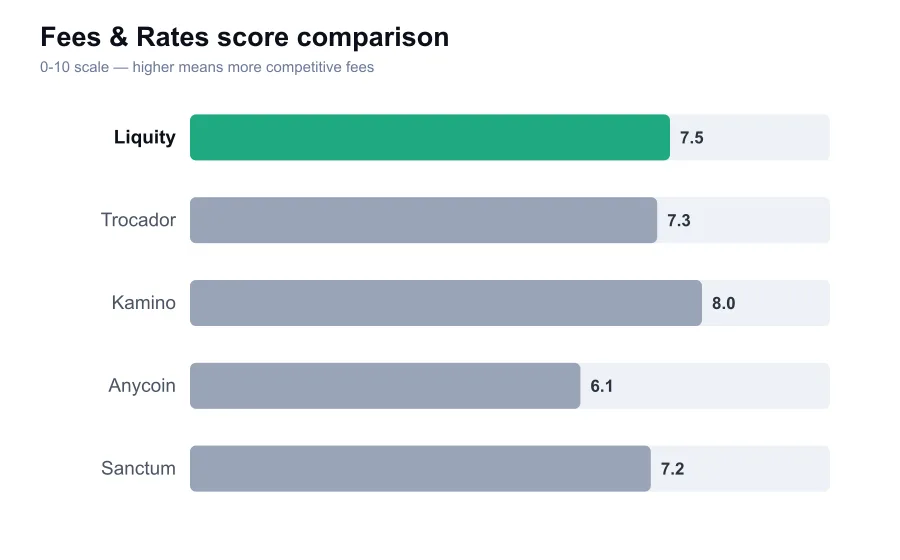
| Fees & Rates | 7.5 | Borrowing structure can beat variable APRs, gas still matters. |
| Transaction Speed | 6.8 | Settlement depends on Ethereum confirmation and gas. |
| Security & KYC Policy | 8.5 | Audited, established smart contracts, but liquidation is real. |
| Reputation & Track Record | 8.2 | A respected DeFi borrowing protocol with real history. |
| Customer Support | 4.8 | Documentation and community help, no transaction rescue. |
Liquity is not really a crypto exchange, and judging it as one would miss the point. It is a decentralized borrowing protocol built around overcollateralized loans, originally using ETH collateral and the LUSD stablecoin. Users deposit collateral into a position, historically called a Trove, and borrow stablecoins against it. It belongs beside Maker, Aave, and other DeFi credit systems, not beside instant swap services such as Kingex or LetsExchange.
That distinction changes almost every part of a review. There is no centralized customer account, no company desk matching your buy and sell order, and no conventional withdrawal queue. Liquity's smart contracts are the product. You interact through a web interface and a wallet such as MetaMask, but the economic rules are enforced on-chain. This gives technically capable users unusual transparency and control, while making user mistakes much harder to recover from.
Liquity's original design was notable for allowing ETH-backed borrowing at a minimum collateral ratio of 110 percent. Borrowers could mint LUSD by depositing more ETH value than the debt they created. If the collateral ratio fell too low, liquidation became possible. A 110 percent minimum is capital-efficient compared with many overcollateralized stablecoin systems, but it also leaves little room for error. Borrowing near the threshold is not prudent unless you are actively managing risk.
The protocol's Stability Pool is central to its liquidation mechanism. LUSD holders can deposit into the pool, where their LUSD can be used to repay liquidated debt. In exchange, they receive liquidated collateral and protocol incentives under the relevant design. This can be an attractive yield source, but it is not a savings account. Depositors take exposure to liquidation timing, LUSD dynamics, gas costs, and the collateral received through the mechanism.
Fees are structurally different from trading fees. Liquity V1 used a borrowing fee that moved with redemption activity and had a minimum rate, rather than charging periodic interest in the ordinary lending-platform sense. Redemptions also have a fee mechanism. That approach can be attractive for borrowers who dislike an open-ended variable APR, but the real cost must include the upfront borrowing charge, gas, liquidation risk, and the opportunity cost of locking ETH.
The newer Liquity direction has expanded beyond the original single-collateral framing, including the BOLD stablecoin and collateral-specific borrowing markets. Those developments make the protocol more flexible, but they also increase the amount a user needs to understand. Different collateral branches can carry different interest settings, risk characteristics, and operational details. DeFi veterans may appreciate the modularity. A beginner can easily mistake a familiar interface for a simple, low-risk loan.
Transaction speed is basically the speed of Ethereum and the network supporting the relevant deployment. A position update is confirmed when the blockchain includes it. During normal conditions, that can feel quick. During heavy congestion, opening a position, repaying debt, adding collateral, or withdrawing collateral can become expensive and slow. The dangerous moment is a fast ETH price fall combined with expensive gas, because borrowers may struggle to adjust collateral before liquidation conditions are reached.
There is no KYC gate in the usual Liquity protocol interaction. A wallet can connect without uploading a passport, creating an email login, or trusting a centralized administrator to approve the transaction. That is a genuine privacy benefit. It is not a promise that every interface, frontend operator, fiat gateway, or wallet provider surrounding DeFi will have the same policy. The core protocol's permissionless nature should not be confused with legal immunity.
Liquity's security case is stronger than most anonymous crypto services because its mechanisms are public and have been studied extensively. The protocol's design has been audited and has operated through real market stress. Its V1 contracts were deliberately designed around immutability, reducing governance interference after deployment. These are meaningful strengths. Smart-contract risk, oracle risk, frontend compromise, and Ethereum-level risk still remain, so calling it risk-free would be absurd.
The price-feed and liquidation design deserve respect, but users must understand what can happen to them. A borrower does not need to be hacked to lose collateral. If their ratio drops below the liquidation threshold, the rules execute as designed. A user who borrows conservatively, keeps a sizeable buffer, and watches ETH volatility can use Liquity intelligently. Someone who takes maximum leverage because 110 percent is technically allowed is effectively inviting trouble.
Reputation is one of Liquity's better categories. It has a recognizable place in DeFi history, a distinctive zero-interest borrowing model in its original iteration, and a community that understands the protocol's mechanics. It has not been a faceless clone launched yesterday. Still, reputation in DeFi is not a refund policy. The protocol's credibility can reduce concern about basic legitimacy, but it cannot make a volatile collateral position suitable for everyone.
Support is where the decentralized model feels unforgiving. There is documentation, community discussion, and interface-level help resources, but no traditional support agent can reverse a signed transaction, restore a compromised wallet, or waive a liquidation. This is a feature to decentralization purists and a serious limitation for ordinary consumers. If you expect a phone number and a human who can repair a mistake, Liquity is simply the wrong product.
Liquidity also matters around the stablecoin itself. Borrowing LUSD or BOLD only helps if you can use, hold, or exchange it on terms you accept. Stablecoin liquidity varies across venues and chains, and a stablecoin's market price can move away from its intended peg. Users should check the exit route before opening a position. Do not assume that minting a stablecoin automatically gives you frictionless dollar liquidity at par in every market.
Liquity is excellent DeFi infrastructure for a certain person: a self-custody user who understands collateral ratios, has a plan for price volatility, and values permissionless borrowing. It is a poor choice for someone looking for a simple exchange, guaranteed stablecoin savings, or recoverable consumer finance. I respect its design and track record more than many DeFi lending experiments. I also think many users underestimate how quickly collateral risk becomes real during a sharp ETH selloff.
Pros and Cons
| Pros | Cons |
|---|---|
| Permissionless self-custody borrowing | — |
| Well-known DeFi protocol design | — |
| No conventional KYC requirement | — |
| Capital-efficient ETH-backed borrowing | — |
Suitability
Is Liquity an exchange?
No. Liquity is primarily a decentralized borrowing protocol. Users lock collateral and borrow protocol stablecoins rather than placing ordinary buy and sell orders.
Does Liquity require KYC?
Core protocol interactions are permissionless and do not normally require account verification. Connected wallets, interfaces, and off-ramp services may have their own policies.
Can I lose my collateral on Liquity?
Yes. If your collateral ratio falls below the applicable liquidation threshold, the protocol can liquidate the position. Borrowing close to the minimum ratio is high risk.
What costs should borrowers consider?
Consider the borrowing or interest mechanism for the relevant Liquity market, redemption dynamics, Ethereum gas, stablecoin liquidity, and the financial cost of collateral locked.