Sanctum
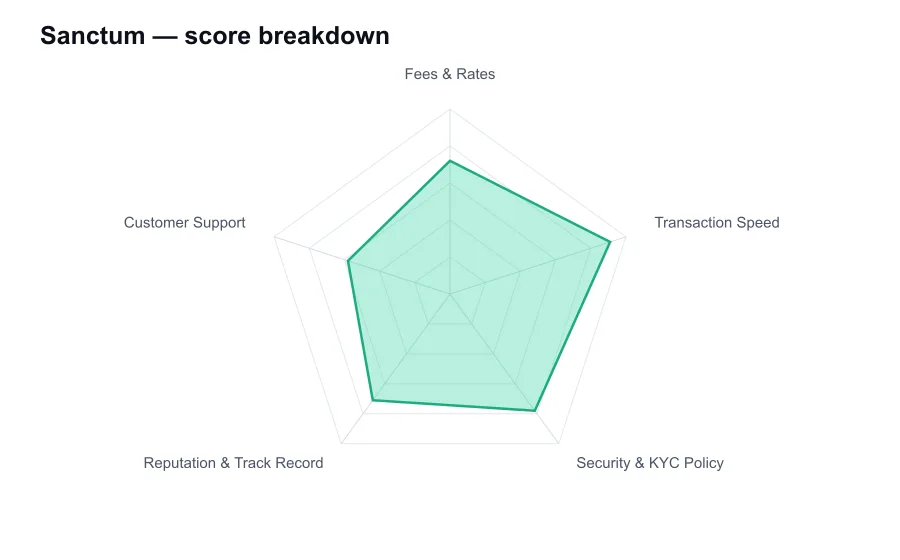
Sanctum scores 7.6/10 overall in our independent review, measured against every other provider we've compared, strongest on Transaction Speed (9.1/10) and weakest on Customer Support (5.8/10).
Score: 7.6/10 How we score →| Best for | Not for |
|---|---|
| Fast SOL and liquid staking token conversions | Costs depend on the live route and liquidity |
Editorial independence: our scores and rankings are produced using the fixed criteria above and are not influenced by advertisers. This is an independent ranking site and is not operated by, or affiliated with, any provider we list.
Affiliate disclosure: some links on this page may earn us a commission at no extra cost to you. This does not affect our rankings.
Criteria Breakdown
| Criterion | Score | Notes |
|---|---|---|
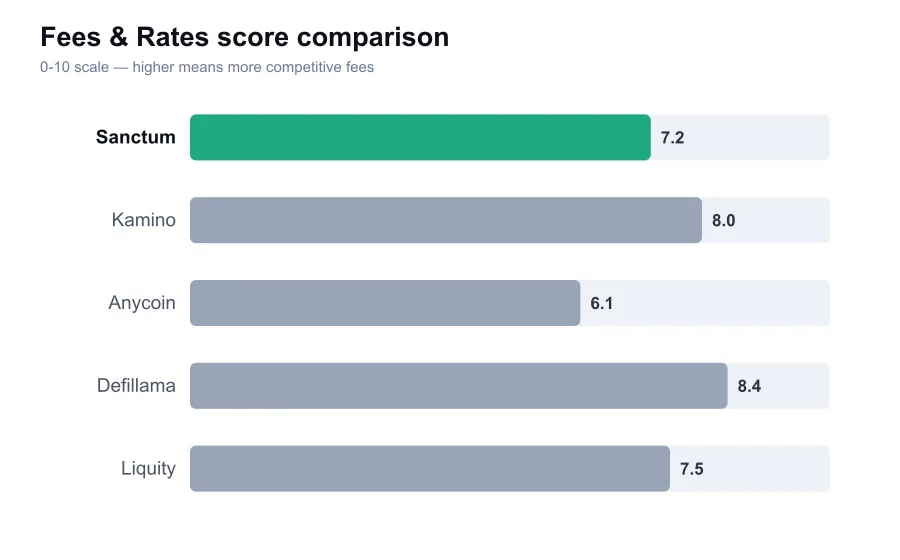
| Fees & Rates | 7.2 | Competitive routes, but costs vary with liquidity and quotes |
| Transaction Speed | 9.1 | Solana swaps normally settle within seconds |
| Security & KYC Policy | 7.8 | Noncustodial and no KYC, with smart contract risk |
| Reputation & Track Record | 7.1 | Well known in Solana LST circles, still relatively young |
| Customer Support | 5.8 | Documentation and community help, not concierge support |
Sanctum is not a conventional crypto exchange, and judging it as one misses the point. It is a Solana focused liquid staking infrastructure project that lets users swap between SOL and a growing collection of liquid staking tokens, often called LSTs. Its real product is liquidity. Sanctum wants a holder of jitoSOL, mSOL, bSOL, INF, or a smaller validator backed LST to move between assets without getting punished by thin markets.
That puts it in an unusual position beside familiar names such as Jupiter and Marinade. Jupiter is still the broader Solana swapping venue for many traders. Marinade is primarily a staking provider. Sanctum is the specialist plumbing that tries to make fragmented liquid staking assets feel interchangeable. For a Solana native user who understands why different LSTs exist, that is genuinely useful infrastructure rather than a flashy retail exchange.
The centerpiece is Sanctum Infinity, a shared liquidity system intended to give supported LSTs a path to deep conversion liquidity. Instead of every token needing a large isolated SOL pool, participating assets can access a common liquidity framework. The practical benefit is clear: smaller LSTs can be easier to enter or leave, and users can diversify validator exposure without manually unwinding a staking position and waiting for an epoch boundary.
Fees require more attention than Sanctum's polished interface initially suggests. Sanctum does not present a simple universal trading fee in the way Coinbase or Kraken does. The cost a user pays is embedded in the route, liquidity conditions, swap impact, and sometimes a variable unstake fee. A quoted exchange may be cheap during normal market conditions, then noticeably less attractive when liquidity is stressed. That is not necessarily deceptive, but it does mean users should inspect the exact output before approving.
The absence of a blunt headline fee can work in your favor for routine LST conversions. Swapping between well supported Solana staking assets is often more efficient than selling into SOL on one venue and buying another LST elsewhere. Yet it also makes price comparison harder. A user who only sees that a transaction completed successfully may not notice they gave up more value than they expected. Sophisticated users should compare Sanctum's quote with Jupiter and direct pool routes, especially on larger trades.
Speed is one of Sanctum's strongest points. A normal onchain swap settles at Solana speed, generally in seconds once the wallet transaction lands and receives confirmation. That feels radically different from native unstaking, where SOL can be tied up until the relevant Solana epoch process completes. Instant liquidity is the reason Sanctum exists. It is particularly useful for someone rotating LST exposure during a volatile market without abandoning staking yield for days.
There is a distinction users should keep in mind. A swap into SOL or another LST is fast because somebody is providing liquidity. A true delayed unstake route follows Solana's protocol timing and cannot be wished away by a smooth interface. Sanctum makes this distinction reasonably visible, but newcomers sometimes equate every unstaking choice with an instant redemption. Read the quote screen carefully. If a route offers immediate SOL, the price may include an unstake cost that is cheaper or more expensive than waiting.
Sanctum is noncustodial in the practical sense that users connect a Solana wallet and sign their own transactions. It does not ask for a passport, address, selfie, or source of funds check for ordinary protocol use. That is a major privacy advantage over centralized exchanges and a good fit for users who already manage Phantom, Backpack, or another Solana wallet. It also means there is no account recovery desk if you lose access to your wallet.
No KYC should not be confused with no risk. The user is exposed to smart contract risk, Solana network risk, wallet approval mistakes, and the changing market quality of the LST selected. Liquid staking tokens also carry their own validator, operational, and depegging considerations. Sanctum can improve liquidity, but it cannot make an obscure LST as battle tested as SOL itself. I would not treat a long list of supported assets as proof that each carries equal risk.
The project has had a meaningful presence in Solana's liquid staking conversation, especially around the expansion of LST ecosystems and its points based community campaigns. Its public profile rose quickly through 2024, helped by integrations and the broader enthusiasm for Solana staking products. That visibility is useful, but Sanctum does not have the long, multi cycle track record of a major centralized exchange or even the years of history behind older DeFi primitives.
Its reputation is also closely tied to Solana. If the chain experiences congestion, outages, or broad ecosystem stress, Sanctum users feel it directly. There is no separate custodian or offchain matching engine that can keep the product functioning independently. The upside is transparency, because transactions are visible onchain. The downside is that a smooth app cannot shield users from the underlying network or from adverse liquidity conditions.
Support is the weaker part of the package. Sanctum's documentation, interface explanations, Discord community, and social channels are useful for a self directed DeFi user. They are not a substitute for named account managers, phone support, or a guaranteed response time. If a transaction is pending, the first place to diagnose it is often Solana Explorer and your wallet, not a support ticket. That is standard in DeFi, but it remains frustrating when real money is involved.
I like Sanctum most for its narrow purpose. It gives Solana users a more practical way to manage liquid staking positions, and its instant conversion routes can be much more elegant than manual unstaking. I do not like it as a first crypto platform. Someone who wants to buy Bitcoin with a bank card, receive a tax statement, or call an agent after a mistake should go elsewhere.
My view is that Sanctum is good infrastructure with a risk profile many casual users will underestimate. It earns strong marks for speed and for respecting self custody, while its fees need to be judged transaction by transaction rather than through a tidy published schedule. Use it with a wallet you control, understand which LST you are receiving, and compare quotes before a large swap. For informed Solana stakers, it is one of the more compelling specialized tools in the ecosystem.
Pros and Cons
| Pros | Cons |
|---|---|
| Fast SOL and liquid staking token conversions | — |
| Noncustodial wallet based access | — |
| Useful liquidity for smaller Solana LSTs | — |
| No routine identity verification | — |
Suitability
Does Sanctum require KYC?
Ordinary use through a connected Solana wallet does not require a Sanctum account or routine identity verification. Your wallet provider or a separate fiat onramp may have different rules.
Is unstaking through Sanctum instant?
A swap to SOL can be immediate if liquidity is available. Delayed native unstaking follows Solana's epoch timing, so check whether you selected an instant route or a delayed redemption.
Are Sanctum fees fixed?
No single fixed fee applies to every transaction. The effective cost depends on the quoted route, liquidity, price impact, and any applicable unstake conditions.