Defillama
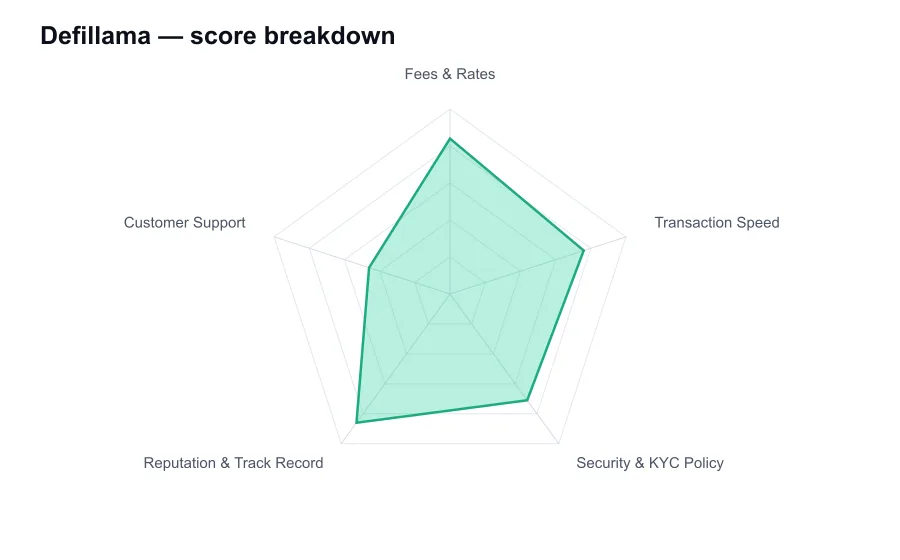
Defillama scores 7.6/10 overall in our independent review, measured against every other provider we've compared, strongest on Reputation & Track Record (8.6/10) and weakest on Customer Support (4.6/10).
Score: 7.6/10 How we score →| Best for | Not for |
|---|---|
| Useful route comparison for wallet swaps | Not a full-service exchange or fiat platform |
Editorial independence: our scores and rankings are produced using the fixed criteria above and are not influenced by advertisers. This is an independent ranking site and is not operated by, or affiliated with, any provider we list.
Affiliate disclosure: some links on this page may earn us a commission at no extra cost to you. This does not affect our rankings.
Criteria Breakdown
| Criterion | Score | Notes |
|---|---|---|
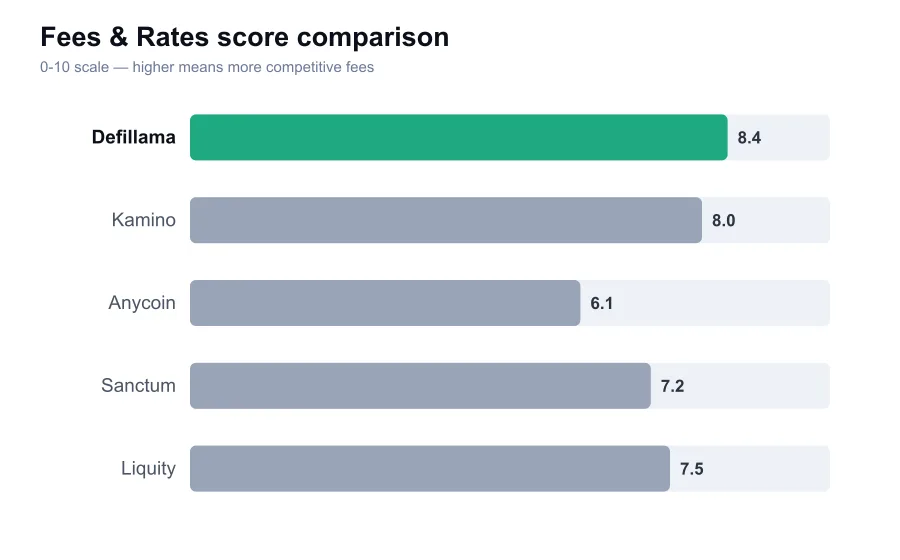
| Fees & Rates | 8.4 | No usual extra LlamaSwap platform fee or markup |
| Transaction Speed | 7.6 | On-chain settlement speed depends on the chosen network |
| Security & KYC Policy | 7.1 | Non-custodial, but route and approval risk remains |
| Reputation & Track Record | 8.6 | One of DeFi's most used independent data brands |
| Customer Support | 4.6 | Useful community channels, limited transaction recourse |
DefiLlama is best known as a DeFi data platform, not as an exchange in the familiar Coinbase or Kraken sense. Its dashboards track total value locked, yields, chains, bridges, protocol revenue and an enormous amount of public on-chain activity. The site also offers a swap interface, often called LlamaSwap, which routes a wallet trade through third-party decentralised exchange liquidity. That distinction is essential. DefiLlama does not run an order book or hold a customer balance for ordinary swaps.
For a trader, the attraction is obvious. A swap aggregator can compare multiple liquidity sources and surface a route that would be tedious to find manually. Instead of opening several DEX sites, connecting a wallet to each, and estimating gas by hand, users can inspect a selection of routes in one place. This is useful for common assets on supported networks, particularly if the trader already lives on-chain and wants a quick cross-check against a preferred venue.
The fee story is better than it first appears, but it is not as simple as a zero-fee slogan. DefiLlama has promoted LlamaSwap as an interface without an extra platform fee or hidden markup. That can be a meaningful advantage versus some aggregators or instant-swap sites that quietly widen the exchange rate. Still, the underlying DEX charges its own trading fee, the network charges gas, and the route can include costs that a casual user will only see in the final output amount.
That final output is what matters. A route through Uniswap, Curve, Balancer, 1inch-connected liquidity or another venue might be excellent on one trade and mediocre on the next. Liquidity changes constantly. I like that DefiLlama's broader ethos has been about making DeFi data inspectable, but users should compare the quote against a direct swap on Curve or Uniswap before approving a large transaction. Aggregation saves time, it does not repeal market structure.
There is no conventional deposit or withdrawal queue, which is a genuine speed advantage. Once a user signs from a self-custody wallet, the transaction goes to the chosen blockchain. On Base, Arbitrum and similar networks, it can settle quickly. On Ethereum, a congested mempool can make the same process slow and expensive. DefiLlama cannot accelerate a chain, and a failed transaction still consumes gas in many circumstances. That is the practical speed limitation.
The interface's most valuable feature may be its context. A user who sees a spectacular yield can move from the yield dashboard to checking the protocol, chain and TVL rather than accepting marketing at face value. DefiLlama has become a common reference point for researchers precisely because it covers far more than token price charts. Its methodology and labels are not infallible, but the platform is far more useful than a swap widget operating in isolation.
Security has two layers here. First, DefiLlama normally does not take custody of a swapper's coins. Funds move from the user's wallet through the approved on-chain transaction, which removes the familiar exchange-collapse risk of leaving an account balance with an intermediary. Second, each route exposes the user to smart contracts, token contracts, wallet approvals and sometimes external aggregators. Non-custodial does not mean consequence-free.
There is also an interface risk that deserves more attention than it gets. A trusted analytics brand can make people lower their guard. Before signing, inspect the transaction in the wallet, verify the token contract, read the spender address and avoid unlimited approvals when a limited approval is practical. A fake token with a familiar ticker is still a fake token. DefiLlama's reputation helps, but it cannot protect users who bypass basic wallet hygiene.
KYC is not normally part of using public analytics pages or connecting a wallet for a decentralised swap. That will appeal to users who value privacy and do not want another service collecting identity documents. It also means DefiLlama is not designed to offer fiat banking rails, chargeback protection or regulated account recovery. If your priority is buying crypto with a bank transfer under a clear legal relationship, this is the wrong category of service.
DefiLlama has a strong reputation within the DeFi community. It grew into one of the most widely cited independent dashboards during the last market cycle, and its brand benefited from taking a data-first, relatively low-hype approach. The team has also had public internal disputes, including the 2023 fork controversy around a proposed token, but the project continued and the core data service remained a major industry reference. That is a better track record than most crypto sites, though not a reason to suspend skepticism.
Its weakness is that the product estate is broad. Analytics, yield lists, bridges, hacks data, governance information and a swap tool create a lot of surface area for users to misunderstand. The yield section can be especially dangerous in the hands of someone who reads a high annualised number as a savings rate. Yield may depend on volatile emissions, leverage, a temporary incentive program or a protocol whose risks are far beyond what a table can show.
Support is community-led and documentation-led rather than personal. Public channels, social accounts and issue reporting are useful for bug reports or clarifying a feature. They are not a substitute for an exchange support desk that can identify your account and trace a missing transfer. Since LlamaSwap is routing an on-chain transaction, there may be no one who can undo a bad signature or recover assets sent to a wrong network.
I would use DefiLlama as a research companion even if I chose not to execute a trade through it. The data tools are often the bigger value. For swaps, it is a sensible route-checking option for a wallet user who understands the transaction they are about to sign. It is less suitable for users who want one company accountable for execution, custody and support, because that is deliberately not what DefiLlama is.
The clearest way to judge DefiLlama is as a highly respected DeFi information layer that happens to offer useful transaction tooling. Its lack of an added swap fee and non-custodial design are attractive, while the actual trade quality depends on the underlying route and chain. I would trust it more as a transparent starting point than a black-box instant exchange. But I would still compare quotes, use a hardware wallet for meaningful amounts, and keep the transaction size modest until the route is familiar.
Pros and Cons
| Pros | Cons |
|---|---|
| Useful route comparison for wallet swaps | — |
| No routine KYC for decentralised use | — |
| Strong DeFi analytics alongside trading tools | — |
| Non-custodial transaction flow | — |
Suitability
Is DefiLlama an exchange?
Primarily, no. It is a DeFi analytics platform. Its LlamaSwap tool helps route wallet swaps through decentralised liquidity rather than operating a conventional custodial exchange.
Does LlamaSwap charge a fee?
DefiLlama has promoted the interface as having no added platform fee or hidden markup. The selected DEX, liquidity pool and blockchain can still charge fees and gas.
Does DefiLlama require KYC?
Viewing data and using a normal decentralised wallet connection does not usually require KYC. Fiat services or third-party providers can have separate requirements.