Trocador
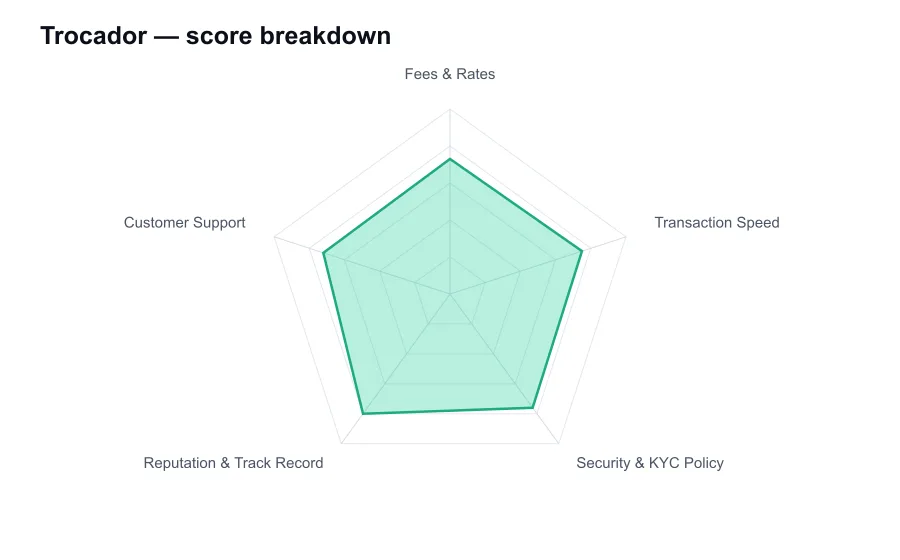
Trocador scores 7.5/10 overall in our independent review, measured against every other provider we've compared, strongest on Reputation & Track Record (8.0/10) and weakest on Customer Support (7.2/10).
Score: 7.5/10 How we score →| Best for | Not for |
|---|---|
| Compares multiple instant exchange offers | Final experience depends on the selected partner |
Editorial independence: our scores and rankings are produced using the fixed criteria above and are not influenced by advertisers. This is an independent ranking site and is not operated by, or affiliated with, any provider we list.
Affiliate disclosure: some links on this page may earn us a commission at no extra cost to you. This does not affect our rankings.
Criteria Breakdown
| Criterion | Score | Notes |
|---|---|---|
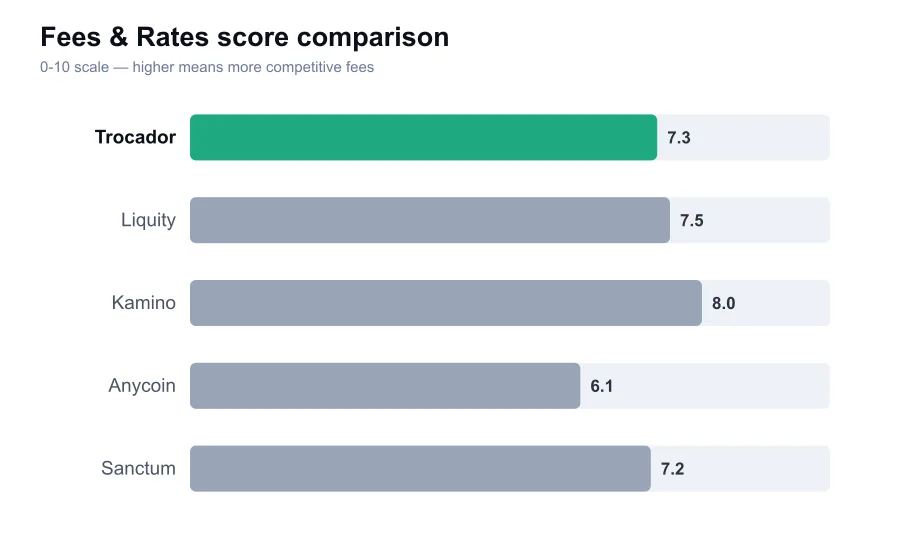
| Fees & Rates | 7.3 | 0.5% platform fee, with partner spread and network fees still relevant |
| Transaction Speed | 7.5 | Fast for many routes, but partner and chain conditions vary |
| Security & KYC Policy | 7.6 | No standing custody and privacy tools, with partner risk remaining |
| Reputation & Track Record | 8.0 | Well-known instant exchange aggregator with an established privacy niche |
| Customer Support | 7.2 | Transaction support can help bridge issues with selected partners |
Trocador is a crypto exchange aggregator with a clear philosophical angle. Rather than operating as a full custodial exchange, it compares offers from multiple instant exchange partners and lets users select a route for converting one asset into another. It has become particularly well known among privacy-conscious crypto users because it offers a no-account workflow and includes tools such as its anonymity rating. That makes it more distinctive than a generic swap widget, though it is still an intermediary layer rather than magic.
The service is best understood as a comparison desk. Trocador does not need to be the company executing every swap itself. It can present offers from partner exchangers, with the user choosing an available rate and sending funds for that transaction. The advantage is obvious: one interface can reduce the work of opening several instant exchange sites and comparing them manually. The downside is equally obvious: the final outcome depends partly on the selected provider, not just on Trocador's own interface.
Fees are comparatively transparent by instant-exchange standards, especially because Trocador has long disclosed a 0.5% service fee on ordinary swaps, with a reduced 0.25% fee for users who apply the platform's loyalty token discount where applicable. That is only one component of cost. The partner's exchange spread and blockchain network fee can still materially affect the final result. A visible platform fee is welcome, but no user should stop comparing the final received amount there.
The platform's price comparison function is useful because it exposes a basic truth about instant exchanges: the cheapest-looking brand is not always the cheapest route for the pair, size, and network you need at that moment. Trocador can make those differences visible. It is especially useful for less common assets where liquidity and partner availability vary. Still, an aggregator quote should be checked carefully for fixed versus floating treatment, minimums, maximums, and whether the route's network fee is included in the displayed result.
For many ordinary swaps, Trocador's speed is good. Once the source transaction has sufficient confirmations and the chosen partner accepts it, execution can proceed without the delay of loading an account with fiat or waiting for an exchange withdrawal approval. On faster networks, the process may be completed in minutes. With Bitcoin, Monero, or congested Ethereum transactions, the blockchain remains the limiting factor. No aggregator can make a slow base layer behave like an internal exchange transfer.
The partner model introduces variability that users need to accept. One route may execute rapidly while another needs additional confirmations, has low liquidity, or encounters a compliance check. Trocador can display status information and help coordinate a support case, but it cannot fully control every operational decision made by a third-party exchanger. That is a reasonable trade-off for having choices, not a reason to assume every listed offer carries identical risk. Selecting the very cheapest option without considering provider reputation can be shortsighted.
Privacy is central to Trocador's identity. Users generally do not need to open a standard account or provide routine KYC merely to request a swap. The platform's anonymity rating is intended to help users assess partner privacy practices and distinguish between routes with different levels of data collection or KYC risk. This is more useful than pretending every instant exchanger provides the same privacy experience. It gives users information, but it does not create immunity from compliance controls.
That caveat matters. A partner may still flag a transaction based on jurisdiction, sanctions screening, source-of-funds tools, suspicious patterns, or its own internal policy. If that happens, the transaction can move from a quick no-account swap into a documentation request. Anyone using Trocador should read the selected provider's terms, avoid any unlawful activity, and understand that privacy means minimizing unnecessary data collection, not bypassing financial crime rules. Serious privacy users know the difference.
Security is strong in the sense that Trocador does not ask customers to leave a standing exchange balance under its custody. The user supplies a destination address and performs a specific conversion. This reduces exposure to the classic centralized-exchange failure where funds sit in an account for months or years. Yet each swap still involves counterparty and operational risk while coins move through the selected exchange provider. Non-custodial in marketing language should never be read as risk-free in practical language.
Trocador's public reputation is meaningfully better than that of many anonymous-looking swap sites. It has been operating for years, has an identifiable niche in the privacy and Monero communities, and has built recognition for comparing instant exchange offers rather than simply advertising one opaque rate. Its response to user concerns and its visible product features have helped it earn trust. It is not regulated like a major centralized exchange, and it should not be evaluated as though it had a bank's consumer protections, but it is not an unknown newcomer either.
The service also benefits from being candid about partner distinctions. Its rating approach and the ability to compare providers create more accountability than a single opaque swap page gives users. I would still prefer that every partner had uniformly deep public audits, transparent ownership, and a robust dispute process, but that is not how this market works. Trocador's real contribution is helping users navigate that imperfect market with more information. That is useful, though it cannot eliminate the risk attached to the underlying providers.
Support is one of the more important differentiators here. Trocador has support channels, transaction tracking, and a reputation for assisting users with partner-related issues. In a failed swap, that middle-layer advocacy can be valuable because a customer otherwise has to chase an unfamiliar exchanger alone. Support cannot reverse a completed on-chain mistake or force a partner to disregard compliance rules, but it can help collect evidence and clarify where a transaction is in the process. That is a practical advantage.
Users should still behave as if they may need to explain every detail themselves. Save the order number, source transaction ID, screenshots of the selected rate, destination address, and any correspondence. Do not send from an exchange that might use a different network than the one selected. Do not use an unsupported memo-less deposit route. These are basic precautions, but instant exchange disputes often begin with basic mistakes. Trocador's interface makes swaps easier, not foolproof.
My opinion is that Trocador is among the better choices for users who value privacy, choice, and direct crypto-to-crypto conversion. The 0.5% platform fee means it will not always win on price against a single competitor, especially on a simple high-liquidity pair. But the ability to compare offers and factor in provider privacy practices can justify that cost. It is excellent as a tool for competent self-custody users. It is less suitable for beginners seeking fiat deposits, guaranteed consumer recourse, or a conventional trading account.
Pros and Cons
| Pros | Cons |
|---|---|
| Compares multiple instant exchange offers | — |
| No standard account required for swaps | — |
| Published 0.5% platform fee structure | — |
| Privacy-focused provider rating tools | — |
| Established reputation in the crypto privacy community | — |
Suitability
What fee does Trocador charge?
Trocador has published a 0.5% service fee for standard swaps. The selected exchange partner's rate spread and blockchain network costs also affect the final amount received.
Does Trocador require KYC?
Trocador generally supports no-account swaps, but a selected exchange partner can request verification if its compliance systems flag a transaction or jurisdiction.
What is Trocador's anonymity rating?
It is a comparison feature intended to indicate the privacy characteristics of exchange partners and their likelihood of requesting data. It is informative, not a guarantee.
Can Trocador help if a swap is delayed?
Yes, transaction support can help investigate partner-related delays. Keep the order ID, transaction hash, selected route details, and screenshots for a faster case review.