Kamino
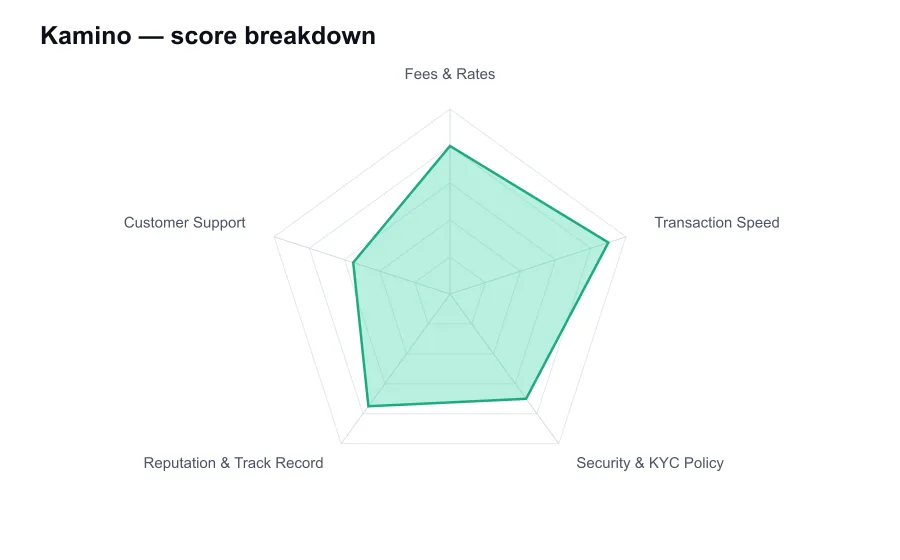
Kamino scores 7.6/10 overall in our independent review, measured against every other provider we've compared, strongest on Transaction Speed (9.0/10) and weakest on Customer Support (5.5/10).
Score: 7.6/10 How we score →| Best for | Not for |
|---|---|
| Fast, low-cost Solana transactions | Smart-contract and oracle risks |
Editorial independence: our scores and rankings are produced using the fixed criteria above and are not influenced by advertisers. This is an independent ranking site and is not operated by, or affiliated with, any provider we list.
Affiliate disclosure: some links on this page may earn us a commission at no extra cost to you. This does not affect our rankings.
Criteria Breakdown
| Criterion | Score | Notes |
|---|---|---|
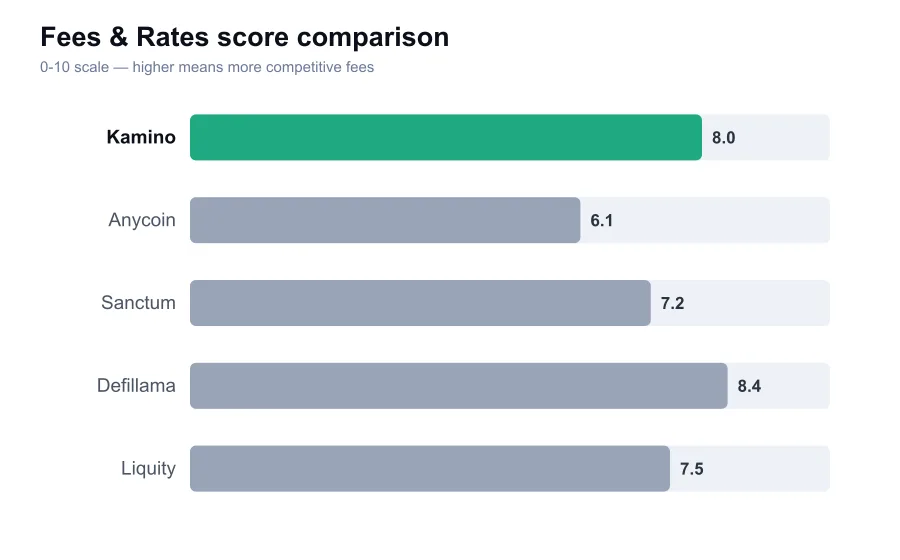
| Fees & Rates | 8.0 | Low Solana fees, product costs vary by position |
| Transaction Speed | 9.0 | Fast Solana confirmation and low-cost actions |
| Security & KYC Policy | 7.0 | Audited DeFi protocol, smart-contract risk remains |
| Reputation & Track Record | 7.5 | Established name within Solana DeFi |
| Customer Support | 5.5 | Documentation and community, no transaction reversals |
Kamino is not a conventional centralized exchange. It is a Solana-based decentralized finance protocol that combines lending, borrowing, liquidity provision and automated liquidity vaults. People often encounter it while looking for a place to put idle SOL, stablecoins or liquid staking tokens to work. That puts it closer to protocols such as Marginfi, Solend and Drift's lending products than to a fiat-to-crypto exchange like Coinbase or Independent Reserve.
That distinction changes the review completely. Kamino doesn't take an email address, open a traditional trading account or hold a customer balance in the usual exchange sense. You connect a Solana wallet and interact with smart contracts. That removes some centralized custody risk, but it replaces it with smart-contract risk, wallet-security risk, oracle risk, liquidation risk and the very real possibility of signing a transaction you don't fully understand.
Kamino's most visible products are its lending markets and liquidity vaults. Lenders deposit assets and earn variable yield from borrowers. Borrowers post collateral and pay a variable interest rate. Liquidity providers can use automated vaults designed to manage concentrated liquidity positions on Solana decentralized exchanges. It is a powerful toolkit, but it is not a savings account and should never be marketed to users as one.
Fees are more nuanced here than at a centralized exchange. There is no standard percentage trading commission paid to Kamino for simply using a dashboard in the way there would be at a retail exchange. Users face Solana network fees, which are normally low, plus protocol-specific interest, reserve factors, swap fees, price impact and sometimes performance or management economics embedded in a vault strategy. The cost depends on the product, not just the protocol name.
For a lender, the important figure is the supply APY after understanding that it is variable. High displayed yields can fall quickly if borrowing demand drops or if incentives change. For a borrower, the borrow APY matters, but so does the collateral asset's volatility and the health factor. A low borrowing rate does not make a position cheap if a 15 percent fall in your collateral brings liquidation dangerously close.
Kamino's liquidity vaults can save users from manually adjusting concentrated liquidity positions. That is useful because active liquidity management is tedious and easy to get wrong. But automation does not repeal market mechanics. A vault can rebalance into the weaker asset, suffer impermanent loss relative to simply holding, incur swap costs or perform poorly during a violent trend. Yield figures need to be judged alongside the strategy's risk, not admired in isolation.
Transaction speed is one of Kamino's genuine advantages. Solana transactions usually confirm in seconds, and the interface makes deposits, borrows, repayments and withdrawals feel far more immediate than equivalent operations on congested Ethereum mainnet. That responsiveness is excellent for managing collateral. It does not mean every action is instantly safe. During periods of congestion, RPC issues or elevated chain demand, transactions can fail, need to be retried or take longer to reach finality.
The protocol's speed becomes particularly valuable in a liquidation scenario. If collateral is falling, a borrower may need to repay debt or add collateral quickly. Solana's low fees make that easier than a high-gas environment, but the user still has to be present, have funds available and understand what needs to happen. DeFi does not call you from a risk desk. A liquidation bot doesn't care that you were asleep, traveling or waiting for a bank transfer.
Security is Kamino's biggest strength and biggest caveat at once. The protocol has had code audits and has developed within the heavily scrutinized Solana DeFi ecosystem, which is a meaningful positive. Still, an audit is not insurance and it is not a guarantee that an exploit, oracle failure, governance mistake or integration problem cannot happen. Smart contracts are adversarial financial software. The relevant question is never whether risk exists, but whether the user is being paid enough to take it.
There is no conventional KYC for basic on-chain use. A wallet can connect without submitting identity documents to the protocol. That privacy is valuable for users who do not want to hand personal data to another centralized intermediary. It should not be confused with complete anonymity. Blockchains are public, wallet activity can be analyzed, and fiat onramps or centralized exchanges may impose their own verification rules.
Self-custody is a major advantage only for users capable of managing it. Kamino cannot recover a seed phrase, reverse a signed transaction or rescue funds sent to the wrong address. Phishing sites and malicious wallet prompts remain a larger practical danger for many users than the protocol's own smart contracts. Bookmark the official site, verify transaction details in the wallet, avoid blind signatures and use a hardware wallet for meaningful balances.
Kamino's reputation is strong within Solana DeFi relative to newer anonymous yield projects. It has become a recognizable protocol with substantial usage and integrations, which gives it more credibility than a freshly launched farm offering implausible returns. But DeFi reputation is cyclical. Total value locked can leave quickly, incentives can distort usage, and a protocol's popularity is not the same as a capital guarantee. I would rank Kamino as established for Solana DeFi, not as low-risk finance.
Support follows the decentralized model. Documentation, community channels and social updates are useful, especially for understanding a product before using it. They are not comparable with having a regulated broker's account team. If a transaction succeeds on chain in a way the user regrets, there may be nobody who can fix it. This is not poor customer service in the ordinary retail sense. It is the consequence of using permissionless software.
The interface is fairly approachable by DeFi standards, but beginners should resist the temptation to click through a high APY. Start by lending a small stablecoin amount, inspect the position, learn how withdrawals work and understand the source of yield. Borrowing against volatile collateral is a second step, not a beginner feature. Leveraged looping and concentrated-liquidity vaults are for users who can explain their downside before they deposit.
Kamino is an impressive piece of Solana infrastructure and a useful protocol for experienced on-chain users. Its low transaction costs, fast execution and broad DeFi functionality are real advantages. Yet it is not an exchange for buying crypto with dollars, not a risk-free yield product and not suitable for anyone who cannot handle self-custody. My take is positive on the technology, but strict on suitability: use Kamino deliberately, keep leverage modest and never let a bright APY do your risk analysis for you.
Pros and Cons
| Pros | Cons |
|---|---|
| Fast, low-cost Solana transactions | — |
| Self-custody wallet access | — |
| Lending, borrowing and liquidity vaults | — |
| No traditional KYC for protocol access | — |
| Established Solana DeFi presence | — |
Suitability
Does Kamino require KYC?
Basic protocol access is wallet-based and does not use traditional account KYC. Your wallet activity remains public on the blockchain, and any fiat onramp or centralized exchange you use may require verification.
Can I lose money lending on Kamino?
Yes. Lending has smart-contract, oracle, stablecoin and market risks. Supply rates are variable, and no DeFi yield should be treated as guaranteed or equivalent to a bank deposit.
How fast are Kamino transactions?
Most normal Solana actions confirm in seconds and cost little, but congestion, wallet settings and RPC issues can cause failed or delayed transactions. Always verify the final on-chain status.
What happens if my borrowing position is liquidated?
If your health factor falls too low, liquidators can repay part of the debt and take collateral at a penalty. Monitor the position and add collateral or repay before it reaches the liquidation threshold.