Curve
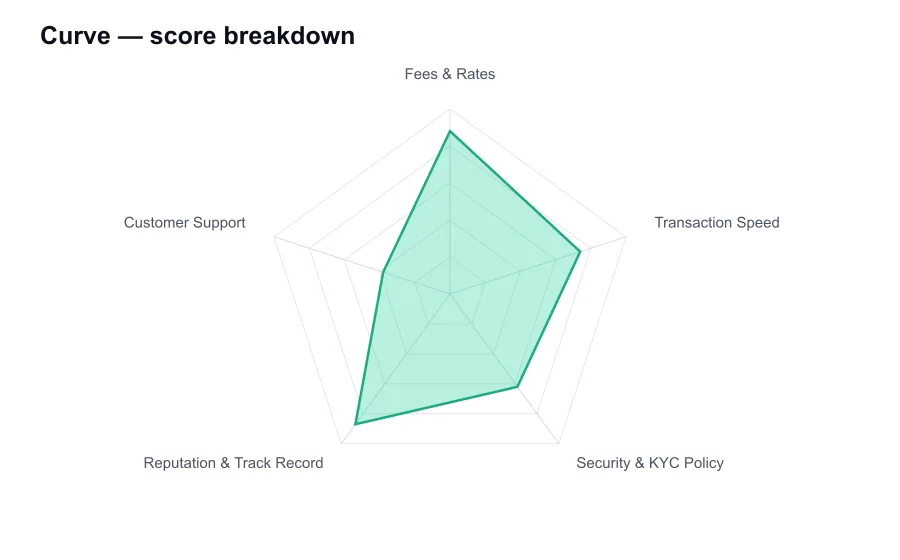
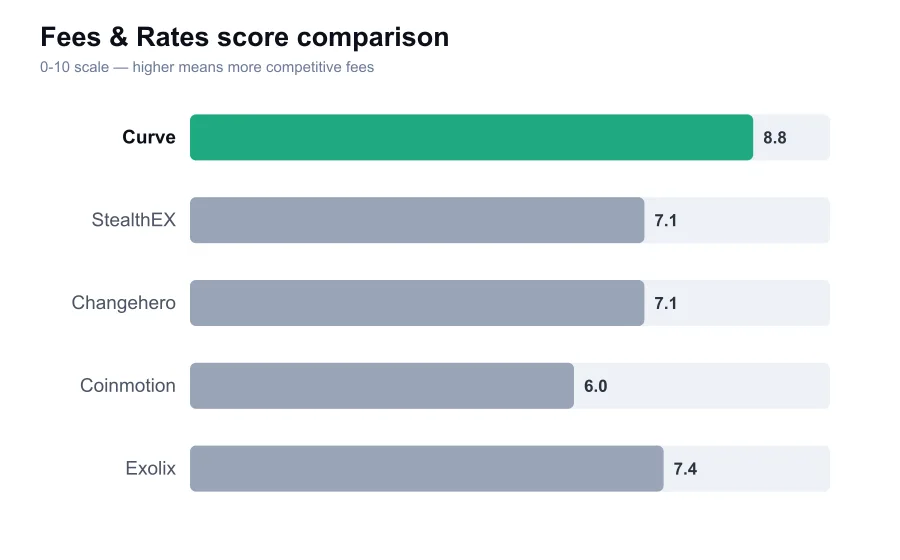
Curve scores 7.4/10 overall in our independent review, measured against every other provider we've compared, strongest on Fees & Rates (8.8/10) and weakest on Customer Support (3.8/10).
Score: 7.4/10 How we score →| Best for | Not for |
|---|---|
| Excellent pricing for major stablecoin swaps | Smart contract and pool-specific risk |
Editorial independence: our scores and rankings are produced using the fixed criteria above and are not influenced by advertisers. This is an independent ranking site and is not operated by, or affiliated with, any provider we list.
Affiliate disclosure: some links on this page may earn us a commission at no extra cost to you. This does not affect our rankings.
Criteria Breakdown
| Criterion | Score | Notes |
|---|---|---|
| Fees & Rates | 8.8 | Many core pools use roughly 0.04% swap fees |
| Transaction Speed | 7.4 | Fast on L2 networks, chain confirmation still applies |
| Security & KYC Policy | 6.2 | Audited protocol, but major exploit history matters |
| Reputation & Track Record | 8.7 | A long-standing and influential DeFi liquidity venue |
| Customer Support | 3.8 | Documentation and community help, not account support |
Curve is not a conventional centralised exchange where customers deposit cash, place limit orders and call a help desk if something breaks. It is one of DeFi's foundational automated market makers, built primarily for swaps between assets that should trade close to the same price. Stablecoins, wrapped versions of major coins and liquid staking tokens are its natural territory. For someone moving USDC into DAI, or stETH into ETH, Curve has often been the cheapest serious venue in the market.
That specialism matters. Curve's StableSwap design is engineered to minimise slippage around a peg, rather than compete with Uniswap on every possible long-tail token. A deep USDC, USDT and DAI pool can be exceptionally efficient for a large trade. Try to use it for a speculative microcap, though, and the experience quickly stops making sense. Curve is a tool with a very sharp edge, not a beginner-friendly supermarket for crypto.
Fees are one of Curve's strongest arguments. Many pools have historically charged around 0.04 percent per swap, though individual pool parameters differ and the fee is not the only cost. Traders also pay the underlying network gas fee, and pools can have imbalances that make the effective execution worse than the displayed headline fee. On Ethereum mainnet, gas can make a small swap absurdly expensive even if Curve itself is charging very little.
The better way to judge Curve's pricing is by the final quote. For stablecoin-sized trades, it frequently beats the simple percentage fee offered by a card-based or centralised broker because its liquidity is so deep. Against Uniswap v3 or v4, Curve can still win on closely correlated assets, especially during ordinary market conditions. Against a major exchange's spot order book, the result depends on size, venue and withdrawal costs. There is no reason to assume a DeFi swap is automatically cheaper.
Liquidity providers receive swap fees and, in some pools, token incentives. That has made Curve attractive to yield seekers, but the incentives should not be mistaken for free income. A pool can drift heavily toward the asset traders are selling, leaving a provider with exactly the coin they least wanted to hold. The CRV rewards system is complicated, and the famous vote-locking model favors people prepared to lock CRV for long periods. Casual users should not chase a high annual percentage figure without reading the pool composition.
Speed is limited mostly by the chain rather than Curve's interface. A swap on Arbitrum, Optimism, Base or Polygon can confirm in seconds or a few minutes, depending on the network. Ethereum mainnet is slower and more costly, particularly when blocks are crowded. The quote is produced quickly, but settlement is final only once the transaction is included on-chain. That is a different experience from an exchange crediting an internal balance instantly.
Curve has no standard account onboarding, no email password and no routine identity check for a wallet swap. You connect a self-custody wallet and approve the transaction. Privacy-minded users will like that. It also means Curve cannot reverse a transfer to the wrong address, restore a compromised seed phrase or protect someone who signs a malicious approval. Self-custody is the point, but it puts far more responsibility on the user.
Security is where the story gets less comfortable. Curve has been extensively used, reviewed and integrated across DeFi, and its contracts have received multiple audits over the years. Yet audits are not insurance. In July 2023, a Vyper compiler vulnerability affected several Curve pools and led to a major exploit, with losses reported around $70 million before recoveries and white-hat actions changed the final damage picture. That incident was not a trivial footnote. It demonstrated how risk can enter through the smart contract language and surrounding dependencies, not just Curve's own intended code.
The protocol survived a difficult period, which says something positive about its community, integrations and economic importance. But survival is not the same as spotless security. Anyone supplying liquidity should check the exact pool, the token contracts, the chain, the pool's ownership status and whether an asset has special risks. A large, established Curve pool is a very different proposition from an obscure incentivised pool that happens to use Curve branding.
Curve's reputation is substantial. It became one of the defining DeFi protocols of the 2020 and 2021 cycle and helped establish the stablecoin liquidity layer that many other protocols rely on. The CRV token, Curve DAO and vote-escrow model have been influential enough to create the so-called Curve Wars, where protocols competed for voting power to direct emissions. That history gives Curve more credibility than a newly launched swap site with a glossy landing page.
There are still reasons to be cautious. Governance and incentives can be difficult for ordinary users to understand, token economics have sometimes been contentious, and DeFi users have long memories of exploits. Curve also asks users to navigate pools, gauges, gauges on different chains, bridges and wallet permissions. That complexity is manageable for an experienced on-chain trader, but it is hostile territory for somebody whose crypto experience begins with a bank card and a mobile app.
Customer support is the clearest weak spot. Curve has documentation, community channels and a public development presence, but it does not operate like a regulated broker with phone support and a dedicated case manager. Discord impersonators and fake support accounts are a real danger. A legitimate team member will not ask for a seed phrase or request that you move funds to a recovery wallet. Users need to treat unsolicited messages as hostile by default.
The interface has improved over time, and the routing tools can make straightforward stablecoin swaps easy enough. Still, an experienced user should inspect the route, price impact, approval amount and wallet network before signing. Wallet pop-ups are not a security review. If a quote suddenly looks much better than every other venue, that is a prompt to investigate pool liquidity and token identity, not a signal to rush.
Curve remains excellent at the job it was designed to do. It is one of the first places I would check for sizeable swaps between major stablecoins and established liquid staking assets, particularly on a low-cost chain. I would not use it as a first crypto purchase platform, nor would I recommend its higher-yield pools to someone unable to explain impermanent loss, smart contract risk and token depegging. Curve earns its place through unusually efficient liquidity, but it demands adult supervision.
Pros and Cons
| Pros | Cons |
|---|---|
| Excellent pricing for major stablecoin swaps | — |
| Deep liquidity across established DeFi assets | — |
| Self-custody swaps with no routine KYC | — |
| Available on several lower-cost networks | — |
Suitability
Does Curve require KYC?
A normal wallet-to-pool swap does not require a Curve account or routine identity verification. Your wallet provider, fiat on-ramp or local laws may impose separate checks.
What does a Curve swap cost?
Many major pools have used fees around 0.04 percent, but each pool can differ. You also pay network gas and may face price impact if a pool is imbalanced.
Is Curve safe after the 2023 exploit?
Curve remains widely used, but the exploit proves that audited DeFi code is not risk-free. Check the exact pool and never supply more liquidity than you can afford to lose.