EasyBit
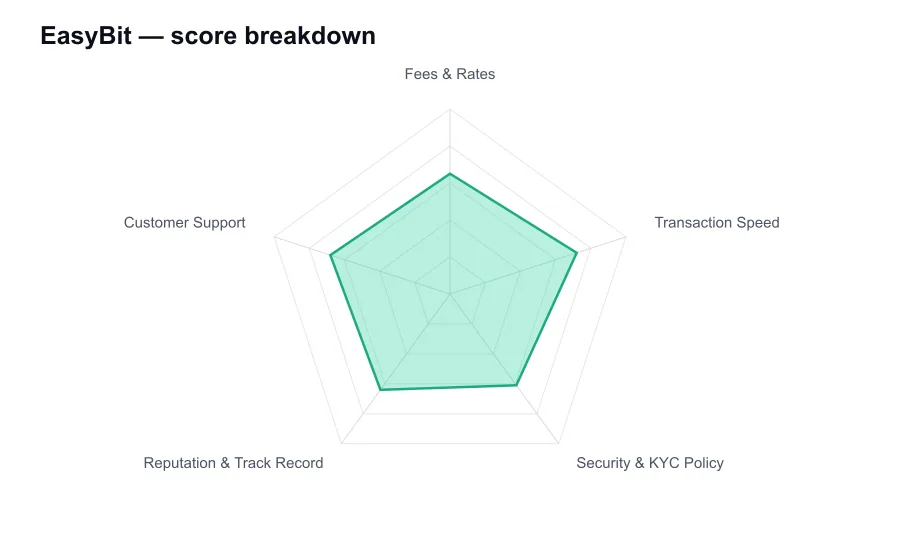
EasyBit scores 6.6/10 overall in our independent review, measured against every other provider we've compared, strongest on Transaction Speed (7.2/10) and weakest on Security & KYC Policy (6.1/10).
Score: 6.6/10 How we score →| Best for | Not for |
|---|---|
| Registration-free crypto swaps in normal cases | Final rate can include spread beyond the headline fee |
Editorial independence: our scores and rankings are produced using the fixed criteria above and are not influenced by advertisers. This is an independent ranking site and is not operated by, or affiliated with, any provider we list.
Affiliate disclosure: some links on this page may earn us a commission at no extra cost to you. This does not affect our rankings.
Criteria Breakdown
| Criterion | Score | Notes |
|---|---|---|
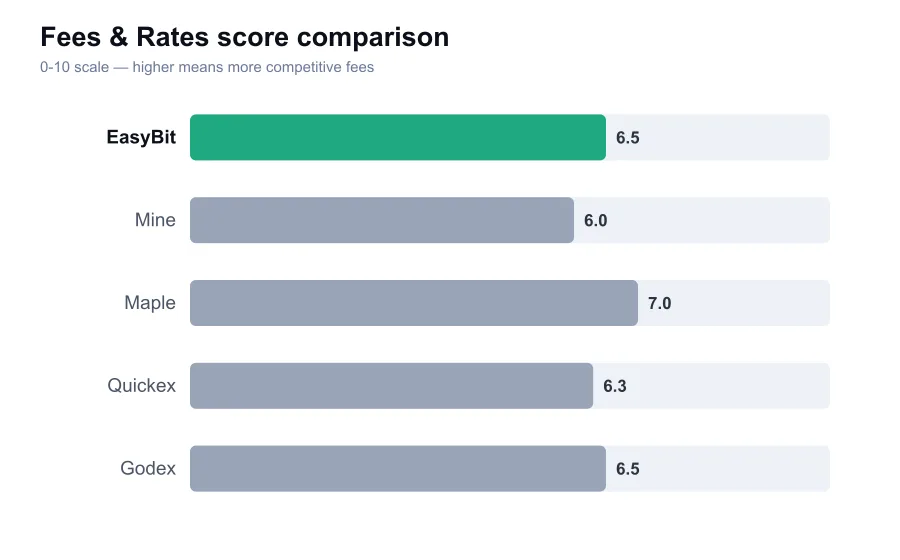
| Fees & Rates | 6.5 | Advertised service fee, but spreads affect final pricing |
| Transaction Speed | 7.2 | Many common swaps finish in minutes after confirmations |
| Security & KYC Policy | 6.1 | No routine KYC, but temporary custodial counterparty risk |
| Reputation & Track Record | 6.4 | Established instant-swap brand, not top-tier exchange scale |
| Customer Support | 6.8 | Transaction support is available, holds can still be slow |
EasyBit sits in the instant crypto exchange category, a market built for people who want to convert one coin into another without opening a full trading account. You choose a pair, send the deposit, provide a destination address and receive the output after the provider sources liquidity and completes the swap. It is a more convenient proposition than manually using a decentralised exchange, but it is not the same thing as trading on a transparent order book.
The appeal starts with the account model. EasyBit has historically offered registration-free exchanges for many crypto-to-crypto swaps, which means there is no routine KYC form just to exchange one asset for another. That is useful for a user who values privacy or simply wants to avoid another password and account balance. It also means the service has compliance limits. Suspicious, unusually large or risk-flagged transactions can be paused and may trigger a request for identity or source-of-funds information.
Anyone attracted by no-KYC language should read that last point carefully. No routine verification is not a guarantee that every transaction will remain anonymous or instant. Blockchain monitoring is standard across this industry, and an exchange service may freeze processing while it investigates a deposit. That can be frustrating, particularly if a trader has already sent funds, but it is more honest to recognise this as an operational reality than to assume an instant exchanger is outside compliance expectations.
EasyBit advertises both floating-rate and fixed-rate exchanges. The difference matters far more than many users realise. A floating rate follows the market while the transaction is processed. If Bitcoin moves hard between your deposit and the provider's hedge, the amount received can change. A fixed rate locks a quoted output for a stated time window, usually requiring the deposit to arrive promptly and in the exact amount. For a volatile pair, I prefer fixed rate whenever the quoted premium is sensible.
The visible service fee has commonly been presented around 0.2 percent, but that is not the entire cost of using an instant exchanger. The rate can include a spread from liquidity providers, network charges are deducted or reflected in the quote, and a fixed-rate guarantee can cost more than a floating quote. The honest comparison is simple: enter the same trade at EasyBit, a liquid centralised exchange and an on-chain aggregator, then compare how many coins land in the destination wallet.
For a modest, urgent conversion, the price can be fair. Convenience has value, especially if the alternative is registering at a new exchange, waiting for an account review or navigating an unfamiliar DEX. For large trades, EasyBit is usually not where I would start. Deep order books at Binance, Kraken or Coinbase Advanced, where available and appropriate, can produce a more transparent price. A large quote from any instant exchange deserves a test transaction first.
Speed is generally good when the source network is operating normally. EasyBit can begin processing once the deposit reaches the required confirmations, then it must obtain the output asset and send it onward. Popular pairs often complete in minutes, while Bitcoin deposits, congested Ethereum transfers and smaller-liquidity assets can take much longer. The service cannot release crypto it has not safely received, so blockchain confirmation time is an unavoidable part of the wait.
The practical mistake is sending a deposit after the rate window expires, from the wrong network, or in an amount that does not match a fixed-rate order. These are common reasons a supposedly quick trade turns into a support case. Check the address, memo or destination tag, network selection and minimum amount before sending. If you are converting XRP, XLM or another asset with a tag requirement, one missing field can create a painful recovery process.
EasyBit is a custodial counterparty during the exchange, even though it sends the result to your external wallet. This is not equivalent to a trustless smart contract trade. You are temporarily relying on the company, its liquidity arrangements, its security controls and its willingness to resolve an exception. Keeping assets in your own wallet before and after the swap limits exposure, but it does not eliminate the counterparty risk during processing.
The site has operated for several years and has accumulated a visible user footprint in the instant-swap market. That is better than using a brand-new service with no record, but its public standing is not comparable with an established regulated exchange or a battle-tested DeFi protocol. Reviews for instant exchangers need to be read with care. Happy trades are often silent, while delayed compliance checks produce understandably angry reports. Look for recurring patterns, not a single glowing or hostile post.
Security policy is difficult to independently audit from the outside. EasyBit can describe encryption, monitoring and operational controls, but customers cannot inspect its treasury practices, hedging relationships or internal access management. That is why I would not treat it as a wallet. Send in the amount needed for the exchange and move on. A legitimate instant exchanger should never need your seed phrase, private key or remote access to a computer.
Support is better positioned than with a pure DEX because there is a company handling the transaction. EasyBit provides website support channels and transaction tracking, which can help if a deposit has not been credited or a payout is delayed. The limitation is predictable: support quality is tested during exceptions, not ordinary swaps. A rapid reply is useful, but it does not make a compliance hold or blockchain delay disappear. Keep the order ID, transaction hash and screenshots from the start.
The interface is accessible enough for a user who already understands crypto wallets. It is not suitable for somebody making a first purchase with money they cannot afford to misdirect. A recipient address cannot be casually corrected after broadcast, and network names that look similar can have materially different consequences. Do a small test send if the amount is important. That advice sounds conservative because it is, and crypto transfers punish casual confidence.
EasyBit is a reasonable convenience service for a straightforward crypto-to-crypto conversion, especially for users who prefer not to create a trading account. Its strongest qualities are privacy-friendly access, fixed-rate options and a relatively simple flow. Its weak points are the less transparent pricing typical of instant exchanges and the possibility of an inconvenient compliance check. I would use it for a moderate, well-understood swap, but I would not make it my primary venue for large trades or long-term custody.
Pros and Cons
| Pros | Cons |
|---|---|
| Registration-free crypto swaps in normal cases | — |
| Fixed-rate and floating-rate options | — |
| Simple external-wallet payout flow | — |
| Useful for modest one-off conversions | — |
Suitability
Does EasyBit require KYC?
Routine crypto swaps can often be completed without creating an account or submitting KYC. Risk controls may still require verification for flagged, suspicious or exceptional transactions.
What is the difference between fixed and floating rates?
A floating rate changes with the market during processing. A fixed rate aims to lock the quoted result for a limited deposit window, usually at a somewhat different price.
How long does an EasyBit exchange take?
Common swaps can finish within minutes after the deposit confirms. Bitcoin confirmations, network congestion, unusual assets and compliance review can make a transaction take longer.