Quickex
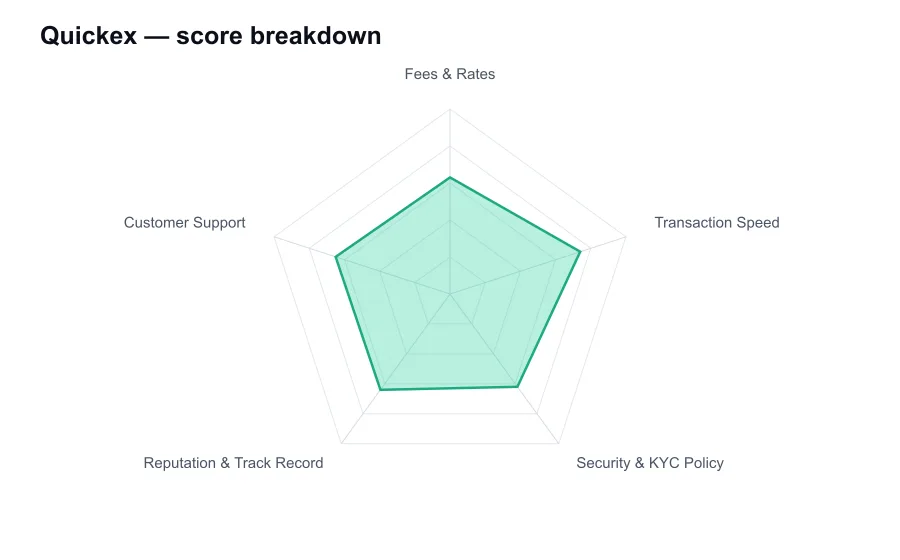
Quickex scores 6.5/10 overall in our independent review, measured against every other provider we've compared, strongest on Transaction Speed (7.4/10) and weakest on Security & KYC Policy (6.2/10).
Score: 6.5/10 How we score →| Best for | Not for |
|---|---|
| Fast wallet-to-wallet exchange workflow | All-in quotes obscure the precise fee and spread |
Editorial independence: our scores and rankings are produced using the fixed criteria above and are not influenced by advertisers. This is an independent ranking site and is not operated by, or affiliated with, any provider we list.
Affiliate disclosure: some links on this page may earn us a commission at no extra cost to you. This does not affect our rankings.
Criteria Breakdown
| Criterion | Score | Notes |
|---|---|---|
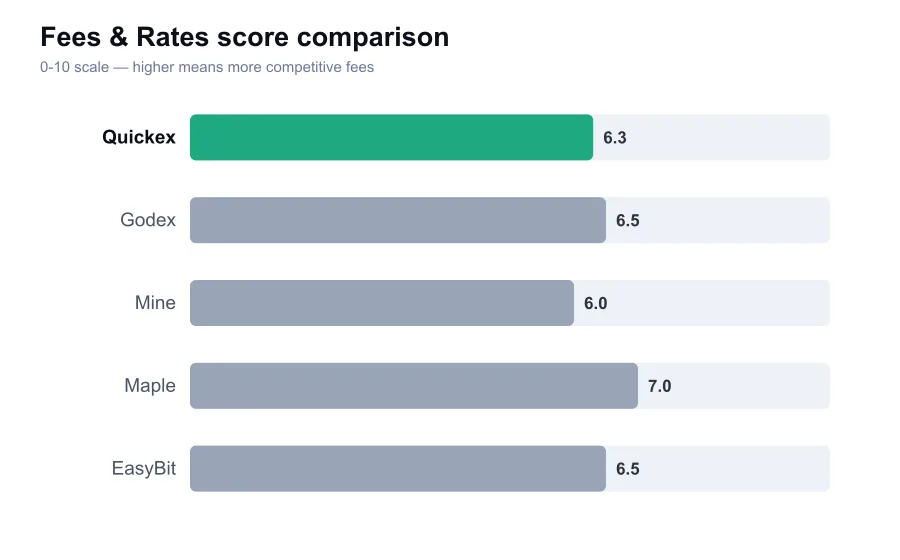
| Fees & Rates | 6.3 | Convenient all-in quotes, but not built for low-cost active trading. |
| Transaction Speed | 7.4 | Many normal swaps finish in minutes after blockchain confirmations. |
| Security & KYC Policy | 6.2 | Direct wallet delivery helps, but compliance holds remain possible. |
| Reputation & Track Record | 6.4 | Established instant-swap presence, still less proven than major exchanges. |
| Customer Support | 6.5 | Chat and email are useful, complex exceptions can take time. |
Quickex is an instant cryptocurrency exchange service built around a simple proposition: send one asset, receive another asset in your own wallet, and avoid the account management of a conventional exchange. It sits in the same market as ChangeNOW, LetsExchange and SimpleSwap, but has operated long enough to be more recognizable than the newest anonymous swap sites. Its appeal is speed of use, not sophisticated trading infrastructure.
The service does not ask users to deposit into a standing trading account before every conversion. You choose a pair, enter the receiving address, review the estimated output and send the source asset. For a crypto-native user moving between networks or consolidating a portfolio, this is genuinely convenient. There are no charts to decipher, no order types to configure and no cash balance waiting inside a centralized exchange. That simplicity is Quickex's strongest product decision.
It also means that Quickex is not a place to seek the best possible execution without doing comparison work. The platform obtains liquidity through partners and presents an all-in quote. Its margin, liquidity-provider charge and network costs are not separated into a clean maker and taker table. That is standard for instant exchangers, but users should resist calling it fee-free. Every swap has a cost, and the only figure that matters is how much of the destination asset reaches the wallet.
Quickex supports floating-rate exchanges and, for selected assets, fixed-rate transactions. Floating is usually appropriate for a small swap in a stable market, but it exposes the final amount to movement during confirmation and execution. Fixed rate provides more certainty, usually for a short stated time window and within defined deposit limits. I prefer fixed rate for a time-sensitive payment or a volatile asset, provided the quote is not materially worse. Certainty has value when crypto prices are moving fast.
The fee picture is reasonable for convenience trades and weak for repeated trading. On a common pair, Quickex can be competitive with other instant services, especially after factoring in the withdrawal fee a centralized exchange would charge. It is rarely the economical option for an active trader who can place limit orders on Kraken, Coinbase Advanced, OKX or Binance. Those exchanges provide visible market depth and explicit fee schedules. Quickex provides a quick answer, not a trading venue.
Network selection can change the cost more than the service's own margin. USDT or USDC sent across a low-cost supported chain can be far more sensible than the same value moved over Ethereum mainnet. Users must verify that the receiving wallet supports the exact chain and token standard chosen. An address can look valid while belonging to an incompatible network. No instant exchange can reliably undo a completed transfer to the wrong chain, and support cannot manufacture access to an unsupported destination.
Quickex is fast under normal conditions. Once the deposit reaches the necessary confirmations and the liquidity route is available, many exchanges are completed within minutes. Bitcoin transfers remain dependent on miners and the fee chosen by the sender. Ethereum transfers can slow sharply during periods of high gas demand. The service can process an order promptly, but it cannot control either blockchain finality or an exchange partner's temporary maintenance window.
The order page and transaction ID are important. A user should retain the deposit address, expected amount, receiving address and blockchain hash until the funds arrive. If a transfer is made below the minimum, outside the stated time window or from a restricted source, processing may require manual intervention. This is where instant exchange marketing meets reality. Most routine swaps are quick. The difficult cases are slower than a regular exchange because there is no account dashboard with broad self-service controls.
Quickex does not usually require a full registration flow for ordinary conversions, which is a meaningful privacy advantage over mainstream regulated exchanges. It should not be described as a guaranteed no-KYC service. The provider reserves the right to request verification where anti-money-laundering systems identify risk. That may include identity documents, a source-of-funds explanation or evidence related to the sending wallet. Anyone who cannot tolerate that possibility should not send funds first and argue about policy later.
From a security perspective, the right way to use Quickex is as a transit service. Send only the amount intended for the current swap, receive directly to a wallet you control and avoid leaving value exposed to an intermediary any longer than necessary. Enable security protections on the wallet at both ends, verify the genuine quickex.io domain and ignore social-media accounts claiming they can accelerate an order. Recovery scams are particularly common after a delayed crypto transfer.
Quickex has a longer operating history than many clone-like swap brands, but its public transparency remains lighter than that of a regulated exchange. It is not trying to be a bank, and users should not judge it by bank standards. Still, an exchange service handling irreversible transfers benefits from clear company disclosure, published compliance practice and credible public customer-service evidence. Quickex offers useful policy material and support channels, yet it does not carry the institutional confidence of a large licensed venue.
Reputation is consequently decent but qualified. Many users report smooth small and medium swaps, which is what an instant-exchange product should deliver. The negative reports that deserve attention involve delayed orders, requested verification and disputes about rate changes. Those issues are not unique to Quickex, but they reveal the risk hidden behind the frictionless front page. A quote can be fast and friendly right until an automated compliance rule decides it needs human review.
Support is centered on live chat, email and transaction-specific assistance rather than a telephone desk. For ordinary questions, this is appropriate and generally faster than the ticket queues at some giant exchanges. For an exceptional case, the quality of the answer matters more than the initial response time. The useful support team member is the one who can identify a transaction hash, explain the missing requirement and provide a realistic timeline, not simply paste a generic policy link.
I like Quickex most for a user who already controls their own wallets and needs an occasional conversion without opening another trading account. It is particularly handy for moving between established assets when the quote is competitive and the destination network is clear. I do not like it for large positions, fiat purchases or anyone who considers a possible compliance review unacceptable. An instant service should reduce steps, not encourage careless transfers.
Quickex is a credible convenience tool, not a replacement for a full exchange. It has a better claim to legitimacy than the newest barely documented swap websites, and its account-light process remains genuinely useful. Yet the all-in rate, potential KYC trigger and limited recourse on blockchain mistakes demand discipline. Compare quotes, use fixed rate where it makes sense, and test new routes with a modest amount. Used that way, Quickex earns a place in a practical crypto toolkit.
Pros and Cons
| Pros | Cons |
|---|---|
| Fast wallet-to-wallet exchange workflow | — |
| No standard account required for routine swaps | — |
| Fixed-rate option on selected transactions | — |
| Broadly established in the instant-exchange category | — |
Suitability
Is Quickex really no-KYC?
Routine swaps generally do not require account registration, but Quickex can request identity or transaction information under its compliance procedures. No instant exchanger can promise that verification will never occur.
Does Quickex offer fixed exchange rates?
Fixed-rate swaps are available for selected pairs and conditions. They can reduce uncertainty during volatile markets, but always review the quoted output and the permitted deposit window before sending.
Why is my Quickex swap taking longer than expected?
Delays usually involve deposit confirmations, a low network fee, blockchain congestion, liquidity maintenance or an order requiring review. Keep the transaction hash and order ID ready for support.