Maple
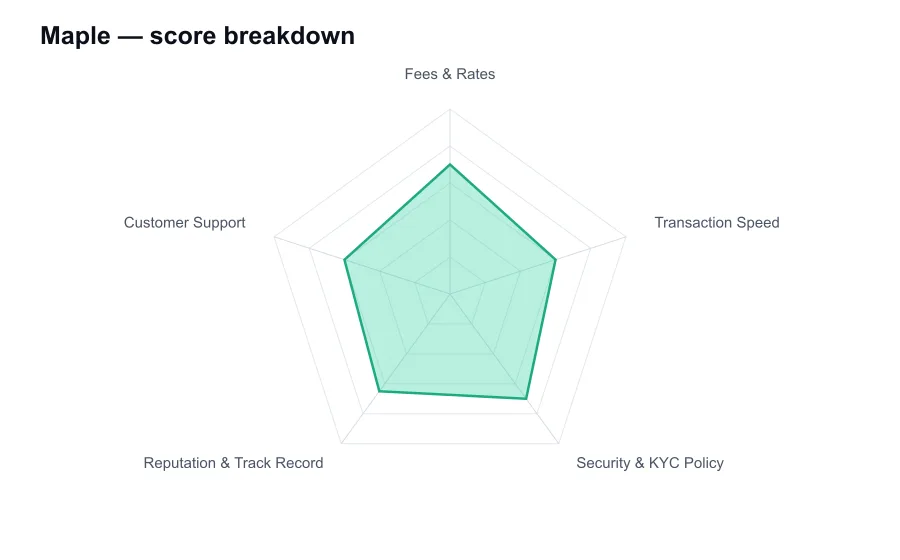
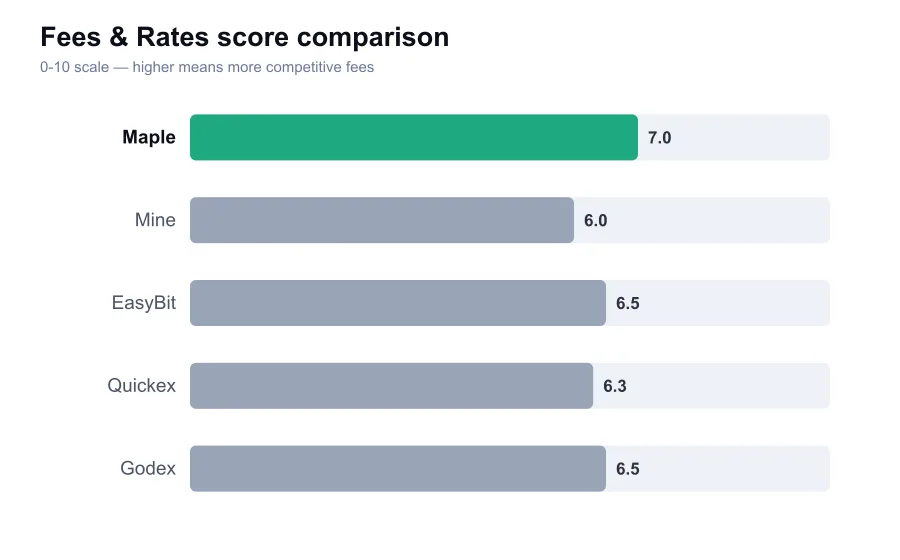
Maple scores 6.6/10 overall in our independent review, measured against every other provider we've compared, strongest on Fees & Rates (7.0/10) and weakest on Customer Support (6.0/10).
Score: 6.6/10 How we score →| Best for | Not for |
|---|---|
| Established on-chain credit protocol | Not a conventional crypto exchange |
Editorial independence: our scores and rankings are produced using the fixed criteria above and are not influenced by advertisers. This is an independent ranking site and is not operated by, or affiliated with, any provider we list.
Affiliate disclosure: some links on this page may earn us a commission at no extra cost to you. This does not affect our rankings.
Criteria Breakdown
| Criterion | Score | Notes |
|---|---|---|
| Fees & Rates | 7.0 | Pool economics can be efficient, but require close reading. |
| Transaction Speed | 6.0 | On-chain actions are quick, redemptions may not be. |
| Security & KYC Policy | 7.0 | Known protocol, but smart-contract and credit risk remain. |
| Reputation & Track Record | 6.5 | Established DeFi credit brand with a difficult past. |
| Customer Support | 6.0 | Good documentation, limited consumer-style assistance. |
Maple is not a conventional retail crypto exchange, and judging it as if it were Coinbase would miss the point. Maple Finance is an on-chain credit marketplace built around institutional and professional lending. Its core proposition is that capital can earn yield by financing borrowers through structured pools, rather than by trading coins on an order book. That puts Maple closer to private credit infrastructure than to a consumer exchange.
The project emerged in 2021 during the first serious push to bring undercollateralized lending on-chain. Its early model used pool delegates, later called Syrup or pool managers in parts of the product ecosystem, to assess borrowers and manage lending pools. Maple's history includes both ambition and a painful lesson: crypto credit can look stable until counterparties fail. The 2022 defaults associated with Orthogonal Trading and related market stress remain essential context.
That episode damaged Maple's reputation, but it also makes the protocol more intelligible than platforms that have never faced a real credit cycle. Losses did not disappear because lending occurred on-chain. Delegated underwriting, borrower concentration, and legal recovery are real risks regardless of the settlement rail. Anyone describing Maple yield as passive, risk-free, or equivalent to a stablecoin savings account is selling a dangerously incomplete picture.
Maple has since emphasized more tightly structured lending, secured lending arrangements, institutional borrowers, and products aimed at accredited or professional capital. The precise availability of pools changes with jurisdiction, investor eligibility, and market conditions. Prospective users need to inspect the actual pool documentation rather than relying on a headline APY. The borrower, collateral terms, liquidity rules, and legal entity are more important than the dashboard's yield number.
Fees are not best understood as a flat trading charge because users are generally not paying a maker-taker rate to exchange BTC for ETH. Fees can be embedded in pool management, protocol economics, borrower interest, withdrawal mechanics, and the difference between gross and net lender yield. A listed APY should always be read as a target or current rate, not a guaranteed return. Compare net yield after all applicable fees and risk, not the largest number on a landing page.
For a sophisticated lender, Maple can be economically attractive because direct on-chain credit may cut some of the overhead seen in traditional private credit funds. But that efficiency is valuable only if underwriting is sound. A few percentage points of additional yield do not make up for a borrower default or an inability to redeem during stress. I would rather accept a lower stated return from a transparent, conservative structure than chase a pool whose credit story I cannot independently evaluate.
Transaction speed is mostly a blockchain and pool-design question. Deposits and withdrawals settle through smart contracts and the underlying network, so a wallet transaction may confirm quickly. That is not the same as instant liquidity. Pool-specific notice periods, withdrawal queues, available cash, and the timing of loan repayments can determine when capital actually becomes available. Users who confuse transaction confirmation with redemption certainty are likely to be disappointed.
This distinction is especially important in credit markets. If a pool has loaned out most of its assets, there may not be enough idle stablecoins to meet every exit request at once. That is normal for lending, but it must be planned for. Maple is not where you park the funds needed for a payroll run, a margin call, or next week's house deposit. The yield exists precisely because capital is being put to work and carries duration risk.
On security, Maple benefits from the transparency of public smart contracts and the scrutiny that comes with being a known DeFi protocol. It has used audits and public documentation, though no audit can eliminate smart-contract, oracle, governance, or integration risk. Users still need to protect their own wallets, verify contract addresses, and understand token approvals. The protocol's controls do not rescue someone who signs a malicious wallet prompt.
KYC is nuanced rather than universal. Maple's institutional credit products have historically involved whitelisted borrowers and may restrict lenders based on legal or jurisdictional requirements. The DeFi-facing experience can be more accessible through self-custody, but access to a specific pool is not guaranteed merely because a wallet can connect. That is a reasonable design for credit products, although it makes Maple less convenient than an open retail swap.
Maple's reputation is mixed but serious. It is far better known than a newly launched yield app, has survived a brutal market cycle, and has public data that can be examined. Yet the 2022 credit losses mean it cannot be placed in the same risk bucket as Treasury-backed stablecoin products or fully collateralized overcollateralized lending. The protocol's recovery shows resilience. The earlier failures show exactly why lender due diligence cannot be outsourced.
Support is adequate for a technically literate DeFi audience, not hand-holding consumer finance. Documentation, community channels, wallet guidance, and pool information do much of the work. If your question is about a failed wallet transaction, the blockchain record can be useful. If your question concerns a legal claim against a borrower or liquidity under stress, the answer may be slower and more complex because that is the nature of credit, not a simple support-ticket problem.
Maple makes the most sense for experienced stablecoin holders, crypto funds, and investors who can analyze structured lending and tolerate illiquidity. It is a poor fit for someone who just wants to buy crypto, make instant swaps, or earn a predictable emergency-fund return. The product is interesting because it treats on-chain finance as credit infrastructure. It becomes dangerous the moment a user treats it like a savings account.
My final take is that Maple is a credible, sophisticated protocol with a history that should make investors more careful, not less interested. Its strongest feature is not the yield display. It is the depth of the credit-market concept and the amount of public structure available for scrutiny. Still, credit losses are not hypothetical here. Use Maple only if you understand who is borrowing your capital, what protects it, and why you can live with delayed liquidity or loss.
Pros and Cons
| Pros | Cons |
|---|---|
| Established on-chain credit protocol | — |
| Transparent pool and transaction data | — |
| Built for institutional lending structures | — |
| Self-custody access in eligible products | — |
Suitability
Is Maple a crypto exchange?
No. Maple is primarily an on-chain credit and lending protocol. Users provide or access capital through pools, rather than using a standard retail order-book exchange.
Can I withdraw from Maple instantly?
Not necessarily. Blockchain confirmation may be fast, but pool liquidity, withdrawal queues, notice terms, and outstanding loans can affect redemption timing.
What is Maple's biggest risk?
Credit risk is the core risk. Borrowers can default, and lenders can also face smart-contract, liquidity, legal, stablecoin, and market-structure risks.