ETZ
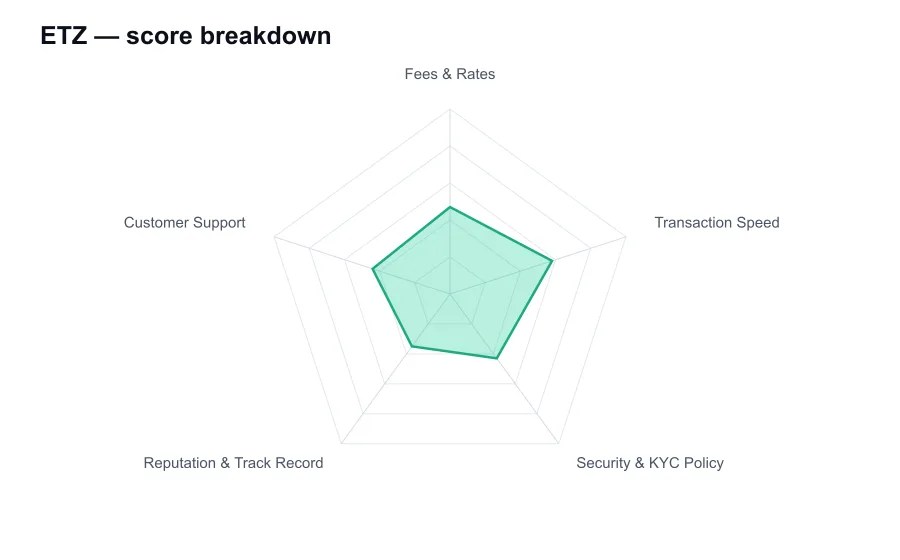
ETZ scores 4.6/10 overall in our independent review, measured against every other provider we've compared, strongest on Transaction Speed (5.8/10) and weakest on Reputation & Track Record (3.5/10).
Score: 4.6/10 How we score →| Best for | Not for |
|---|---|
| Simple crypto-to-crypto exchange format | Limited independently verifiable track record |
Editorial independence: our scores and rankings are produced using the fixed criteria above and are not influenced by advertisers. This is an independent ranking site and is not operated by, or affiliated with, any provider we list.
Affiliate disclosure: some links on this page may earn us a commission at no extra cost to you. This does not affect our rankings.
Criteria Breakdown
| Criterion | Score | Notes |
|---|---|---|
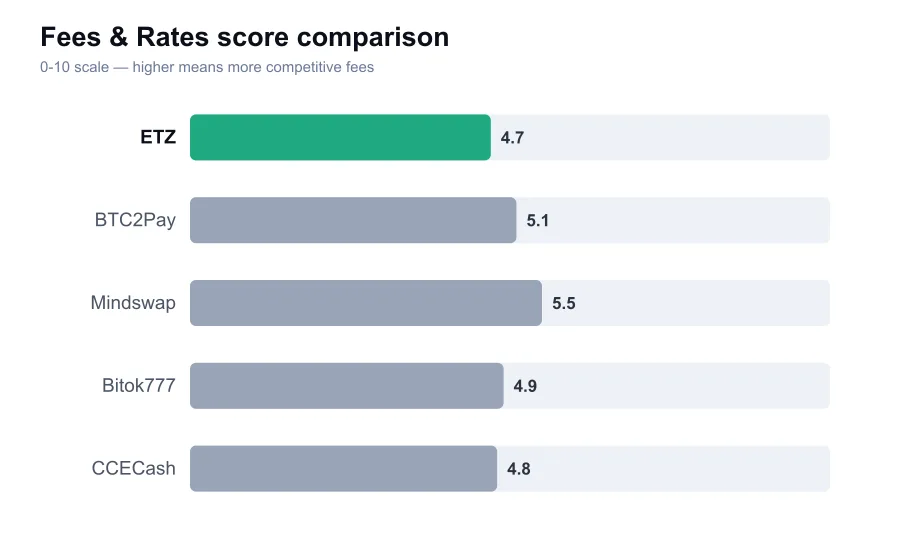
| Fees & Rates | 4.7 | Final-rate transparency is limited for comparison shopping |
| Transaction Speed | 5.8 | Standard instant-swap timing, dependent on confirmations |
| Security & KYC Policy | 4.3 | Temporary custody and limited public security evidence |
| Reputation & Track Record | 3.5 | Thin independently verifiable public track record |
| Customer Support | 4.4 | Insufficient public evidence for confidence in exceptions |
ETZ is a far less established name than Curve, DefiLlama or the major centralised exchanges, and that lack of a deep public record shapes this review more than any attractive claim on a landing page. It presents itself in the broad instant-exchange space, where a customer submits one crypto asset and receives another without using a classic order-book account. That can be a convenient format, but it is also a category where transparency varies sharply from provider to provider.
The first issue is identity and verifiability. With a major exchange, users can usually find corporate disclosures, licensing information, a long history of product announcements, public executives and years of third-party coverage. With ETZ, independently verifiable information is comparatively thin. That does not prove misconduct. It does mean a careful user should apply a higher evidence standard before sending a meaningful amount, especially because an instant exchange controls funds while the conversion is underway.
ETZ's likely value proposition is speed and low-friction conversion. A user does not necessarily want a trading terminal, a custodial balance or an elaborate account application just to exchange one asset for another. The direct flow can be appealing: select coins, paste the recipient wallet address, send the deposit and wait for the payout. The problem is that simple interfaces can hide the mechanics that matter most, including liquidity source, rate spread, required confirmations and how exceptions are handled.
Fees should be judged by the output quote, not a promotional number. Many instant exchanges state a low fee, or describe a quote as competitive, while making their revenue through the difference between wholesale liquidity and the rate shown to the customer. That is not inherently improper. It becomes a problem when the customer cannot tell whether a wide spread, network charge or service fee caused the shortfall. ETZ does not have the kind of deeply documented, independently comparable fee schedule that inspires confidence for larger trades.
Before using ETZ, I would enter an identical test trade on at least two alternatives. For liquid assets, compare the quoted destination amount against a reputable centralised spot exchange and a DEX aggregator such as 1inch or LlamaSwap where appropriate. Include withdrawal fees and gas, since a cheap-looking trade can lose its advantage at the final transfer. If ETZ cannot explain why its quote differs, that is enough reason to choose the more transparent venue.
Speed is similarly conditional. An instant-exchange interface can create an order immediately, but it cannot bypass blockchain confirmation rules or source liquidity faster than market conditions allow. Bitcoin deposits often need several confirmations. Ethereum and other networks can become congested. Less liquid assets can take longer to acquire and withdraw. A realistic promise is processing after confirmation, not instantaneous settlement simply because the product is called an instant exchange.
The most important operational question is what happens if something goes wrong. A wrong network, missing tag, underpayment, late fixed-rate deposit or compliance flag can turn a fast swap into a manual case. A strong provider publishes a clear recovery policy, gives users a transaction ID and responds from an identifiable support channel. A weak provider leaves customers with a chat bubble, vague status labels and no meaningful escalation path. ETZ has not built enough public evidence to give it the benefit of the doubt here.
KYC language requires particular care. A service may advertise no registration or no standard KYC, yet reserve the right to request identity documents if its transaction monitoring identifies risk. That arrangement is common in crypto and not automatically unreasonable. The concern is predictability. Users should know whether a transaction can be paused, which documents could be requested, how long a review might take and what happens if verification is declined. Do not interpret a no-KYC label as a promise of unconditional anonymity.
From a security perspective, the instant-exchange model has an obvious limitation. You can avoid leaving a standing balance on the platform, which is better than treating an obscure provider as a wallet. But between deposit and payout, you are taking counterparty risk. ETZ's public profile does not give me enough confidence to recommend using it for anything but a small test amount. There is no substitute for demonstrated operating history, independent security information and visible accountability.
Users should also protect themselves from the risks that no provider can fully solve. Bookmark the authentic site only after verifying it from reliable sources. Never use a link sent in a direct message. Confirm the coin ticker and network, especially where bridged or similarly named assets exist. Do not approve a wallet transaction that requests broad token permissions unless you understand why. A legitimate support representative will not ask for a seed phrase or private key.
Reputation is ETZ's weakest category. I found no body of widely recognised industry analysis, regulatory standing or long public track record that would place it beside established brands. In crypto, obscurity is not a crime, and some young products are perfectly functional. Yet users are not obliged to finance a provider's reputation-building phase with their own assets. There are too many established alternatives for blind trust to be a rational default.
Support is hard to score generously without consistently documented user experiences and clear escalation standards. A responsive chat agent can solve a simple address-format question, but the real test is a stuck deposit or a transaction held for compliance. Until ETZ demonstrates a dependable record through transparent policies and sustained user feedback, I would assume support is adequate only for routine cases. Save every order page, transaction hash and communication if you decide to test the service.
ETZ may still serve a narrow purpose for a user making a small conversion who has independently verified the destination, current domain and quote. Even then, use a small test transaction before increasing size. That is not paranoia. It is basic risk management in a sector where a transfer is usually irreversible and where a provider's public footprint is limited. Anyone moving a meaningful amount has better options with clearer pricing, stronger reputations and more accountable support.
My view is blunt: ETZ has not earned trust at the level required for large or time-sensitive transactions. Its low-friction model may be convenient, but convenience does not compensate for thin public information and limited independent validation. If you already know the service and have had successful small transactions, keep your exposure disciplined. New users should treat it as a speculative convenience tool, not as a primary exchange, custody service or place to send funds they cannot afford to have delayed.
Pros and Cons
| Pros | Cons |
|---|---|
| Simple crypto-to-crypto exchange format | — |
| Potentially useful for small one-off swaps | — |
| Avoids maintaining a standing trading balance | — |
Suitability
Should I use ETZ for a large crypto exchange?
I would not. ETZ has limited independently verifiable reputation and pricing information compared with established exchanges. If you test it, start with a small amount you can afford to have delayed.
Can an instant exchange really be no-KYC?
A provider may not request routine verification at order creation, but transaction monitoring can still trigger an identity or source-of-funds request. Read the policy before sending funds.
How can I check an ETZ quote?
Compare the final amount received against at least two alternatives for the same pair, amount and network. Include gas, withdrawal charges and any network fee in the comparison.