Allswap
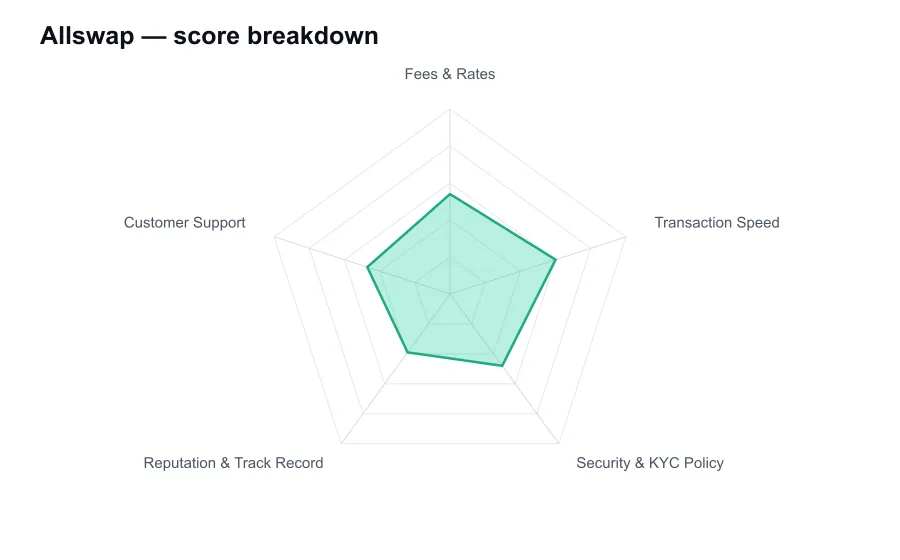
Allswap scores 5.0/10 overall in our independent review, measured against every other provider we've compared, strongest on Transaction Speed (6.0/10) and weakest on Reputation & Track Record (3.9/10).
Score: 5.0/10 How we score →| Best for | Not for |
|---|---|
| Simple direct crypto swap interface | Limited public ownership and operating-history disclosure |
Editorial independence: our scores and rankings are produced using the fixed criteria above and are not influenced by advertisers. This is an independent ranking site and is not operated by, or affiliated with, any provider we list.
Affiliate disclosure: some links on this page may earn us a commission at no extra cost to you. This does not affect our rankings.
Criteria Breakdown
| Criterion | Score | Notes |
|---|---|---|
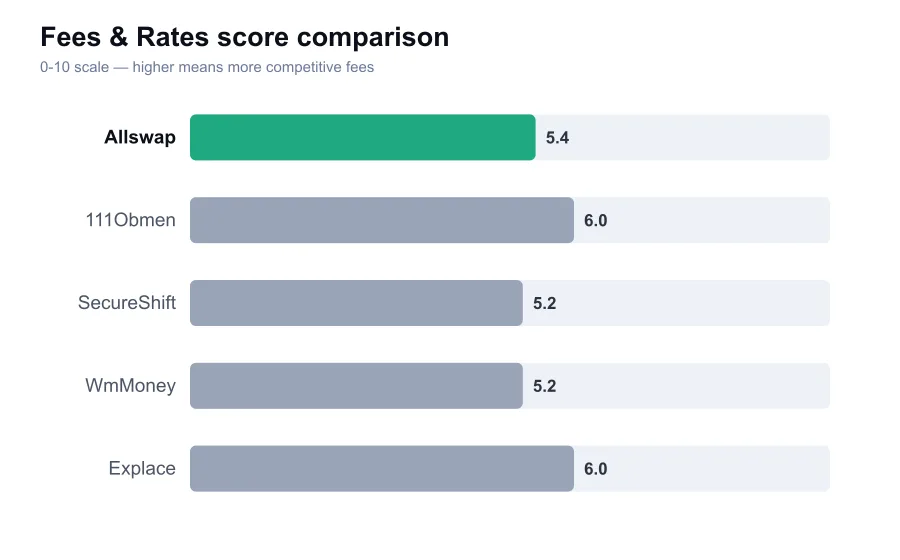
| Fees & Rates | 5.4 | Quote-based costs need careful comparison, with limited pricing transparency |
| Transaction Speed | 6.0 | Potentially quick on routine orders, but limited public reliability evidence |
| Security & KYC Policy | 4.8 | Non-custodial structure helps, but public operational disclosure is thin |
| Reputation & Track Record | 3.9 | Limited independently verifiable long-term track record |
| Customer Support | 4.7 | Support channels should be tested with small amounts first |
Allswap sits in the crowded outer edge of the instant exchange market, where a clean swap widget and a wide token list can make a small provider look more established than it really is. The basic proposition is familiar. You choose a cryptocurrency, send funds to a generated address, and receive another asset at your chosen wallet. For users who already understand self-custody, that can be more convenient than registering at a centralized exchange. The harder question is whether the provider has earned enough trust to handle anything beyond a carefully tested amount.
That question matters more with Allswap than with better documented brands. Public information about ownership, operating history, licensing position, and independent security practices is comparatively limited. A lack of public noise is not proof of misconduct, but neither is it evidence of reliability. In crypto, a service should not receive a high trust score merely because it has a working website and offers popular coins. Customers need to know who is taking temporary control of their funds and what happens when an order does not proceed normally.
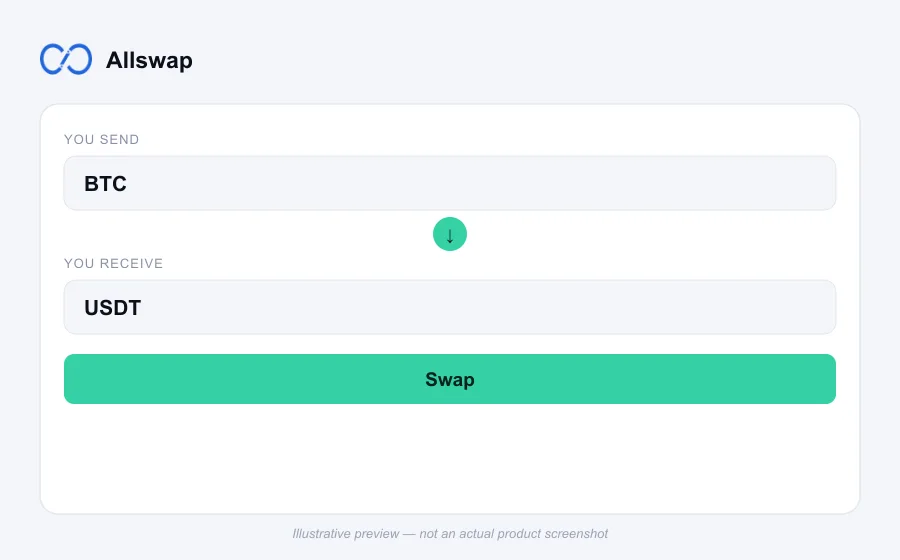
The interface follows the usual instant-swap formula and is easy enough to understand. That is a modest positive. A novice can see the send asset, receive asset, amount, destination address, and order reference without navigating professional trading screens. But simplicity can conceal the real mechanics. Allswap is not necessarily matching your order against a transparent public market. It may be relying on external liquidity, internal inventory, or both, and that affects pricing, speed, and the ability to resolve a disruption.
Fees are the area where I would be most disciplined. There is no compelling reason to assume that a smaller quote-based exchange is offering the best price just because it advertises a low or zero service fee. A zero-fee claim can coexist with a substantial spread in the exchange rate. Network fees also vary by chain. The only number that matters is the exact amount expected to arrive in your wallet, compared with alternatives at the same moment.
For a small swap, a slightly weaker rate may be an acceptable price for convenience. For a large transfer, it is not. Compare Allswap's quote with at least two established instant exchangers and with the executable price on a liquid centralized venue. Do not compare against the headline price on a crypto tracking site. That is not a rate you can necessarily trade at. If Allswap's final output is materially worse, the convenience argument disappears.
Transaction speed will depend heavily on the deposit chain, required confirmations, and the liquidity route used for the pair. A fast chain can produce a quick result if everything goes as planned. A Bitcoin deposit can take considerably longer, while Ethereum gas conditions can delay both incoming and outgoing transfers. Those are normal limits. The concern is how well Allswap communicates during exceptions, such as a delayed deposit, a changed rate, or a payout that has been broadcast but not yet confirmed.
A transaction-status page and a clear order identifier are minimum requirements, not premium features. Before sending anything, a customer should confirm that the order page identifies the correct network and documents the amount required. Send only the requested asset on the requested chain. A token sent over the wrong network, or a deposit without a required memo or tag, may be difficult or impossible to recover. That risk exists everywhere, but a smaller support operation may have fewer resources to investigate it.
Allswap appears to be aimed at low-friction crypto exchange rather than a fully verified custodial account. That does not create a blanket exemption from KYC. Any service that screens transactions can flag a deposit and request identity or source-of-funds information. Users sometimes treat this as deceptive because the site did not demand documents at the first screen. It is better understood as a risk-based process, although the fairness of that process depends on how clearly the provider explains it and how quickly it resolves genuine cases.
The security upside of a non-custodial swap is real but limited. You do not leave a balance sitting in an account, and you retain your own receiving wallet. On the other hand, you are still exposed from the moment you send the deposit until the payout reaches you. There is no chargeback on a blockchain transfer. If a website is compromised, spoofed, or simply unreliable, a customer has few remedies beyond records, public pressure, and whatever support channel exists.
That is why I would not recommend Allswap for large sums, payroll-style transfers, treasury activity, or any transaction with a strict deadline. A stronger exchange, preferably one with clear corporate disclosures and a long, inspectable history, is the better tool for those jobs. This is not a judgment that every smaller exchange is bad. It is a recognition that risk should be priced into behavior. The smaller the public track record, the smaller the initial transfer should be.
Reputation is Allswap's weakest category. There is not enough widely documented, long-term evidence to place it alongside established instant exchange operators, let alone regulated brokers. User feedback on smaller services can be difficult to evaluate because review platforms contain both genuine reports and promotional content. Look for specific details, transaction dates, support outcomes, and a consistent pattern across sources. A flood of short, enthusiastic reviews with no transaction context should not carry much weight.
Support should be judged by evidence, not by the presence of a contact icon. Before depositing, inspect the help pages, refund policy, terms, and channels available if an order stalls. A provider that explains confirmations, rate changes, AML checks, and wrong-network deposits is showing more operational maturity than one that merely says support is available around the clock. If you need an immediate answer at 3 a.m. for a five-figure transaction, Allswap is not the sensible venue to test that assumption.
There is a limited use case for Allswap. Someone who is already comfortable with crypto, has checked the live quote, and wants to test a minor conversion may find the process convenient. The test should be genuinely small, with a wallet you control and a saved record of every page. Do not use it because an unfamiliar social-media account says it has the best rate. Do not use it because a search ad placed it above a provider you recognize.
My verdict is deliberately conservative. Allswap may handle uncomplicated small swaps adequately, but the limited depth of publicly verifiable information means it has not earned a broad recommendation. Good crypto risk management is often boring. Choose established venues for significant money, use hardware-wallet controlled addresses, and regard an unfamiliar instant exchange as a service to verify rather than a shortcut to trust. Until Allswap builds a clearer record, its convenience does not outweigh that caution.
Pros and Cons
| Pros | Cons |
|---|---|
| Simple direct crypto swap interface | — |
| No long-term hosted balance needed | — |
| Potentially convenient for small conversions | — |
| Self-custody destination wallets | — |
Suitability
Should I use Allswap for a large crypto transaction?
I would not. The provider has limited publicly verifiable track-record information, so large, urgent, or business-critical transfers are better placed with established alternatives.
Can an Allswap swap require KYC?
A low-friction swap service can still apply risk screening and request identification or source-of-funds information if a transaction is flagged.
How can I check an Allswap quote?
Compare the exact receive amount, network, and rate type with at least two established instant exchanges before depositing. Do not rely on a headline fee claim.