Mindswap
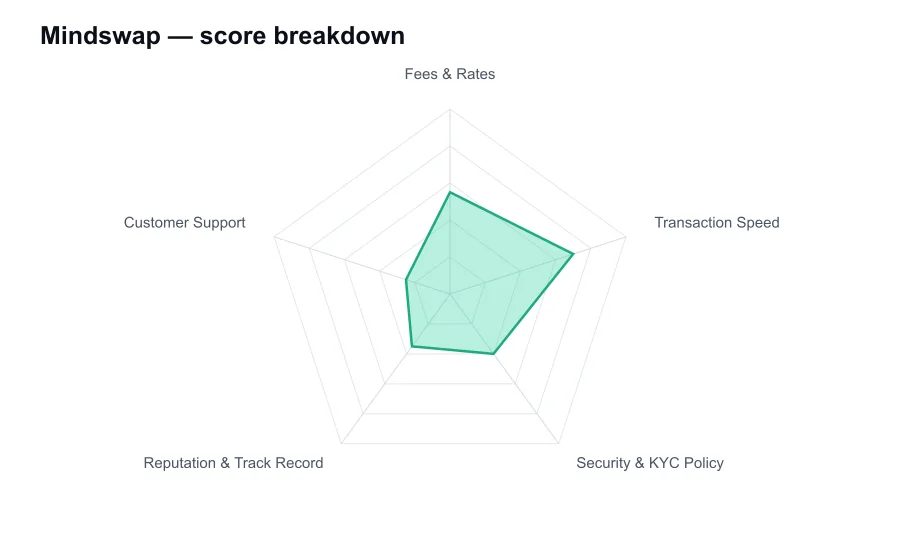
Mindswap scores 4.7/10 overall in our independent review, measured against every other provider we've compared, strongest on Transaction Speed (7.0/10) and weakest on Customer Support (2.5/10).
Score: 4.7/10 How we score →| Best for | Not for |
|---|---|
| Self-custody trading model | Limited current relevance and visibility |
Editorial independence: our scores and rankings are produced using the fixed criteria above and are not influenced by advertisers. This is an independent ranking site and is not operated by, or affiliated with, any provider we list.
Affiliate disclosure: some links on this page may earn us a commission at no extra cost to you. This does not affect our rankings.
Criteria Breakdown
| Criterion | Score | Notes |
|---|---|---|
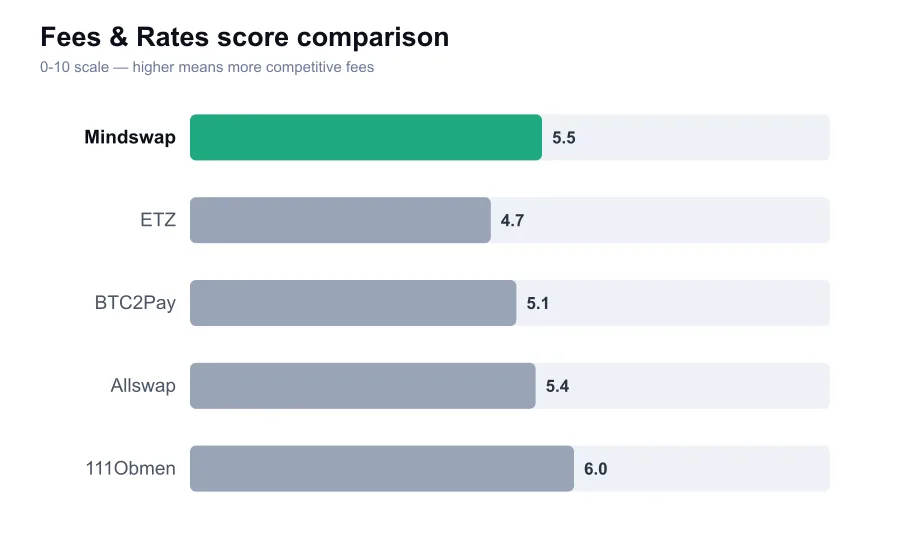
| Fees & Rates | 5.5 | Low Polygon gas, but liquidity and price impact can dominate. |
| Transaction Speed | 7.0 | Polygon confirmation is typically fast. |
| Security & KYC Policy | 4.0 | Legacy protocol status increases maintenance concerns. |
| Reputation & Track Record | 3.5 | Historically known, but not a leading current DEX. |
| Customer Support | 2.5 | Community-style help cannot reverse blockchain mistakes. |
Mindswap was a decentralized exchange and DeFi project associated with the Polygon ecosystem, built during the period when low network fees made Polygon a popular alternative to Ethereum mainnet. Its appeal was straightforward: connect a wallet, swap tokens through automated market-maker pools, and avoid the account creation typical of centralized exchanges. That model remains useful in principle, but Mindswap's present-day relevance is far weaker than its early DeFi pitch suggests.
The first thing a user should understand is that Mindswap was not a custodial broker. It did not operate like Binance or Coinbase, where an account holds balances and customer service can potentially reverse an internal mistake. A DEX routes transactions through smart contracts. Your wallet authorizes the action, the blockchain settles it, and an error is usually final. That grants control, but it also shifts responsibility directly to the user.
In its active form, the service centered on token swaps and liquidity provision on Polygon. Polygon transactions can settle quickly and at a fraction of Ethereum mainnet's historical gas cost, which was a genuine advantage for smaller trades. A swap might be confirmed within seconds or a few minutes depending on network conditions. That does not mean the trade itself was automatically good, because price impact and token liquidity matter far more than a cheap gas fee.
Fees on automated market makers usually include a liquidity-provider fee, with the exact allocation governed by the protocol's pool design and smart contracts. Mindswap's historical fee structure should not be assumed to remain active or applicable to every interface that uses its name. For any legacy DEX, the only reliable source is the currently deployed contract and the transaction preview. A stale article, social post, or old analytics page is not a fee schedule.
The real cost problem on small or aging DEXs is often not the stated swap fee. It is thin liquidity. A 0.3 percent pool fee can be tolerable, while a 5 percent or 15 percent price impact is not. Long-tail tokens may also have transfer taxes, malicious contract functions, or unreliable pricing. Users who focus only on gas are looking at the least important number. Check the route, slippage tolerance, liquidity depth, and expected received amount before approving anything.
Speed was historically one of Mindswap's better characteristics because Polygon was designed for low-cost, high-throughput transactions. Yet technical confirmation speed should not be confused with operational reliability. A swap can confirm instantly and still deliver a token that cannot be resold at the quoted market price. In DeFi, execution quality means final output, not merely the time between clicking confirm and seeing a transaction hash.
Security is where the age and maintenance status of a protocol become decisive. Smart contracts may remain live after their original teams reduce development, but live is not the same as actively maintained. A project with limited current communication, little recent code activity, and no visible security process deserves a much more cautious rating than an actively supported DEX. Unpatched dependencies, compromised front ends, and imitation websites are serious risks.
Mindswap's self-custody setup also means there is no KYC in the conventional centralized-exchange sense for a standard wallet interaction. That appeals to users who value privacy and direct wallet control. Still, no-KYC should not be misread as no risk or no compliance relevance. Stablecoin issuers can freeze assets, blockchain analytics exist, and local laws may still apply to users. Privacy is not a substitute for due diligence.
The protocol's reputation is mainly historical. It was part of the broader rush of Polygon DeFi applications rather than a dominant, enduring exchange like Uniswap, QuickSwap, or Curve. That does not erase its technical achievements, but it changes the recommendation dramatically. Network effects matter in DEX trading. Deep liquidity, active development, audited contracts, and a broad user base are not cosmetic advantages. They are what make a trading venue usable during stress.
A prospective user should be wary of token listings and websites trading on the old Mindswap name. Crypto projects are frequently cloned, abandoned domains are exploited, and old token-contract references can lead to unsafe approvals. Verify official communications through several independent sources, inspect the contract on a block explorer, and avoid unlimited token approvals. If you cannot establish that a front end is current and official, do not connect your primary wallet.
Customer support is inherently limited in a decentralized protocol, and that limitation becomes sharper once a project loses momentum. There may be community channels, archived documentation, or social accounts, but those are not a substitute for a staffed support desk. Nobody can reverse a completed smart-contract transaction. A user who needs personal help, chargeback rights, or recovery from routine mistakes belongs on a reputable centralized exchange, not an aging DEX.
For active Polygon trading today, QuickSwap and Uniswap's supported routes generally offer a stronger combination of liquidity, integrations, and current attention. The comparison is not flattering to Mindswap. Even if a legacy pool still functions, there is little reason to make it a default venue unless it offers uniquely deep liquidity for a specific asset and the user has independently verified every contract involved.
Mindswap may still interest DeFi researchers, collectors of ecosystem history, or advanced users interacting with a specific legacy asset. It is not a platform I would recommend to newcomers, routine traders, or liquidity providers looking for dependable long-term exposure. The cost of being wrong in an abandoned or thinly maintained DeFi environment is much higher than the tiny gas savings that originally made Polygon DEXs attractive.
My verdict is that Mindswap belongs more to Polygon DeFi's earlier chapter than to a current shortlist of exchanges. Its original model was sensible, and cheap on-chain execution was a legitimate strength. But reputation, ongoing maintenance, liquidity depth, and support are what separate a usable DEX from a relic. Unless you have a narrow, well researched reason to use a verified Mindswap contract, choose a more active venue.
Pros and Cons
| Pros | Cons |
|---|---|
| Self-custody trading model | — |
| Historically low Polygon transaction costs | — |
| No conventional account signup | — |
| On-chain transaction transparency | — |
Suitability
Does Mindswap require KYC?
A standard self-custody DEX interaction historically did not require conventional account KYC. Users still remain responsible for legal compliance and should not assume anonymity.
Why can a cheap Mindswap swap still be expensive?
Low Polygon gas does not protect against price impact, wide effective spreads, token taxes, or illiquid pools. The quoted output and route matter more than gas alone.
Can Mindswap reverse a mistaken transaction?
No. Smart-contract transactions are generally irreversible after confirmation. Use a separate wallet, verify contracts, and start with small amounts.