SecureShift
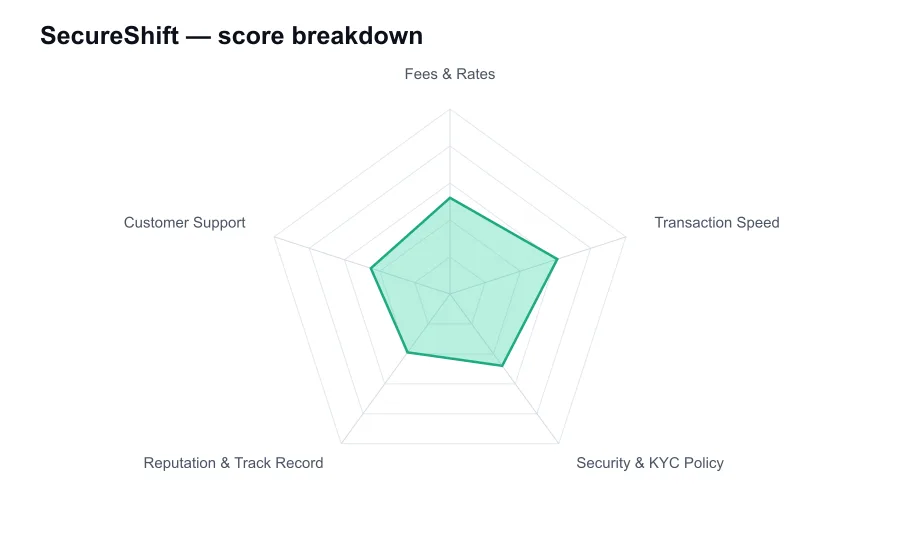
SecureShift scores 5.0/10 overall in our independent review, measured against every other provider we've compared, strongest on Transaction Speed (6.1/10) and weakest on Reputation & Track Record (3.9/10).
Score: 5.0/10 How we score →| Best for | Not for |
|---|---|
| Simple wallet to wallet swap flow | Limited public company and security transparency |
Editorial independence: our scores and rankings are produced using the fixed criteria above and are not influenced by advertisers. This is an independent ranking site and is not operated by, or affiliated with, any provider we list.
Affiliate disclosure: some links on this page may earn us a commission at no extra cost to you. This does not affect our rankings.
Criteria Breakdown
| Criterion | Score | Notes |
|---|---|---|
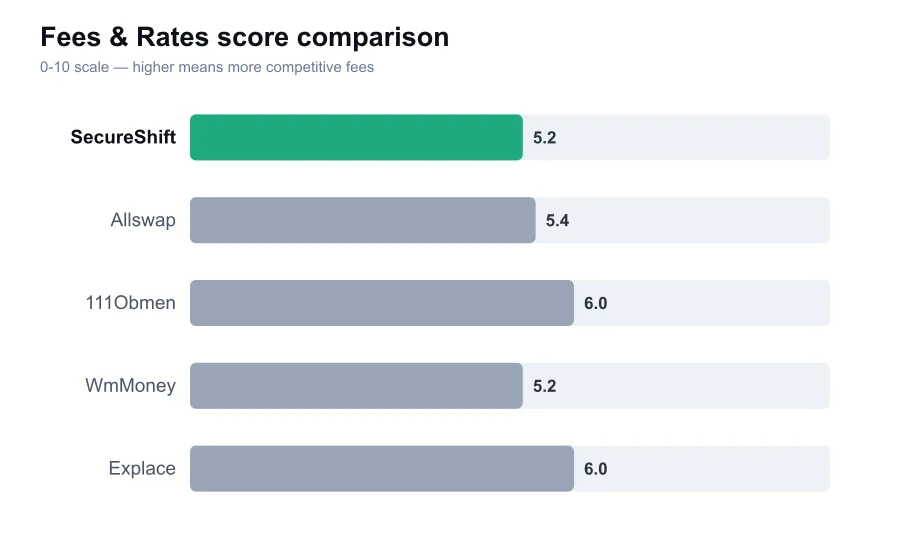
| Fees & Rates | 5.2 | Quoted rates are convenient, but margins are not transparent |
| Transaction Speed | 6.1 | Fast routes exist, but blockchain confirmations control timing |
| Security & KYC Policy | 4.8 | No routine signup, but limited public security detail |
| Reputation & Track Record | 3.9 | Too little independently established operating history |
| Customer Support | 4.5 | Online support only, with limited escalation confidence |
SecureShift presents itself as an instant cryptocurrency exchange, which places it in the crowded category occupied by services such as ChangeNOW, SimpleSwap, StealthEX, and LetsExchange. The basic promise is familiar: choose two coins, send one in, and receive the other without opening a full trading account. That model is attractive to users who want a quick conversion and do not want to deposit funds into a conventional exchange.
The appeal is obvious. There is usually no trading terminal to learn, no order book to interpret, and no routine registration process before a small swap. A user can go from BTC to ETH or USDT to another supported asset through a simple quote flow. For people who already control a wallet, that is less intimidating than setting up an account at a centralized exchange and navigating identity checks before making a single trade.
My concern with SecureShift is not that the instant exchange model is inherently bad. It is that public information about the business, its operating team, security practices, liquidity sources, and long term record is much thinner than I would want for a service handling irreversible crypto transfers. A clean website is not evidence of operational depth. In this part of the market, transparency is a security feature, and SecureShift does not inspire the same confidence as the better documented competitors.
Fees are quoted as part of the conversion rate rather than offered in a conventional transparent schedule. That is common for instant exchangers, but it makes comparison essential. The number that matters is the final amount of destination crypto you will receive after network costs, provider margin, and market movement. A service can advertise a low or zero platform fee while still giving a less competitive all in rate than a rival. SecureShift users should price check every meaningful swap.
The distinction between fixed and floating rates matters even more here. A floating quote can move between the moment you submit the order and the moment your deposit reaches the provider, especially with Bitcoin or a congested network. If SecureShift offers a fixed rate for a route, read the time limit and deposit instructions closely. Sending late, sending the wrong amount, or using an unsupported network can turn a supposedly simple swap into a support case.
Speed is adequate in the best case, but it is not fully under SecureShift's control. A swap only begins in earnest after the incoming transaction receives the confirmations required by the provider and any liquidity partner. Fast networks can complete in minutes. Bitcoin, Ethereum during congestion, and assets requiring extra compliance review can take substantially longer. Anyone promising instant completion across all chains is overselling the process.
SecureShift does benefit from the fact that it is not designed to hold a standing user balance. You send funds for a conversion and receive an output address payment, rather than leaving coins in a hosted account for weeks. That reduces one form of exchange custody exposure. It does not remove counterparty risk during the swap. For a period of time, the provider or its partner controls the process, and crypto transfers cannot simply be reversed if something goes wrong.
The service appears to operate without routine account creation or standard KYC for ordinary swaps. That is useful for privacy minded users, but no responsible reviewer should describe it as a guarantee of anonymity. Most instant exchanges reserve the right to request verification under anti money laundering procedures, sanctions screening, suspicious transaction flags, or partner compliance checks. If a transaction is flagged, funds may be delayed while documents are requested.
That conditional KYC risk is one reason I would avoid using SecureShift for a large, time sensitive transfer. The problem is not just privacy. A user who needs funds to arrive by a particular deadline has little comfort if a swap is paused and there is no established support escalation path. Small test transactions are sensible with any unfamiliar provider. With SecureShift, they are mandatory in my view.
Reputation is where the service loses ground sharply. There is not enough extensive independent history, high quality third party scrutiny, or publicly visible company detail to put it in the same category as established exchanges. That does not prove misconduct. It does mean the burden of trust remains on the user, and the user has less evidence to work with. Crypto users have learned, painfully, that lack of information should be treated as a warning rather than a blank slate.
Customer support appears to be centered on online contact channels rather than a mature support organization with published service levels. That may be sufficient for a simple completed swap. It is much less reassuring if a deposit has an unusual memo, a blockchain has reorganized, or a compliance review begins. There is no phone line or institutional support structure to lean on. Keep transaction hashes, order IDs, wallet screenshots, and exact amounts from the start.
The platform is best approached as a convenience tool, not a place to build trust gradually through large deposits. If you have a small conversion involving a common asset and you have checked the route's rate against competitors, it may do the job. If you are moving a five figure amount, converting funds connected to a business, or working against a deadline, the lack of transparency becomes difficult to justify.
I would also avoid treating a broad asset list as a quality signal. Many instant exchange sites list hundreds of currencies because liquidity is sourced through partners. That can be convenient, but it does not mean every route has deep liquidity or reliable execution. Obscure assets can produce poorer rates, longer processing, or a completed deposit followed by a request for manual assistance. Stick to well established chains if you decide to use the service.
SecureShift is not a provider I would place at the top of a reader's shortlist. Its no account convenience is real, and the instant swap format has legitimate uses. But the limited public track record and limited transparency force a conservative assessment. Use a better established alternative if reputation and recourse matter, which is most of the time.
My final view is blunt: SecureShift may be acceptable for a small, nonurgent test swap, but it has not earned blind trust. The fee quote needs comparison, the completion time can depend on external networks, and conditional compliance reviews remain possible despite the no signup appeal. There are too many established instant exchange competitors to ignore those gaps. Caution is not pessimism here, it is basic crypto hygiene.
Pros and Cons
| Pros | Cons |
|---|---|
| Simple wallet to wallet swap flow | — |
| No routine account registration | — |
| No standing custodial account balance | — |
| Useful for small common asset conversions | — |
Suitability
Does SecureShift require KYC?
It does not appear to require routine account registration for ordinary swaps, but verification may be requested if a transaction triggers anti money laundering or compliance checks.
Are SecureShift swaps really instant?
Processing begins after your deposit receives the required blockchain confirmations. Actual delivery depends on the source chain, destination chain, liquidity partner, and any manual review.
How can I check SecureShift's real fee?
Compare the exact destination amount for the same input amount against other instant exchanges. The final quoted output is more meaningful than any advertised platform fee.