WmMoney
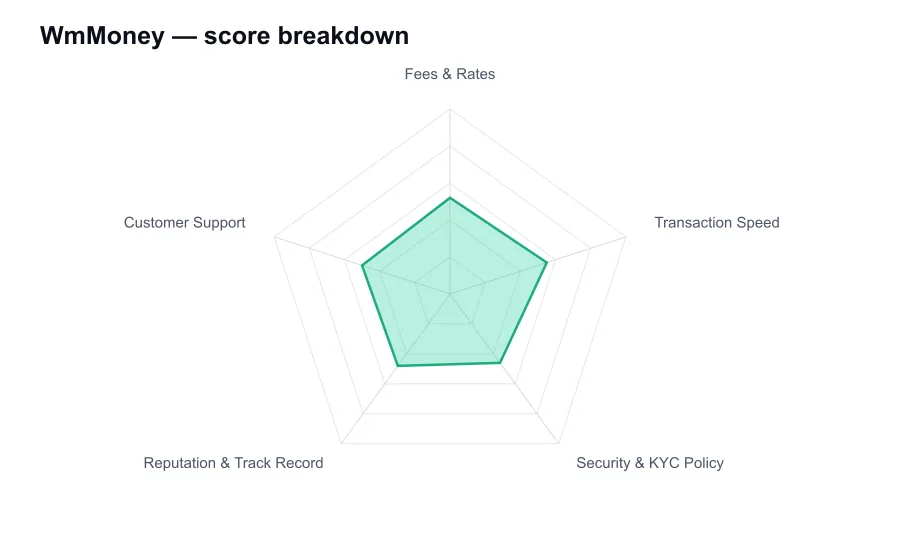
WmMoney scores 5.0/10 overall in our independent review, measured against every other provider we've compared, strongest on Transaction Speed (5.5/10) and weakest on Security & KYC Policy (4.6/10).
Score: 5.0/10 How we score →| Best for | Not for |
|---|---|
| May cover niche electronic money exchange routes | Limited public transparency compared with major exchanges |
Editorial independence: our scores and rankings are produced using the fixed criteria above and are not influenced by advertisers. This is an independent ranking site and is not operated by, or affiliated with, any provider we list.
Affiliate disclosure: some links on this page may earn us a commission at no extra cost to you. This does not affect our rankings.
Criteria Breakdown
| Criterion | Score | Notes |
|---|---|---|
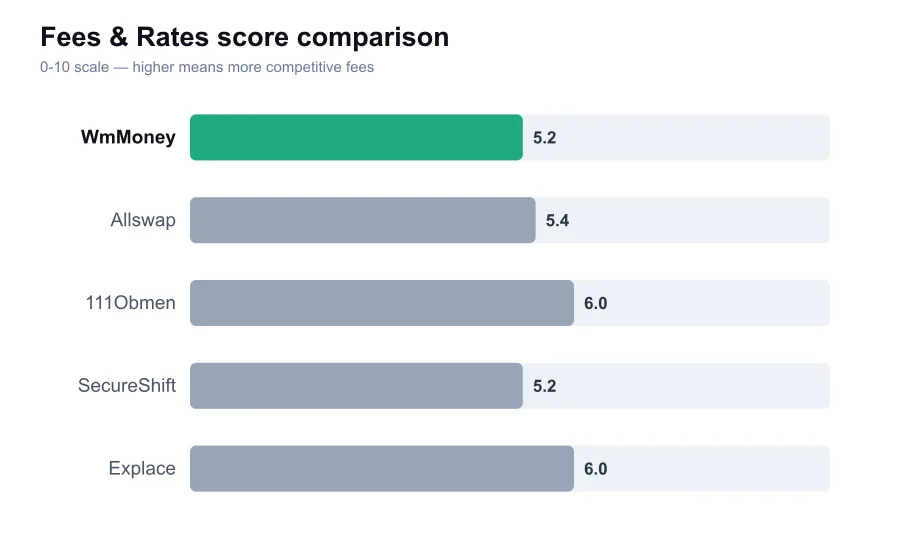
| Fees & Rates | 5.2 | Costs are mainly embedded in quotes and need external comparison. |
| Transaction Speed | 5.5 | Routine orders may be quick, but manual processing risk is higher. |
| Security & KYC Policy | 4.6 | AML checks may apply, with limited public security evidence. |
| Reputation & Track Record | 4.8 | Smaller public footprint demands careful independent verification. |
| Customer Support | 5.0 | Direct help may be available, but escalation depth is unclear. |
WmMoney is the sort of name that requires extra care from a prospective customer. It appears associated with the exchange bureau end of the market, where users seek conversions between cryptocurrency, WebMoney style electronic funds, bank cards, and regional payment options. This is not a mainstream global trading brand with the public footprint of WhiteBIT or Kraken. That difference should shape expectations from the moment you consider opening an order.
The attraction of a service in this category is obvious. It may offer a payment direction that a large centralized exchange does not support, or it may reduce several steps into one transaction. A person holding an electronic balance who needs USDT, or holding crypto and needing a regional payout method, may find WmMoney more immediately useful than a sophisticated exchange terminal with hundreds of trading pairs.
The downside is that information quality is often thinner. With a major exchange, a user can usually inspect published fees, licensing statements, order book depth, security documentation, and a large volume of independent discussion. With a small exchanger, the most important facts tend to live in the current order form, terms page, reserve display, and support conversation. That is enough for a careful small transaction, but it is not the same level of transparency.
Fee assessment should start with the final amount shown before payment. WmMoney style services commonly earn through the exchange rate and payment route margin, rather than a neat maker and taker commission. You may not see a line saying 0.1 percent fee, but you are still paying for the conversion. Compare the received amount with a major exchange reference price and at least one alternative exchanger using the same payment method.
The result may be acceptable. A user paying a modest premium for a hard to access local route is making a rational convenience purchase. The problem is assuming every quoted rate is competitive because the service does not show a visible extra charge. On electronic money and card directions, the effective spread can be materially larger than a simple crypto to crypto trade. Read the numbers, not the marketing language.
Minimums and reserves matter more here than at a large exchange. A small reserve can prevent an immediate payout even if the order form accepts your request. It can also mean that the advertised direction is technically available but operationally awkward for a larger amount. If your transaction is beyond a modest personal conversion, contact support before sending and ask whether the exact payout method and amount can be handled within the required time.
Speed is hard to rate generously without a stable public record of automated execution across many routes. A straightforward crypto deposit followed by an available electronic payout may complete quickly. A transaction involving card processing, a manual operator, an old payment network, or an incoming Bitcoin transfer may not. Any website can call a process instant. What matters is whether the recipient receives usable funds without a later review or reversal.
Users can reduce avoidable delays by following the order instructions exactly. Send the precise amount if the instructions require it, include any required memo or payment reference, and use the specified blockchain. Do not send USDT on an assumed network. A network mismatch is one of the most expensive errors in crypto, and smaller services may lack the technical staff or wallet access needed to recover it.
Security and KYC policy are the major concerns. A low registration threshold does not mean transactions are beyond anti money laundering review. WmMoney may request documents, proof of payment, wallet information, or source of funds evidence where its controls identify risk. A responsible user should view this as a possibility before sending, not as an unfair surprise after a transaction has been paused.
The real issue is not whether an exchanger has an AML clause, since nearly all do, but how clear its rules are about blocked transactions, refunds, and expected review time. If those procedures are vague, a customer has less certainty in the difficult scenario. I would not use WmMoney for money tied to a deadline or for funds whose history is complicated enough that a compliance question would be hard to answer.
There is also a basic counterparty concern. A small exchanger may be perfectly operational while still lacking audited proof of reserves, detailed security attestations, public executive accountability, or a clearly verifiable regulatory framework. That does not justify calling it unsafe as a fact. It does justify assigning a lower trust score than a platform with years of broad public scrutiny and mature governance.
Public reputation research should be active, not passive. Search for current feedback, not only the testimonials presented on the site. Check whether independent monitoring services list the domain and whether complaints identify a concrete issue. Be wary of review pages made of repetitive language or accounts that only praise one provider. Small exchange services can have genuine satisfied users and still be a poor choice for a large first transfer.
Support is likely to be more personal than at a giant exchange, which can be an advantage for a simple order. You may reach someone who can inspect the transaction instead of navigating layers of automated support. It can also be a weakness if the service has limited staffing, no clear escalation path, or reduced coverage outside normal regional working hours. A chat icon is not proof of 24 hour resolution.
I would preserve every piece of transaction evidence: the order page, original quote, payment receipt, wallet address, transaction hash, and correspondence. This is good practice everywhere, but it is especially important with a smaller operator. If something goes wrong, a concise evidence package gives support a real chance to resolve it. Emotional messages without an order number rarely move a case forward.
WmMoney may have a place for experienced users who understand the payment system they are using and only need a practical conversion route. It is a weaker choice for someone new to crypto, someone moving a substantial personal saving, or someone who needs the compliance and dispute framework of a larger exchange. The convenience can be real, but the safety margin is narrower.
My final view is cautious. WmMoney should be evaluated order by order rather than trusted on name recognition alone. If the current domain, live support response, exchange quote, reserve, and external feedback all check out, a small test transaction may be reasonable. I would not grant it the confidence reserved for WhiteBIT or another established centralized exchange. Use it as a narrowly scoped payment tool, not a wallet, investment venue, or place to park money.
Pros and Cons
| Pros | Cons |
|---|---|
| May cover niche electronic money exchange routes | — |
| Simple exchange bureau workflow | — |
| Potentially practical for small regional conversions | — |
Suitability
Does WmMoney have a published flat exchange fee?
The practical cost is usually reflected in the quote for a specific direction. Compare the final receive amount, not just the displayed asset price.
Can WmMoney ask for verification documents?
It may request documents or transaction evidence under AML and risk controls. Review its current rules before sending funds.
Is WmMoney suitable for a large transfer?
I would not recommend a large first transfer. Confirm reserves with support and test the exact route with a smaller amount first.