Goexme
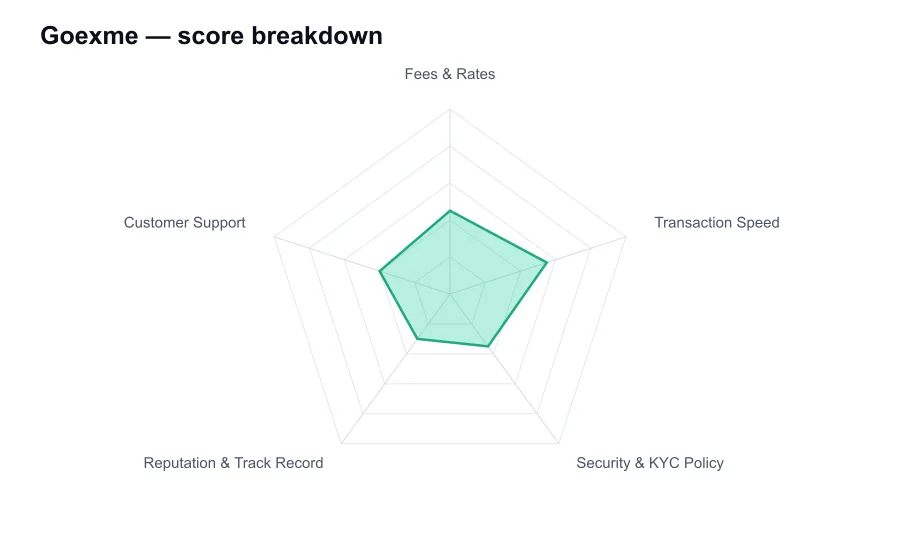
Goexme scores 4.1/10 overall in our independent review, measured against every other provider we've compared, strongest on Transaction Speed (5.5/10) and weakest on Reputation & Track Record (3.0/10).
Score: 4.1/10 How we score →| Best for | Not for |
|---|---|
| Simple crypto-to-crypto swap flow | Limited public operating history |
Editorial independence: our scores and rankings are produced using the fixed criteria above and are not influenced by advertisers. This is an independent ranking site and is not operated by, or affiliated with, any provider we list.
Affiliate disclosure: some links on this page may earn us a commission at no extra cost to you. This does not affect our rankings.
Criteria Breakdown
| Criterion | Score | Notes |
|---|---|---|
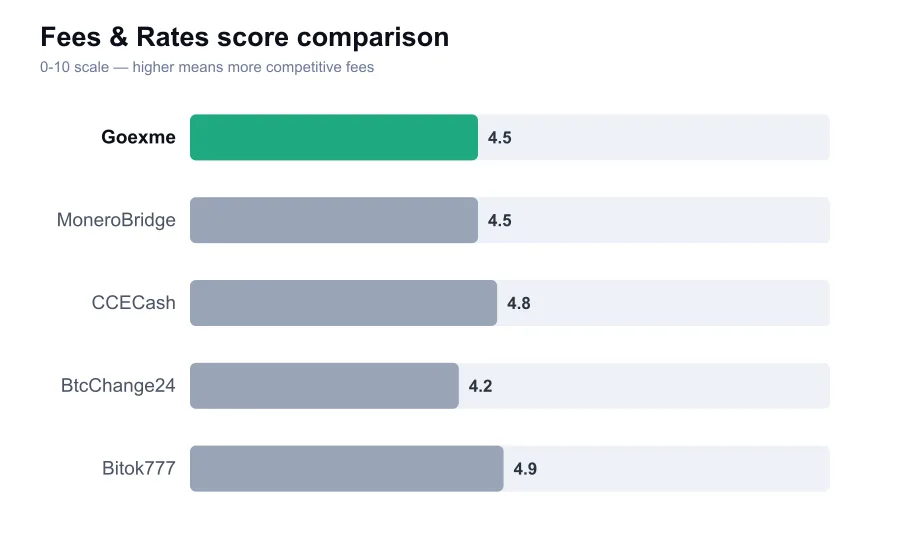
| Fees & Rates | 4.5 | Quoted rates can obscure spread and partner costs |
| Transaction Speed | 5.5 | Routine swaps may be quick, network delays still apply |
| Security & KYC Policy | 3.5 | Limited public security and compliance transparency |
| Reputation & Track Record | 3.0 | Little established independent track record |
| Customer Support | 4.0 | Support quality is hard to verify before a problem |
Goexme presents itself as a lightweight crypto exchange service aimed at people who want to swap assets without the ceremony of opening an account at a large regulated venue. It sits in the crowded instant-exchange corner of the market, alongside services such as ChangeNOW, SimpleSwap and StealthEX, rather than competing directly with Binance or Kraken's order-book platforms. The appeal is obvious: pick two coins, send funds, and receive the output asset. The problem is that a simple front end doesn't remove the need for trust.
The first thing I look for with a smaller exchange brand is a clear corporate footprint. Goexme doesn't have the public profile, regulatory disclosures, executive visibility or years of independently documented operating history that inspire confidence in an exchange handling irreversible transfers. That doesn't prove misconduct. It does mean a user has to accept considerably more counterparty risk than they would at an established provider.
Its model appears built around crypto-to-crypto conversion, not fiat banking. That can be convenient for a wallet user who already holds BTC, ETH, USDT or another supported asset. It also means there is less practical recourse if a transaction is delayed, repriced or subject to a compliance review. A bank transfer dispute process is imperfect, but it is still better than sending coins to a deposit address and hoping a small provider resolves a problem quickly.
Pricing is where Goexme needs more clarity. Instant conversion services often show a quoted output rather than a plainly separated trading fee. The apparent convenience can conceal a spread, liquidity-provider markup and network fee within the rate. That is not inherently deceptive, but it makes honest comparison difficult. A quoted 0.5 percent fee is easier to evaluate than a polished screen that gives no reliable way to distinguish service revenue from market movement.
For small swaps, the difference may be tolerable. If you are converting $50 of one major asset into another, a few dollars of spread may be a reasonable price for avoiding an account opening. On a $5,000 or $20,000 conversion, it is a different story. Even a one percent pricing gap costs meaningful money. I would compare Goexme's final received amount with at least two alternatives before sending anything, and I would do it at the same moment because volatile markets can make stale comparisons useless.
Fixed-rate quotes deserve particular caution. They can protect the customer from movement between the initial quote and settlement, but only if the provider genuinely honors the rate after confirming the incoming deposit. Floating-rate swaps are more common and can settle at a noticeably different rate during a rapid move. If Goexme offers a rate choice, read the execution terms before assuming the number on the first screen is guaranteed.
Speed will depend less on Goexme's interface than on the chains and liquidity partners behind it. A normal swap involving a well-supported asset can finish after the incoming network confirmations and an outbound transaction are processed. Bitcoin deposits may take far longer than a Solana or Polygon transfer, especially during congestion. The honest expectation is minutes for straightforward liquid pairs, not a promise of instant settlement in every case.
There is a major distinction between blockchain confirmation and completed delivery. A provider may detect your deposit quickly, then wait for confirmations, run automated risk checks, source liquidity and finally broadcast the destination payment. Each stage can add time. That is manageable if transaction status is detailed and support is responsive. It becomes frustrating if the tracker only says pending while the user has no usable explanation.
Goexme's security proposition is also limited by the fact that the user is temporarily trusting a third party with assets. Non-custodial branding often means the service doesn't maintain a long-term balance account, not that it never takes control of coins during conversion. The funds still pass through addresses managed by the operator or its partners. That is fundamentally different from swapping through a self-custody smart contract, and users should treat it accordingly.
KYC can be the point where no-account exchanges disappoint. A service may allow an order to begin without identity verification, then request documents if its screening systems flag the transaction, wallet history, amount or destination. This is common across the sector and can be legally defensible, but it is a poor experience if the policy is not explained in plain language before funds are sent. Never assume no sign-up means guaranteed anonymity.
Security disclosures matter here. Large exchanges publish proof-of-reserves material, security architecture descriptions, bug-bounty information, licensing details and incident communications. Goexme does not command that same level of public scrutiny or transparency. I would not use it as a storage location, I would not send a life-changing amount, and I would test its process with an amount I could afford to have tied up while a support case is investigated.
Reputation is Goexme's weakest area. There simply isn't a deep, long-running body of credible public reporting from regulators, major industry researchers or a broad base of experienced customers. Newer and smaller services can work perfectly well, but absence of evidence is not a substitute for a track record. The crypto market has repeatedly shown how quickly a convenient exchange widget can become unavailable when liquidity, compliance or operating controls fail.
Customer service is likely to be the deciding factor if anything goes wrong. A support email or chat channel is not enough by itself. What matters is whether a real person can identify an order, explain the hold, request only necessary documentation and give a credible timeline. I would save the order ID, deposit transaction hash, screenshots of the quote and destination address before contacting support. Those basics make a difficult case much easier to pursue.
The service may suit an experienced user making a modest, one-off swap and willing to price-shop carefully. It is not a sensible default for beginners, large conversions, fiat purchases or anyone who needs a heavily regulated counterparty. The low-friction pitch is attractive, but low friction is not the same as low risk.
My view is blunt: Goexme has not earned the level of trust that would justify using it casually for substantial funds. It may complete routine swaps without issue, as many small exchange services do. Yet unclear all-in pricing, limited public accountability and uncertain support depth leave too many unanswered questions. Use a better-known alternative if the rate is close, and use a regulated exchange if the transaction matters enough that you need reliable recourse.
Pros and Cons
| Pros | Cons |
|---|---|
| Simple crypto-to-crypto swap flow | — |
| Potentially no account for basic orders | — |
| Useful for small one-off conversions | — |
Suitability
Does Goexme require KYC?
A swap may begin without a traditional account, but identity or source-of-funds checks can still be requested under compliance screening. Don't send funds assuming every order will remain verification-free.
Are Goexme rates fixed?
Check the quote type and the order terms. Instant-exchange rates may be floating and can change before execution, while a fixed quote may have timing and confirmation conditions.
How fast is a Goexme swap?
Timing depends on the deposit chain, required confirmations, liquidity and compliance checks. A simple liquid-pair order may take minutes, while Bitcoin congestion or a review can take much longer.