MoneroBridge
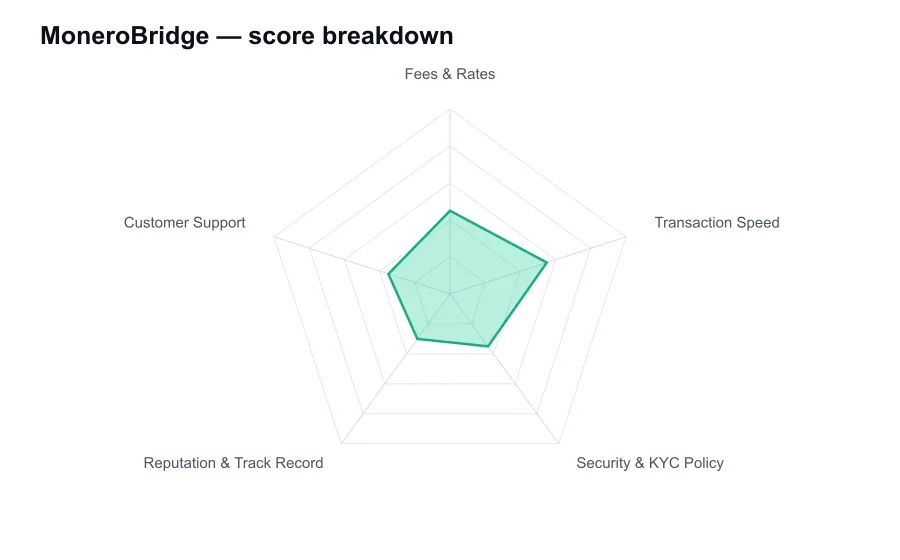
MoneroBridge scores 4.1/10 overall in our independent review, measured against every other provider we've compared, strongest on Transaction Speed (5.5/10) and weakest on Reputation & Track Record (3.0/10).
Score: 4.1/10 How we score →| Best for | Not for |
|---|---|
| Direct Monero focused swap workflow | Thin public operating history |
Editorial independence: our scores and rankings are produced using the fixed criteria above and are not influenced by advertisers. This is an independent ranking site and is not operated by, or affiliated with, any provider we list.
Affiliate disclosure: some links on this page may earn us a commission at no extra cost to you. This does not affect our rankings.
Criteria Breakdown
| Criterion | Score | Notes |
|---|---|---|
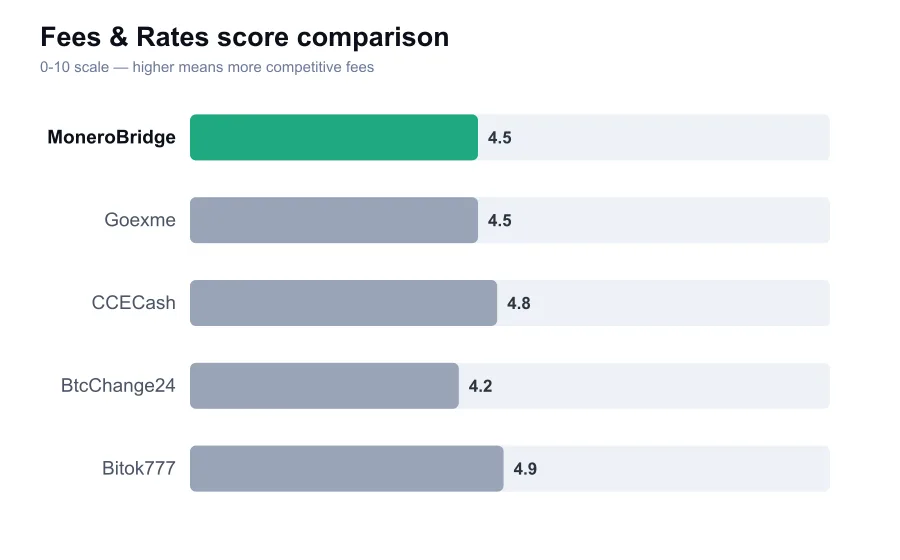
| Fees & Rates | 4.5 | Quoted spreads need close comparison before sending funds. |
| Transaction Speed | 5.5 | Settlement depends on source chain confirmations and liquidity. |
| Security & KYC Policy | 3.5 | Limited public detail on operator controls and safeguards. |
| Reputation & Track Record | 3.0 | A limited independently verifiable public track record. |
| Customer Support | 3.5 | Support depth and escalation performance are hard to verify. |
MoneroBridge presents itself as a privacy focused swap service for users moving into or out of Monero without opening a conventional exchange account. It occupies a narrow corner of the market, one aimed at people who dislike custodial platforms, lengthy onboarding, and the surveillance heavy culture that has become normal at large centralized exchanges. That pitch is understandable. The problem is that MoneroBridge is also a difficult service to independently assess.
The first thing a careful buyer should recognize is that this is not a household name in crypto. It does not have the public profile of Kraken, Bitstamp, Coinbase, or even long established instant swap brands such as ChangeNOW and SimpleSwap. A small footprint is not proof of wrongdoing, but it does change the risk calculation. With a lightly documented service, users are relying more on the operator's promises and less on a long public record.
MoneroBridge's appeal rests on convenience. A user generally selects the source asset, enters a Monero receiving address, sends funds to the quoted deposit address, and waits for the swap to settle. That is much simpler than funding an exchange, completing identity checks, placing an order, withdrawing, and hoping the withdrawal queue is quiet. For a modest one off conversion, the flow can feel refreshingly direct.
Its pricing is harder to praise with the same confidence. Small swap services frequently advertise a competitive rate while embedding their compensation in the quoted exchange rate, network fee estimate, or both. That does not automatically make the service expensive, but it means a headline figure is less useful than the amount of XMR that actually reaches the destination. Compare the final payout with at least two established instant exchangers before depositing.
The important number is the effective spread. If the market price suggests a swap should deliver 1 XMR and the quote delivers materially less after miner fees, the service is charging more than its marketing language may imply. Fixed rate quotes can protect against volatility, but they usually carry a wider spread because the operator is accepting price risk. Floating quotes may be cheaper, though the final result can move sharply during a busy market.
Monero adds another complication. Its network settlement is not instantaneous, and services normally wait for confirmations before releasing the outgoing side. A Bitcoin to Monero conversion can therefore take from roughly twenty minutes to well over an hour, depending on the source chain, fee level, liquidity, and the service's confirmation policy. A delayed swap isn't necessarily a failure. Silence during a delayed swap is the real concern.
I would not use MoneroBridge for time sensitive trades, large treasury movements, or a conversion needed to meet a liquidation deadline. It may be suitable for a small personal transfer where the user can tolerate waiting and has checked the destination address carefully. Anyone promising near instant settlement across every blockchain is selling a fantasy. Blockchain finality, liquidity sourcing, and manual compliance checks all create friction.
The absence of standard account KYC is likely a major reason people look at a service like this. No account can mean less personal data exposed in a breach and less onboarding hassle. But no routine KYC does not mean no compliance intervention. Many noncustodial swap providers reserve the right to pause an order and request source of funds information if automated monitoring flags a transaction.
That possibility should be treated seriously, especially with coins or wallets associated with sanctions screening alerts, gambling services, mixers, stolen funds, or high risk merchant flows. Monero's privacy properties do not eliminate the counterparty risk created by sending funds to a service controlled address. Until the outgoing transaction is broadcast, the operator has custody of the inbound asset. That is the central tradeoff in every instant swap.
There is little publicly verifiable material to support strong claims about MoneroBridge's corporate structure, reserve policy, security architecture, licensing, penetration testing, or incident response process. That lack of disclosure is a weakness, not a neutral detail. A transparent company can still fail, but a customer at least knows who is responsible and how disputes are meant to be handled. Here, accountability appears much thinner.
Security minded users should split any meaningful amount into test transactions. Start with the minimum practical swap, confirm that the payout arrives in a wallet you control, then consider a second transfer only if the quote, timing, and support response were satisfactory. Save the order ID, deposit transaction hash, quoted payout, and receiving address before sending. Those records are essential if something goes wrong.
Customer support is another area where a small operation can either surprise you or expose itself quickly. A contact form, chat widget, or email address is not equivalent to a staffed support organization. What matters is whether a human can explain a stalled order, identify the required confirmations, and provide a transaction ID for the outgoing payment. Publicly visible response history is limited, so buyers should not assume rapid escalation.
The reputation question is decisive here. MoneroBridge may appeal to users who value a low friction privacy oriented route, but it has not built the broad, independently documented track record needed to inspire confidence with serious capital. Services handling irreversible blockchain transfers should earn trust slowly through years of transparent operations, recognizable ownership, and consistent public support. MoneroBridge has not demonstrated that standard clearly enough.
My view is blunt. Treat MoneroBridge as an experimental convenience service, not as trusted financial infrastructure. A small test exchange may be reasonable for someone who accepts the risk and understands wallet operations. For meaningful sums, regulated venues with established compliance processes, or reputable swaps with stronger public histories, are the safer choice. Privacy is valuable, but it is not a substitute for due diligence.
Pros and Cons
| Pros | Cons |
|---|---|
| Direct Monero focused swap workflow | — |
| May avoid conventional account onboarding | — |
| Useful for small test conversions | — |
| Noncustodial style user experience | — |
Suitability
Does MoneroBridge require KYC?
It may allow routine swaps without conventional account verification, but a provider can still pause a transaction and request compliance information if its monitoring flags the order.
How long can a MoneroBridge swap take?
Timing depends on the source blockchain, confirmation requirements, network congestion, and liquidity. A conversion can take twenty minutes or substantially longer.
Is MoneroBridge safe for a large swap?
I would not treat it as suitable for a large transfer because public information about its controls, ownership, and support record is limited. Test with a small amount first.