Nexchange
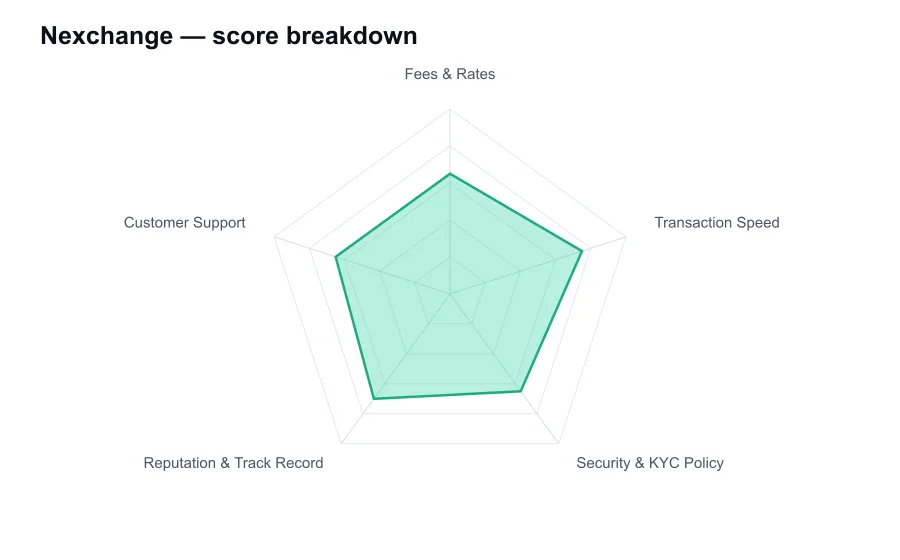
Nexchange scores 6.8/10 overall in our independent review, measured against every other provider we've compared, strongest on Transaction Speed (7.5/10) and weakest on Customer Support (6.5/10).
Score: 6.8/10 How we score →| Best for | Not for |
|---|---|
| Established API and white label focus | Quotes can be less competitive than order books |
Editorial independence: our scores and rankings are produced using the fixed criteria above and are not influenced by advertisers. This is an independent ranking site and is not operated by, or affiliated with, any provider we list.
Affiliate disclosure: some links on this page may earn us a commission at no extra cost to you. This does not affect our rankings.
Criteria Breakdown
| Criterion | Score | Notes |
|---|---|---|
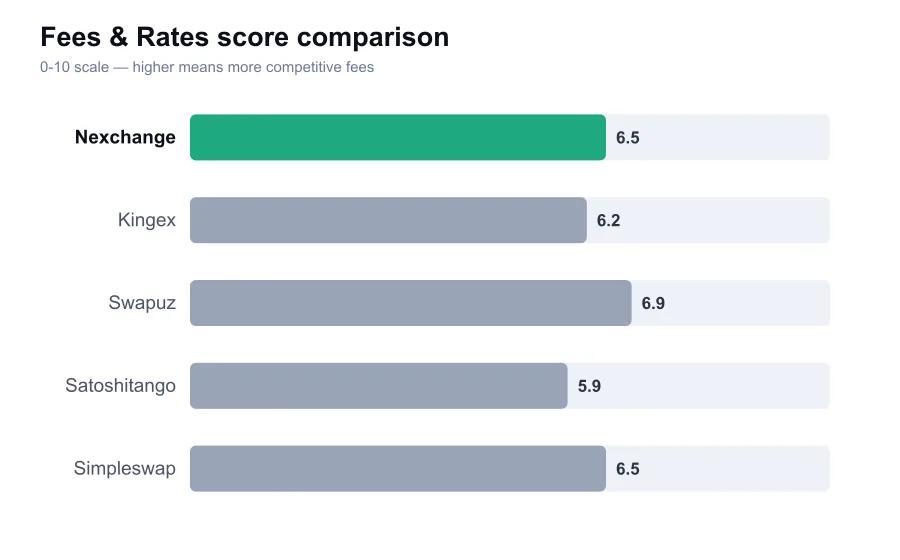
| Fees & Rates | 6.5 | Convenient quotes, but spreads may trail liquid order books. |
| Transaction Speed | 7.5 | Efficient order handling, limited by chain confirmations. |
| Security & KYC Policy | 6.5 | Transactional model helps, but orders still require trust. |
| Reputation & Track Record | 7.0 | An established API and white label exchange provider. |
| Customer Support | 6.5 | Best suited to technical partners and documented integrations. |
Nexchange is best understood as a cryptocurrency exchange service and API provider rather than a full retail trading venue in the style of Coinbase or Kraken. Its product is built around automated conversion, white label exchange functionality, and programmatic access. That makes it interesting to developers, wallets, brokers, and businesses that need crypto swaps inside their own product, while making it less compelling for traders who want deep order books and advanced charting.
The company has been operating since the middle of the last decade, which gives it a longer record than many instant exchange brands. Longevity does not eliminate counterparty risk, but it matters. Crypto infrastructure has a habit of disappearing after a single bad market cycle. Nexchange has survived enough changing conditions to deserve more credit than a brand new swap widget with no operating history.
The service's main attraction is convenience through integration. An API driven partner can quote a conversion, create an order, receive status updates, and complete a customer swap without building relationships with multiple exchanges from scratch. That can be valuable for a wallet provider or merchant service. The end user sees a simple conversion flow, while Nexchange handles liquidity routing and operational plumbing in the background.
That convenience has a price. Nexchange is not usually the place to expect the tightest possible execution versus a highly liquid spot market. Like other instant conversion services, its economics are reflected in the rate offered to the user, along with network costs and, in some cases, payment or operational charges. The only honest way to judge price is to compare the quoted receive amount with live prices on liquid exchanges at the same moment.
For small retail swaps, the difference may be acceptable. Paying a modest premium for a clean workflow can be rational if it saves time and removes the need to manage exchange accounts. For larger transactions, however, spread becomes expensive quickly. A business converting substantial volume should negotiate commercial terms, request clear pricing documentation, and measure actual execution against a benchmark such as Binance, Kraken, Coinbase Exchange, or a market data index.
Nexchange has historically offered fixed and floating rate style order options in some integrations. Fixed rate execution gives customers a degree of price certainty but can include a premium because the provider assumes volatility risk. Floating execution can produce a better rate but leaves the final payout exposed to market movement between deposit and completion. A good integration explains this in plain language rather than burying it behind a toggle.
Speed is generally good for the category, but users should keep their expectations grounded. Nexchange can process the internal order logic quickly, yet it cannot make Bitcoin confirmations, Ethereum congestion, wallet maintenance, or compliance checks disappear. A simple exchange between well supported assets may complete in minutes after the deposit confirms. Orders involving slower chains, low liquidity assets, or large values can take much longer.
For API clients, dependable status information is almost as important as settlement speed. A useful provider gives clear states for awaiting deposit, confirming, exchanging, sending, complete, and failed. That lets a partner communicate honestly with its users rather than guessing. Nexchange's integration oriented model is a plus here, because operational visibility is a bigger priority than it is on many anonymous swap pages.
The security picture is mixed in the way it is for most exchange infrastructure. Nexchange is not designed as a place where a consumer should park assets for months. The sensible workflow is transactional: send in funds for a conversion, then receive the destination asset in a wallet controlled by the user. This limits exposure time, but it does not remove the trust required while the order is being processed.
KYC and anti money laundering controls need special attention. Nexchange's service model has included verification and compliance screening where required, particularly for fiat related activity, larger transfers, or risk flagged orders. A partner should disclose this possibility to its users before they deposit. Customers expecting an unconditional anonymous exchange will be unhappy if an order is paused for documents after funds have already been sent.
Its public reputation is respectable within the API and white label niche, though it is not as visible to ordinary consumers as a mainstream exchange. That is not necessarily a flaw. Infrastructure businesses are often judged by integration stability and commercial relationships more than social media presence. Still, prospective enterprise clients should ask for uptime expectations, incident communication procedures, supported asset policies, and a clear explanation of who bears losses from misaddressed deposits.
Support appears better suited to partners and technical users than to a novice retail customer who wants phone based reassurance. Documentation and API support are central to the product, and that is appropriate. Yet a user caught in a delayed swap needs a prompt explanation, not just a generic blockchain warning. Before integrating, a business should test response times and establish an escalation contact for failed or compliance held orders.
Nexchange compares favorably with a throwaway swap site because it has an established API oriented business model and a longer record. It compares less favorably with an exchange order book for price discovery and deep execution. Those are not contradictory judgments. The right product depends on whether the buyer values integration convenience more than exact control over execution price.
My view is that Nexchange is a legitimate candidate for businesses needing embedded conversion, provided they do their integration and compliance homework. Retail users can use it for ordinary sized swaps, but should compare quotes and avoid treating it as a wallet. For serious traders, a liquid exchange remains the better tool. Nexchange is useful infrastructure, not a magic shortcut around normal blockchain costs, market spreads, or regulatory scrutiny.
Pros and Cons
| Pros | Cons |
|---|---|
| Established API and white label focus | — |
| Useful embedded conversion workflow | — |
| Good operational order status visibility | — |
| Longer track record than many swap widgets | — |
Suitability
Is Nexchange an exchange or a wallet?
It is primarily an exchange and conversion infrastructure provider. It is not a sensible choice for long term storage, so send the resulting assets to a wallet you control.
How does Nexchange make money?
The effective cost can be reflected in the quoted conversion rate, network charges, and commercial terms. Compare the final payout with liquid market prices for the clearest answer.
Can an Nexchange order require verification?
Yes. Compliance screening can lead to requests for information, especially for fiat activity, larger orders, or transfers flagged by risk controls.
Is Nexchange suitable for a large trade?
For a large trade, obtain a quote and compare it with execution on a liquid exchange. API convenience does not guarantee the narrowest spread or deepest liquidity.