Simpleswap
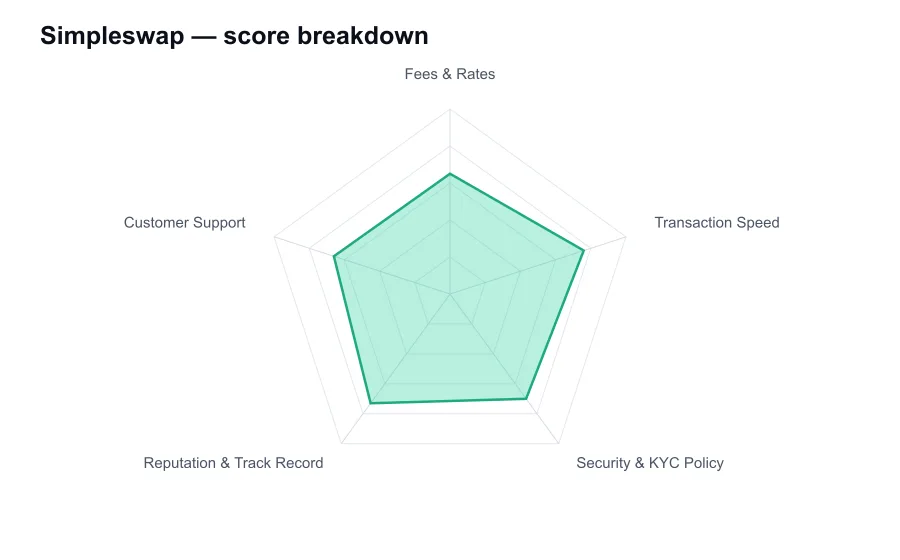
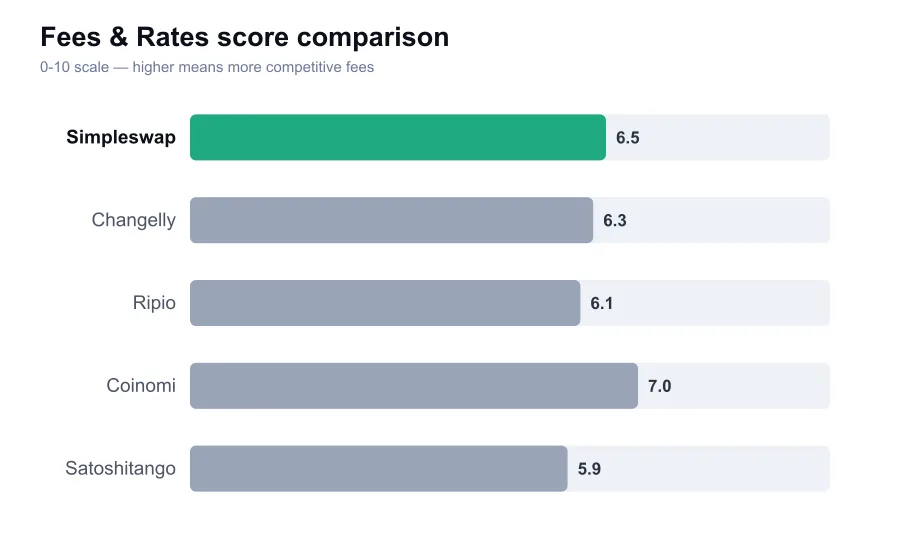
Simpleswap scores 7.0/10 overall in our independent review, measured against every other provider we've compared, strongest on Transaction Speed (7.6/10) and weakest on Fees & Rates (6.5/10).
Score: 7.0/10 How we score →| Best for | Not for |
|---|---|
| No routine account registration | Quoted rates can trail direct exchange execution |
Editorial independence: our scores and rankings are produced using the fixed criteria above and are not influenced by advertisers. This is an independent ranking site and is not operated by, or affiliated with, any provider we list.
Affiliate disclosure: some links on this page may earn us a commission at no extra cost to you. This does not affect our rankings.
Criteria Breakdown
| Criterion | Score | Notes |
|---|---|---|
| Fees & Rates | 6.5 | Convenient quotes, but direct spot trading is often cheaper |
| Transaction Speed | 7.6 | Common routes finish quickly after network confirmations |
| Security & KYC Policy | 7.0 | No routine account, but temporary counterparty risk remains |
| Reputation & Track Record | 7.3 | Established instant exchange brand with years of visibility |
| Customer Support | 6.6 | Order tracking and online help, limited recourse for errors |
SimpleSwap is one of the more recognizable instant exchange services, built for users who want to convert crypto without maintaining a traditional exchange account or studying a trading screen. It sits between a wallet feature and a full centralized exchange. You select what you are sending, select what you want to receive, provide a destination address, and the service coordinates the conversion through its own infrastructure and liquidity partners.
That simplicity is the reason people use it. A holder who has BTC in a self custody wallet and wants ETH, USDT, or a smaller altcoin can avoid opening an account at a major exchange, depositing funds, placing an order, and withdrawing again. For occasional conversions, the reduction in steps feels substantial. It is especially useful for users who care about keeping their main wallet separate from an exchange login.
SimpleSwap supports a large asset catalog and many network options. This breadth is useful, but users need to slow down at the address screen. USDT, USDC, ETH, and other familiar names can exist on multiple networks, and choosing the wrong chain is one of the easiest ways to create a costly problem. The interface cannot protect someone who sends an unsupported network version to the deposit address. Check the asset ticker and network, then check them again.
The fee question is more complicated than it first appears. SimpleSwap generally presents a final conversion quote rather than a clean universal percentage fee. Its economics are built into the offered rate, network costs, and liquidity sourcing. That is common in the instant exchange industry, but it means users cannot assume the provider with the prettiest interface is the cheapest. The effective fee is the gap between a competitive market conversion and the output amount you are actually offered.
SimpleSwap offers floating rate and fixed rate options on supported routes. Floating rates can give a better initial quote, but the received amount may change while the incoming payment waits for confirmations and the market moves. Fixed rates are more useful for people who want predictability, though they may include a premium and come with a strict deposit window. Neither option is automatically better. The right choice depends on volatility, network speed, and how accurately you can send the stated amount.
Compared with a deep spot market at Kraken, Coinbase Advanced, or Binance, SimpleSwap will often cost more for straightforward high volume pairs. That is the price of convenience and accountless access. The difference may be modest for a small swap, then become material as size increases. Before converting a significant amount, I would compare SimpleSwap with at least one rival instant exchanger and a major exchange's final withdrawal adjusted price. It takes a minute and can save real money.
Speed is solid for the category. Once the incoming transaction has the necessary confirmations and the route has available liquidity, many common swaps complete within minutes. On fast networks, the experience can feel nearly immediate. On Bitcoin, Ethereum during congestion, or routes involving multiple provider steps, it can take longer. The advertised ease should not lead users to expect the speed of an internal exchange ledger transfer.
The service's biggest practical benefit is that it is not a place where you keep a permanent trading balance. You provide a receiving wallet address, and the intended result is sent there after processing. That is safer than casually leaving funds on an exchange for months, but it is not completely noncustodial. During the conversion, you have entrusted coins to a third party process. You are also trusting it to execute correctly and send to the address you supplied.
SimpleSwap does not ordinarily demand an account or standard KYC for every transaction. That is a legitimate attraction for users who value privacy and want fewer data collection points. Still, users should read the compliance policy rather than repeat the simplistic claim that an instant exchange is always anonymous. A transaction may be paused for anti money laundering checks, sanctions screening, risk scoring, or a request for identification. No KYC at signup does not mean no KYC under any circumstances.
Security depends heavily on the user. Use a trusted wallet, verify the destination address before submitting, avoid links from ads or unsolicited messages, and save the order ID and transaction hash. Phishing copies of instant exchange websites are a persistent threat. SimpleSwap's own security is only part of the equation. If a user pastes a scammer's address as the recipient, no support team can reverse a completed blockchain payout.
Reputation is stronger than that of many obscure instant swap sites. SimpleSwap has been active for years, has a recognizable brand in the exchange aggregator ecosystem, and is regularly compared with other no account conversion services. It still should not be treated as equivalent to a highly regulated, publicly scrutinized exchange with formal customer protections. Its reputation is established enough for ordinary use, but the instant exchange model itself has less recourse than a conventional account based platform.
Support is available through online channels and the service provides transaction tracking tools, which are useful when a route takes longer than expected. The support experience is generally best for clear technical issues where the user can provide an order ID, transaction hash, amount, network, and screenshots. It is less comforting for complex compliance holds or mistaken deposits. That is not unique to SimpleSwap, but it is the point where the supposedly simple model becomes much less simple.
SimpleSwap also has fiat purchase options through third party payment partners in certain regions. These can be convenient, especially for someone who wants to go directly from a card payment to a self custody wallet. They are rarely the cheap route. Card processors, partner fees, and identity verification requirements can all apply. I see fiat purchases here as an emergency convenience feature, not the best regular buying strategy.
For modest wallet to wallet swaps, SimpleSwap is a credible option. It has more brand recognition and a more mature product than a little known instant exchange, while retaining the no account appeal that makes the category useful. Its weaknesses are not hidden secrets. Rates can be less favorable than trading directly, timing depends on blockchains, and support cannot undo a user error. Use it for what it is, not for what it is not.
My final take is positive but disciplined. SimpleSwap is a good convenience layer for self custody users who need an occasional conversion and understand the difference between a quote and a transparent exchange fee. It is not the cheapest choice for repeated large trades, and it is not a guarantee that every transaction will avoid compliance review. For the right job, it is reliable enough to recommend. For serious trading or major transfers, more direct and more transparent venues still win.
Pros and Cons
| Pros | Cons |
|---|---|
| No routine account registration | — |
| Broad crypto and network selection | — |
| Fixed and floating rate options | — |
| Useful order tracking for active swaps | — |
Suitability
Does SimpleSwap require KYC?
Most ordinary swaps do not require account registration or routine KYC. However, SimpleSwap can request verification for transactions flagged by compliance or anti money laundering controls.
What is the difference between fixed and floating rates?
A fixed rate aims to lock the output if you deposit the correct amount within the stated time. A floating rate changes with the market during processing and can deliver more or less than the initial estimate.
How long does a SimpleSwap transaction take?
Many common swaps complete within minutes after the incoming deposit is confirmed. Timing varies by blockchain, network congestion, liquidity, and whether the transaction needs manual review.
Is SimpleSwap cheaper than Binance or Kraken?
Usually not for large standard trades. SimpleSwap charges through the all in quote and convenience model, while liquid spot exchanges can offer tighter execution if you are willing to use an account.