Ripio
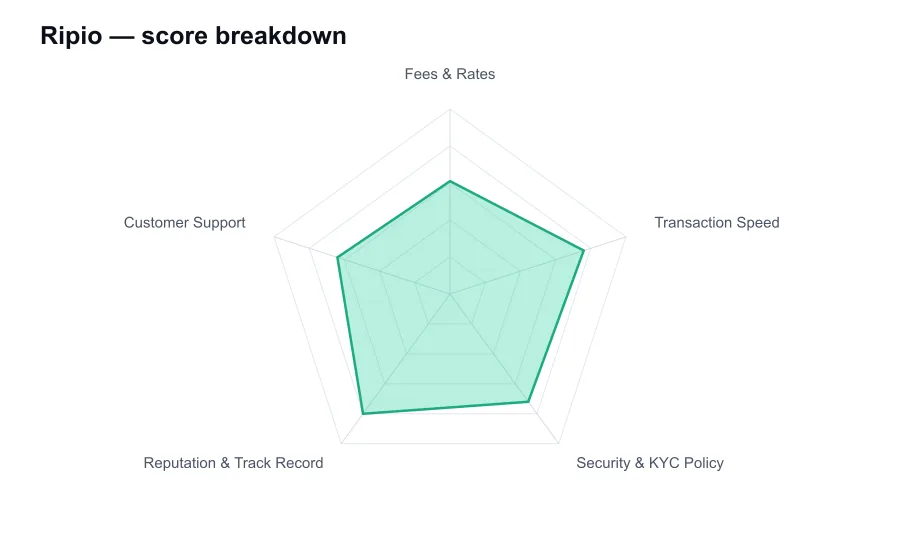
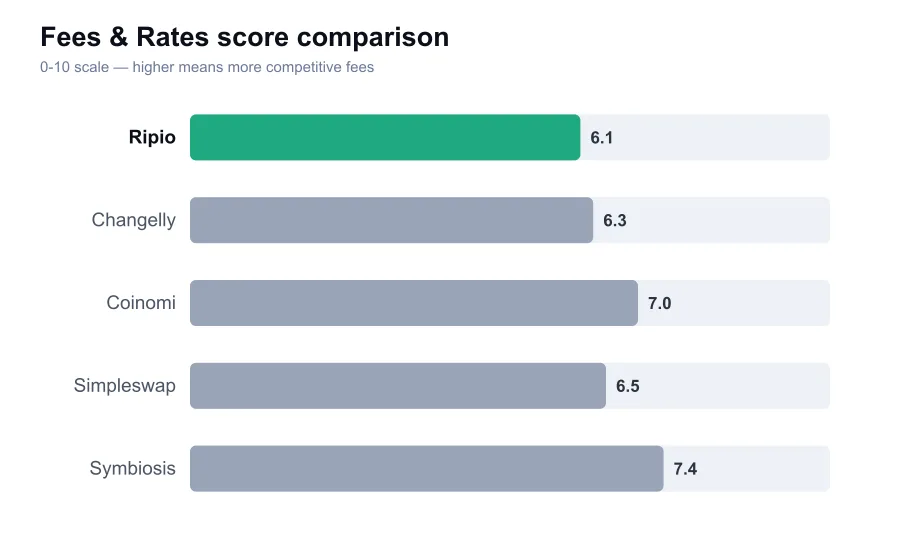
Ripio scores 7.1/10 overall in our independent review, measured against every other provider we've compared, strongest on Reputation & Track Record (8.0/10) and weakest on Fees & Rates (6.1/10).
Score: 7.1/10 How we score →| Best for | Not for |
|---|---|
| Deep experience with Latin American payment rails | Retail spreads can be less clear than exchange commissions |
Editorial independence: our scores and rankings are produced using the fixed criteria above and are not influenced by advertisers. This is an independent ranking site and is not operated by, or affiliated with, any provider we list.
Affiliate disclosure: some links on this page may earn us a commission at no extra cost to you. This does not affect our rankings.
Criteria Breakdown
| Criterion | Score | Notes |
|---|---|---|
| Fees & Rates | 6.1 | Convenient local access, but retail spreads need close comparison. |
| Transaction Speed | 7.6 | Strong local payment rails, crypto settlement remains network-dependent. |
| Security & KYC Policy | 7.2 | Established custodial platform with full KYC and normal custody exposure. |
| Reputation & Track Record | 8.0 | A long regional operating history through difficult market cycles. |
| Customer Support | 6.4 | Useful local help resources, escalation quality varies by market. |
Ripio is one of Latin America's longest-running crypto companies, founded in Argentina in 2013 during a period when buying Bitcoin locally was far more difficult than it is today. It has expanded from a regional wallet and broker into a broader fintech platform offering crypto trading, peso and real payment rails, savings-style products in some markets, and business services. Its real advantage is local relevance. Ripio understands how people in Argentina, Brazil and neighboring markets actually fund accounts and move money.
That makes it very different from a global exchange that merely translates its interface into Spanish or Portuguese. Ripio has historically focused on local bank transfers, local currencies and an app designed for everyday users, not just professional traders. In markets shaped by inflation, capital controls and volatile exchange rates, the ability to buy stablecoins or Bitcoin with familiar payment methods has practical value. This is a regional financial service first, and a crypto exchange second.
The app is approachable. New users can see balances, buy and sell supported crypto assets, make transfers and access additional products without being thrown into a dense order-book screen. That design lowers the barrier for someone who wants their first USDC or Bitcoin purchase. It can also obscure the true cost of a trade. Simplicity is valuable, but an investor should never confuse a clean purchase button with institutional-grade execution.
Ripio's fees are not as consistently transparent as the published maker and taker schedules at Kraken or Coinbase Advanced. Retail purchases and sales often use a quoted price that includes spread, and costs can vary by country, payment rail, asset and product. Some advanced or promotional offerings may advertise low or zero commission, but the spread still deserves scrutiny. Before confirming, compare Ripio's displayed output against another local provider and against the mid-market price.
For a small recurring purchase, the convenience premium may be acceptable. For a larger conversion, it can become expensive quickly. This is especially true in local-currency markets where banking friction and foreign-exchange restrictions already widen prices. Ripio should be judged against local alternatives such as Mercado Pago's crypto service, Lemon, Belo, Bitso or Mercado Bitcoin where available, rather than only against global giants. The best choice depends heavily on the country's bank rails and liquidity at that moment.
Deposit and withdrawal speed is one of Ripio's strongest practical qualities. Local transfers in Argentina and Brazil can often be credited quickly, sometimes near real time depending on the payment method, bank and compliance checks. Crypto withdrawals depend on blockchain conditions, as they do everywhere. A stablecoin sent through a low-cost supported network may arrive quickly. A Bitcoin or Ethereum transfer can take longer, particularly during congestion or a security review.
There is a meaningful distinction between local fiat speed and trading speed. A user may be able to add pesos or reais rapidly, while a crypto purchase is still priced through a broker-style quote rather than a deep, visible order book. That is fine for the platform's intended audience. It is less attractive for traders who need precise entries, advanced charting, stop orders and certainty that a large order will not move the effective price. Ripio is about access and usability, not execution sophistication.
Identity verification is central to the service. Ripio operates with financial and compliance obligations in the countries it serves, so users should expect to provide personal information, government ID and potentially extra documentation for larger activity. This is not an anonymous wallet or a no-KYC crypto ramp. The verification process is a reasonable trade-off for users who value local bank integration, but it will disappoint anyone seeking private, permissionless access to digital assets.
On security, Ripio offers the expected protections of a modern custodial app, including account verification procedures and app-based security measures. Customers should enable every available login protection, use a unique password and be wary of fake support accounts. The larger security issue is custody. Funds held in Ripio are exposed to the company's operational controls, legal environment and account-access policies. A platform wallet is convenient for spending or trading, but it is not the place I would keep long-term holdings without a compelling reason.
Ripio's longevity counts heavily in its favor. It has operated through years of Argentine inflation, multiple crypto cycles and the 2022 sector failures that wiped out many younger brands. It has raised institutional capital, expanded regionally and developed business-facing products, including Ripio Business. That does not guarantee every customer interaction will be smooth, but it creates a much more substantial track record than a newly launched exchange with anonymous operators and a polished landing page.
The regulatory landscape across Latin America remains uneven, and Ripio's services, assets and product availability vary by country. Customers should not assume that a feature advertised in Argentina is available in Brazil, Colombia, Uruguay or Spain. Rules also change quickly, particularly around stablecoin products and interest-like rewards. The right approach is to read the local terms for the exact Ripio entity serving the account, not rely on a general description found on social media.
Its reputation among regional users is solid but not spotless. Positive users usually praise the familiar local transfers, easy onboarding and ability to buy crypto without navigating foreign exchanges. Negative feedback often centers on account reviews, delayed withdrawals, changing limits or slow resolution of a particular ticket. This is the standard fault line for regulated fintechs. The more local payment access a company offers, the more it must police fraud and financial crime, and legitimate customers sometimes get caught in that machinery.
Customer support is available through digital channels and help resources, with service quality appearing to vary by country and case complexity. Basic app questions are usually well served by the knowledge base. A blocked transfer or verification issue can require persistence, screenshots and supporting documents. Ripio would benefit from clearer escalation timelines for sensitive cases, especially in markets where a user's local-currency balance may be rapidly losing purchasing power while a review is pending.
The app's broader ecosystem is its main reason to choose it. A customer who receives income in local currency, wants simple exposure to Bitcoin or stablecoins, and occasionally uses crypto for payments can keep the process in a familiar environment. Someone building a diversified long-term portfolio may prefer to buy locally through Ripio, then withdraw to self-custody. That division of labor captures Ripio's strengths without treating a convenient fintech app as a vault.
Ripio is a good regional gateway, not a universal crypto solution. It earns credit for longevity, local infrastructure and a product that meets Latin American users where they are. Its weaker points are quote-based pricing, country-by-country inconsistency and the inevitable friction of a fully identified custodial service. For newcomers in its supported markets, it is among the more credible places to start. For advanced traders and privacy-focused users, there are better specialized tools.
Pros and Cons
| Pros | Cons |
|---|---|
| Deep experience with Latin American payment rails | — |
| Long operating history since 2013 | — |
| Accessible app for first-time crypto buyers | — |
| Practical local-currency funding in supported markets | — |
Suitability
Is Ripio available outside Argentina?
Ripio has operated in multiple Latin American markets and has expanded internationally, but supported assets, payment methods and products vary by country. Check the local Ripio app and terms before opening an account.
Does Ripio require identity verification?
Yes. Ripio is a regulated-style custodial fintech service and users should expect identity verification, with possible additional documentation for larger transfers or compliance checks.
How does Ripio make money on crypto trades?
Retail transactions can include a spread in the quoted buy or sell price, and charges may vary by product and market. Review the final quote and compare local alternatives for larger trades.