Symbiosis
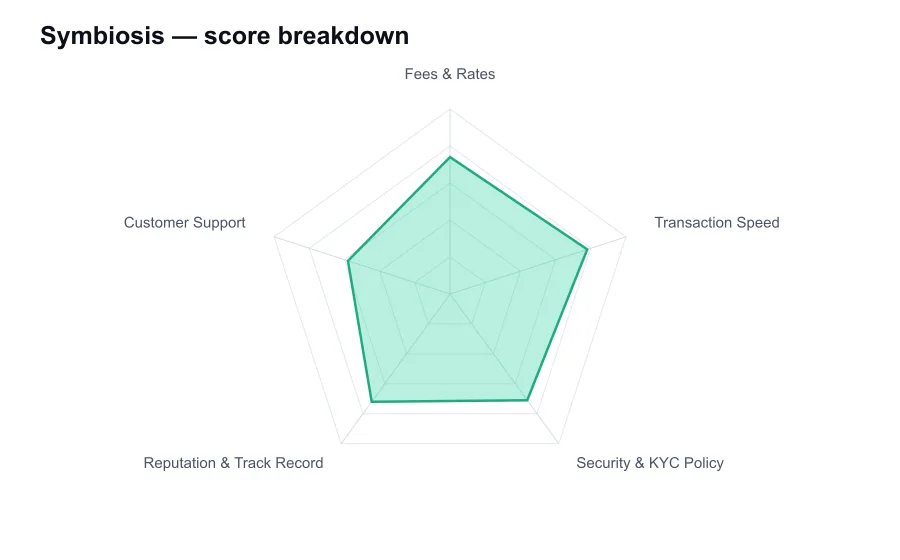
Symbiosis scores 7.2/10 overall in our independent review, measured against every other provider we've compared, strongest on Transaction Speed (7.8/10) and weakest on Customer Support (5.8/10).
Score: 7.2/10 How we score →| Best for | Not for |
|---|---|
| Single-flow swaps across multiple blockchain networks | Bridge and smart contract risk cannot be ignored |
Editorial independence: our scores and rankings are produced using the fixed criteria above and are not influenced by advertisers. This is an independent ranking site and is not operated by, or affiliated with, any provider we list.
Affiliate disclosure: some links on this page may earn us a commission at no extra cost to you. This does not affect our rankings.
Criteria Breakdown
| Criterion | Score | Notes |
|---|---|---|
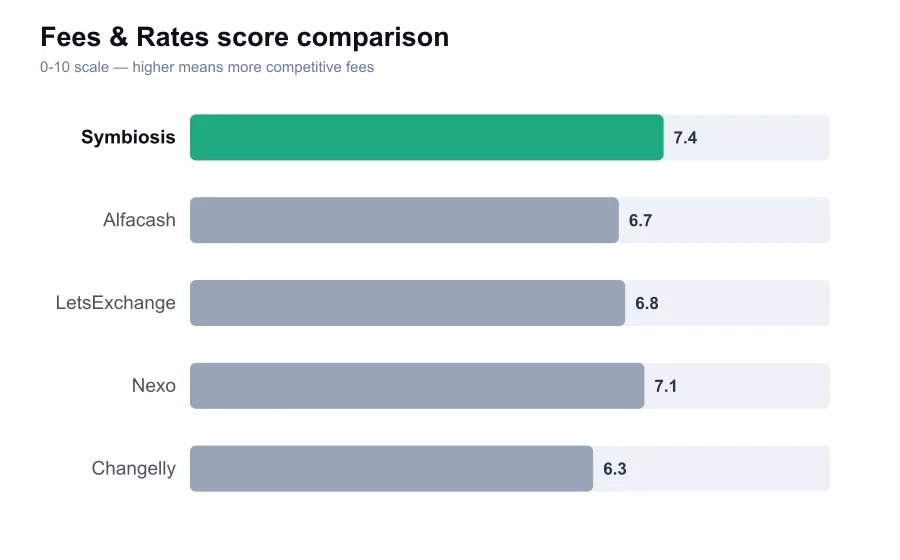
| Fees & Rates | 7.4 | Competitive routing, but gas and slippage can raise the real cost |
| Transaction Speed | 7.8 | Often settles in minutes, subject to chain and route conditions |
| Security & KYC Policy | 7.1 | Non-custodial access, but smart contract and bridge risk remain |
| Reputation & Track Record | 7.2 | Established DeFi interoperability protocol, not a mainstream exchange |
| Customer Support | 5.8 | Documentation and community help, not consumer-grade account support |
Symbiosis is not a conventional crypto exchange. It is a cross-chain liquidity protocol built to let users swap assets between networks without manually hopping through a centralized platform, bridging tokens, then finding another DEX. In practice, it sits somewhere between a bridge, a swap router, and a cross-chain execution layer. That makes it useful for DeFi-native users, but it also means the experience is more technically demanding than buying crypto through a familiar broker.
The core pitch is attractive. A user can begin with an asset on one supported chain and receive another asset on a different chain through a single interface. Symbiosis has historically focused on EVM networks and has expanded its interoperability ambitions beyond a simple Ethereum sidechain tool. The platform's value is strongest where fragmented liquidity makes manual bridging expensive, slow, or irritating. For somebody already active across Arbitrum, BNB Chain, Polygon, Optimism, Base, and similar networks, that convenience is real.
Fees are harder to judge here than on a regular exchange because there is no clean, universal percentage posted for every transaction. A Symbiosis trade can include an AMM swap fee, cross-chain protocol costs, relayer or executor compensation, and network gas on the origin and destination chains. The quote shown before confirmation matters far more than a headline fee claim. This is not the sort of service where you should assume a 0.2% looking swap fee tells the whole story.
For modest transfers, the final received amount can be competitive against doing several separate transactions yourself. It can also become poor value if liquidity is thin, the route needs multiple pools, or the destination chain is expensive. Ethereum mainnet gas is the obvious villain, but slippage is often the quieter problem. Symbiosis is best used with a clear eye on the quote, the price impact field, and the minimum amount you will receive. Blindly accepting the default route is not sophisticated DeFi use.
The protocol's routing can save a surprising amount of time. Instead of completing a bridge deposit, waiting for finality, switching networks, approving a second contract, and swapping again, a successful transaction is handled as one intended outcome. On lower-cost chains, many swaps settle in minutes. The actual pace depends on block confirmations, token liquidity, bridge mechanics, and the destination network. It is quick compared with manual multi-step bridging, not instant in the way a centralized exchange ledger transfer is instant.
There are moments where that distinction becomes painfully clear. A congested source chain, a stalled relayer, or a route with inadequate liquidity can leave a transaction pending longer than expected. Cross-chain transactions involve more moving pieces than a Uniswap swap on one chain, and users should expect occasional friction. Symbiosis generally provides transaction status information, but a status page does not make a stuck transaction less stressful when funds are between networks.
The non-custodial design is one of Symbiosis's strongest qualities. Users connect their own wallet and approve smart contract interactions rather than placing an account balance under the control of a company. There is no standard retail onboarding, no password recovery safety net, and typically no identity verification for ordinary on-chain use. Privacy-minded users will appreciate that, particularly compared with regulated centralized exchanges that collect documents before permitting withdrawals.
That same setup shifts responsibility decisively onto the user. A wallet approval is not the same thing as opening an exchange account, and sending assets to the wrong network or signing a malicious transaction cannot be fixed by a support agent. The important security questions are smart contract risk, bridge architecture, multisig and validator assumptions, external audits, and whether the connected wallet is being used safely. Symbiosis has published audit-related materials and operates as an established DeFi protocol, but an audit is evidence of work, not a guarantee against exploits.
Bridge risk deserves a blunt discussion. Cross-chain protocols have been among the most heavily targeted parts of DeFi because they handle valuable assets and rely on complex messaging or liquidity systems. Symbiosis is not uniquely unsafe, but it is exposed to the same category of technical and economic risk that has hurt better-known bridge projects in the past. I would not route a life-changing sum through any bridge simply because a website displays a favorable exchange rate. Splitting large transfers and testing the route first is sensible.
Its reputation is respectable within the interoperability niche, though it does not have the public recognition or years of uninterrupted consumer-service history of Kraken, Coinbase, or even major swap aggregators such as 1inch. Symbiosis launched during the multichain DeFi expansion and has maintained a visible protocol and community presence through a difficult period for bridges. That counts for something. Still, its reputation is technical rather than mainstream, and users should distinguish active development from the kind of institutional accountability found at a large regulated venue.
The interface is reasonably approachable for an on-chain product. It presents source and destination assets, estimated output, route information, and transaction steps without drowning the user in bridge jargon. Yet the first-time user still needs to understand gas, wallet networks, token approvals, and why an estimated return may differ from a final execution. A polished interface cannot erase blockchain complexity. Beginners who have never used a self-custody wallet may find a simple centralized exchange less intimidating.
Support is a weaker area than the trading flow. Symbiosis has documentation, transaction tracking, community channels, and channels for reporting issues, but it does not offer the kind of phone-based, regulated account support that many consumers expect. Resolution quality can depend on whether the issue is a user-side wallet mistake, an on-chain delay, or a genuine protocol problem. Community support can be knowledgeable, but it is not the same as having a named case manager who can reverse an error.
For a DeFi user, that limitation is acceptable because reversibility is not really part of the product's promise. For an ordinary buyer, it can be a deal breaker. There is no chargeback route and no customer-service button that can undo a completed blockchain transfer. Anyone using Symbiosis should save transaction hashes, check the connected site address carefully, verify the destination network, and start with an amount they can afford to troubleshoot. Those habits matter more than any marketing claim.
Symbiosis earns a place in a multichain toolkit because it removes tedious steps and usually preserves self-custody. I like it more as an execution utility than as a place to park assets or make a first crypto purchase. Its strengths are convenience, broad chain utility, and privacy-friendly access. Its weakness is the unavoidable complexity of cross-chain risk. Experienced DeFi users can get real value from it, while newcomers should learn ordinary wallet and network mechanics before relying on it for important transfers.
Pros and Cons
| Pros | Cons |
|---|---|
| Single-flow swaps across multiple blockchain networks | — |
| Non-custodial wallet-based access | — |
| No standard KYC for ordinary protocol use | — |
| Can reduce manual bridging steps | — |
Suitability
Does Symbiosis require KYC?
Ordinary wallet-based protocol use generally does not require a standard KYC account. Users still need a compatible self-custody wallet and must comply with any applicable local rules.
How long does a Symbiosis cross-chain swap take?
Many routes complete within minutes, but timing depends on confirmations, network congestion, liquidity, and destination-chain conditions. A complex route can take longer.
Why is the received amount lower than expected?
The final amount can reflect swap fees, network gas, liquidity conditions, price movement, and slippage. Read the route quote and minimum received figure before confirming.