Coinomi
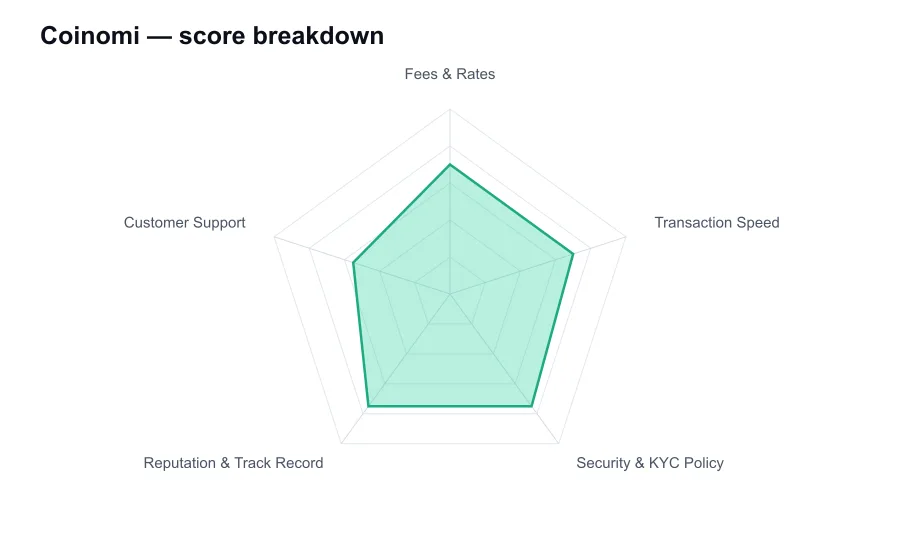
Coinomi scores 7.1/10 overall in our independent review, measured against every other provider we've compared, strongest on Security & KYC Policy (7.5/10) and weakest on Customer Support (5.5/10).
Score: 7.1/10 How we score →| Best for | Not for |
|---|---|
| Non custodial wallet with user controlled keys | Integrated swaps can have weak pricing |
Editorial independence: our scores and rankings are produced using the fixed criteria above and are not influenced by advertisers. This is an independent ranking site and is not operated by, or affiliated with, any provider we list.
Affiliate disclosure: some links on this page may earn us a commission at no extra cost to you. This does not affect our rankings.
Criteria Breakdown
| Criterion | Score | Notes |
|---|---|---|
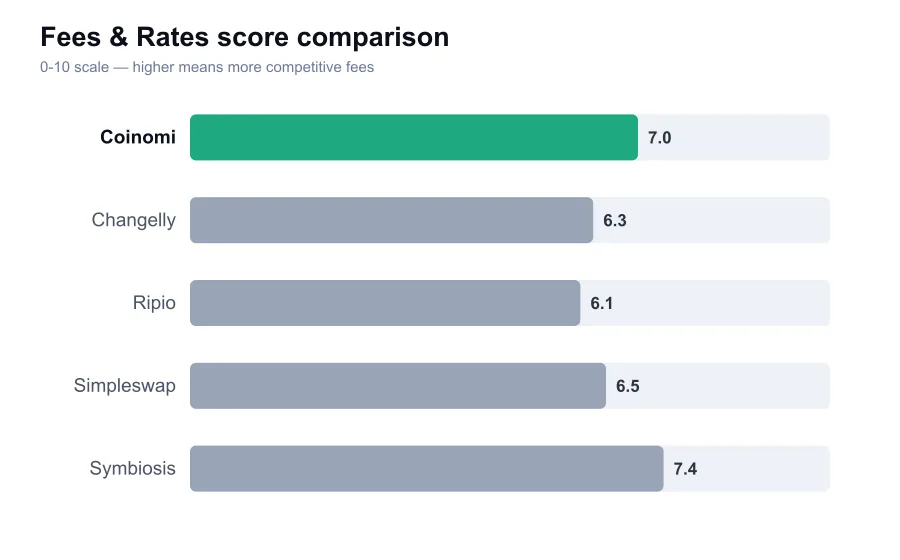
| Fees & Rates | 7.0 | Wallet is free, but partner swap spreads can be high |
| Transaction Speed | 7.0 | Broadcast is quick, settlement follows each blockchain |
| Security & KYC Policy | 7.5 | Non custodial keys, but users carry the risk |
| Reputation & Track Record | 7.5 | Multi asset wallet operating since 2014 |
| Customer Support | 5.5 | Useful documentation, limited recovery options |
Coinomi is not an exchange in the conventional sense. It is a long running non custodial cryptocurrency wallet that lets users hold a broad range of assets and access third party swap, purchase, and exchange integrations from inside the app. That distinction changes the review completely. Coinomi does not normally take custody of your seed phrase or private keys, which is a major advantage for self custody. It also means that the rates, execution quality, and identity checks attached to an in app swap may come from a partner rather than Coinomi itself.
The wallet has been around since 2014, an unusually long life in this industry. It built an audience by supporting Bitcoin, Ethereum, many major chains, and a huge assortment of tokens at a time when multi asset wallets were less common. Its interface remains approachable for a wallet with this much coverage. You can manage several accounts, view balances, receive assets, and restore access through the recovery phrase without needing to create a standard custodial exchange account.
That self custody model is Coinomi's strongest feature. The recovery phrase is generated and controlled by the user, so the user is not waiting for a company to approve a withdrawal. If Coinomi's app disappeared tomorrow, a correctly backed up phrase could generally be restored in another compatible wallet. That is a meaningful protection against exchange failures. It comes with an uncomfortable responsibility, though. Lose the phrase, expose it to a scammer, or approve a malicious transaction, and there is no support agent who can reverse the result.
Coinomi itself is free to download and does not charge a conventional custody fee. Network fees are required by blockchains, and users can often choose an appropriate fee level depending on the network. This is a better structure than a wallet that quietly adds its own withdrawal markup. It is also important not to confuse a network fee with Coinomi's revenue. On Bitcoin or Ethereum during congestion, the cost can be high because of the network, not because Coinomi has suddenly become expensive.
The more complicated fee story begins with its integrated services. Coinomi has offered access to third party exchange and swap partners, plus fiat purchase providers. These partners quote the rate, apply their own spread or fee, set minimum amounts, and may impose different KYC rules. Convenient does not mean cheap. In app swaps can be significantly more expensive than moving funds to a competitive exchange, especially for a large order or an illiquid token pair. Always compare the final amount received, not just the headline exchange rate.
For a small emergency conversion, paying for convenience may be reasonable. For a substantial Bitcoin to stablecoin trade, it can be a costly habit. External swap providers also introduce extra counterparty exposure for the duration of the transaction. You may retain control of the wallet, but the coins sent to a swap provider are no longer in your hands until the swap completes. I prefer using Coinomi as a wallet first and treating built in swaps as occasional tools rather than the centre of a trading workflow.
Transaction speed is mostly determined by the chain and the fee selected, rather than by Coinomi's servers. A Bitcoin payment needs network confirmations. An Ethereum token transfer needs gas and can become costly or delayed in a busy mempool. Coinomi can create and broadcast the transaction, but it cannot make a congested chain settle instantly. Users who understand that will find the experience sensible. Users expecting a wallet to behave like a fast internal transfer system at Binance may be disappointed.
The app supports fee control on certain networks, and that can be helpful if you know what you are doing. Set the fee too low and a transaction can sit pending for a long time. Set it unnecessarily high and you overpay. For newcomers, automatic fee suggestions are safer than guessing. For experienced users, the ability to make choices is a real benefit. Coinomi generally gives more direct blockchain exposure than broker apps, which is exactly why it needs to be used with more care.
Coinomi's security reputation is decent but not beyond criticism. It is a self custody wallet with a long operating history and it has publicly emphasized that private keys remain on the device. The project also dealt with a reported security issue in 2019 involving a spellcheck feature that could send entered recovery phrases to a third party service on affected Android configurations. Coinomi said the issue was fixed quickly. The lesson is still important, never enter a recovery phrase into an internet connected field unless restoring a wallet in a trusted, offline aware environment.
The wallet does not require standard account KYC for basic installation, generation of a wallet, receiving crypto, or normal on chain transfers. That is a genuine advantage for users who want direct control without opening an exchange account. However, the third party fiat and swap services accessible through the wallet may ask for identity documents. Coinomi cannot waive a partner's legal requirements. Anyone advertising it as a universal no KYC way to buy crypto is oversimplifying the product.
The broad asset support deserves both praise and skepticism. It is useful to keep several chains in one interface, particularly for someone managing established assets across Bitcoin, Ethereum, and selected altcoin ecosystems. But long token lists can tempt users into adding obscure assets with weak liquidity, fake contract addresses, or abandoned development. A wallet displaying a token does not validate the token's quality. Verify contract addresses from official project sources and do not assume every available integration has been deeply vetted.
Customer support is adequate for a free software wallet but cannot solve blockchain finality. Coinomi provides help documentation and support channels for app, restoration, and transaction questions. It cannot retrieve a mistaken transfer, reverse a confirmed payment, or recover a phrase you failed to save. Some users interpret that as poor support. It is actually a consequence of non custodial design. The fair criticism is that response times and partner related problems can feel frustrating when an in app exchange order is involved.
Coinomi is at its best as a versatile software wallet for people who understand seed phrase discipline and want access to many supported chains without handing their private keys to a centralized exchange. It is less attractive as a primary buying venue, high value vault, or trading terminal. For significant long term holdings, I still prefer a reputable hardware wallet. For routine trading, I prefer a liquid exchange with transparent order books and lower execution costs.
My final view is positive, with boundaries. Coinomi has survived long enough to earn more trust than an unknown wallet app, and its non custodial approach gives users control that brokers cannot match. The integrated conversion tools are handy, but they should not be mistaken for low cost exchange infrastructure. Use Coinomi to own and move crypto, back up the phrase properly, and keep large balances under stronger hardware protection. That is the sensible way to get the best from it.
Pros and Cons
| Pros | Cons |
|---|---|
| Non custodial wallet with user controlled keys | — |
| Broad multi chain and token support | — |
| No account KYC for basic wallet use | — |
| Established wallet brand since 2014 | — |
Suitability
Is Coinomi an exchange?
No. Coinomi is primarily a non custodial wallet. It can connect users to third party swap and purchase services, but those providers set their own rates, terms, and KYC rules.
Does Coinomi require KYC?
Basic wallet use does not normally require KYC. Identity verification may be required by third party services used for fiat purchases or exchanges inside the app.
Are Coinomi swaps cheap?
Not always. The wallet itself is free, but integrated providers can charge spreads or fees. Compare the final amount received with a major exchange before making a large swap.
Can Coinomi recover a lost seed phrase?
No. A recovery phrase is controlled by the user. If it is lost and no backup exists, neither Coinomi nor any other legitimate party can restore the wallet.