Nexo
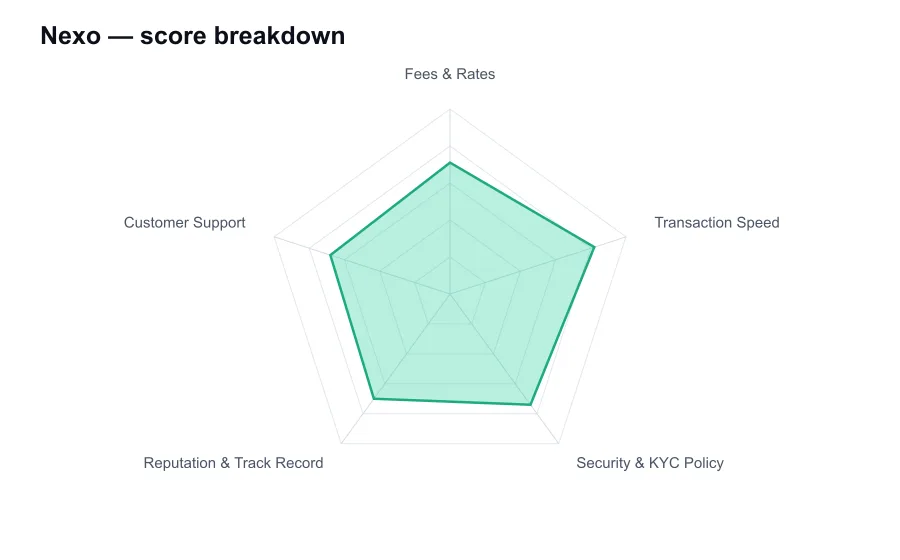
Nexo scores 7.3/10 overall in our independent review, measured against every other provider we've compared, strongest on Transaction Speed (8.2/10) and weakest on Customer Support (6.8/10).
Score: 7.3/10 How we score →| Best for | Not for |
|---|---|
| Polished app combining trading, credit and card spending | Earn products and availability vary sharply by jurisdiction |
Editorial independence: our scores and rankings are produced using the fixed criteria above and are not influenced by advertisers. This is an independent ranking site and is not operated by, or affiliated with, any provider we list.
Affiliate disclosure: some links on this page may earn us a commission at no extra cost to you. This does not affect our rankings.
Criteria Breakdown
| Criterion | Score | Notes |
|---|---|---|
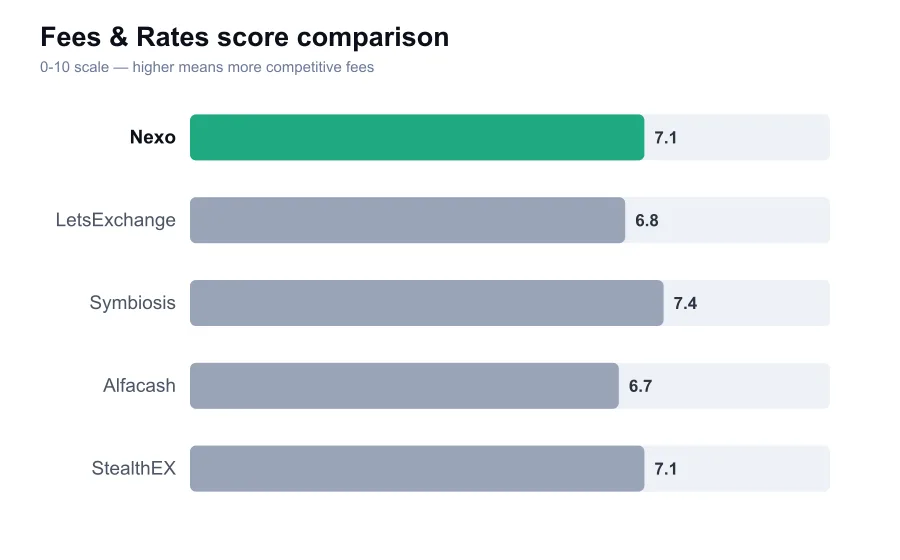
| Fees & Rates | 7.1 | Competitive loyalty pricing, but spreads can beat the headline rate. |
| Transaction Speed | 8.2 | Internal swaps are fast, external transfers follow network conditions. |
| Security & KYC Policy | 7.4 | Strong account controls, mandatory KYC and centralized custody risk. |
| Reputation & Track Record | 7.0 | Survived the lending crisis, but regulatory history weighs on it. |
| Customer Support | 6.8 | Useful chat and help center, slower during compliance reviews. |
Nexo is a crypto financial platform rather than a simple exchange. It built its name on interest-bearing accounts, crypto-backed credit lines and a polished mobile app, then added spot trading, card spending and futures. That positioning still matters. Nexo is aimed at investors who want their coins to do more than sit in cold storage, and it feels closer to a private banking app for digital assets than a high-volume trading venue.
The product is unusually mature for a company founded in 2018. Deposits, swaps, borrowing, repayment, portfolio tracking and a Mastercard-backed card are all tied together cleanly. New users can buy crypto by card or bank transfer, then use the platform without having to connect several wallets and protocols. The interface is one of Nexo's strongest assets. It is calm, clear and substantially easier to navigate than Binance or OKX for somebody who isn't trying to trade every hour.
That convenience has a price, though it is not always displayed as a line-item fee. Nexo Exchange generally builds its charge into the quoted conversion rate. Its published base exchange fee has commonly been 0.5 percent, with loyalty-tier reductions for holders of the NEXO token. A Platinum user, which requires at least 10 percent of the portfolio in NEXO, can receive a substantial discount. The spread on an instant conversion can still make the effective cost less attractive than a limit order on Kraken or Coinbase Advanced.
For occasional purchases, Nexo's pricing is acceptable. For active traders, it is not. A person swapping BTC into ETH once a month will likely value the straightforward quote and fast execution. A person rotating positions all day should compare the quote against a proper order-book exchange first. Nexo's Exchange now supports market, limit and trigger orders, which is a welcome improvement, but liquidity and fee transparency still do not rival the largest global venues.
Card purchases are a more obvious weak spot. Like most crypto apps, Nexo passes through payment-provider costs and can show noticeably worse pricing than a bank transfer purchase. Bank transfers are usually the sensible route for fiat funding, subject to local availability and bank processing times. Crypto deposits are generally credited after the required blockchain confirmations. Withdrawals depend on the network, and Nexo's loyalty program includes a limited number of free withdrawals each month for higher tiers.
Transaction speed is good within the app. An internal exchange conversion is normally completed in seconds, and collateral changes for an existing credit line are reflected quickly. External transfers are a different matter. Nexo can broadcast a withdrawal promptly, but Bitcoin, Ethereum and other public chains determine final arrival time. During congestion, users should not confuse a delayed network confirmation with a frozen Nexo transaction. The app normally gives enough status detail to tell which stage a withdrawal has reached.
The lending proposition deserves more scrutiny than the glossy interface invites. Nexo lets customers borrow stablecoins or fiat against supported crypto, with loan-to-value ratios determined by the collateral. Interest rates improve with loyalty status and lower loan-to-value. This can be useful for someone who wants liquidity without selling a long-held asset. It can also turn a routine market drop into a forced collateral problem. Crypto-backed credit is not passive income, and Nexo cannot remove liquidation risk with a friendly design.
Security controls are better than those at many smaller yield platforms. Nexo requires identity verification for normal use, supports two-factor authentication, withdrawal address whitelisting and device management, and says it uses institutional custody arrangements and insurance through third-party custodians. It also has a real-time attestation history, although users should understand that an attestation is not the same thing as a full public audit of every liability, wallet and operational control.
KYC is mandatory in practical terms. Basic registration is quick, but buying, earning, borrowing and withdrawing meaningful amounts requires personal details, government identification and sometimes proof of address or source-of-funds information. That is normal for a centralized company operating in regulated markets. It is not a service for privacy-first users. If no-KYC access is essential, Nexo is the wrong product from the start.
Nexo's regulatory record is mixed, and pretending otherwise would be irresponsible. The company settled with the US Securities and Exchange Commission and state regulators in 2023 over its Earn Interest Product, agreeing to pay $45 million and stop offering the product to US investors. It also announced a phased exit from the US market. Those events did not make Nexo disappear, but they are a reminder that yield products can change abruptly when regulators decide their legal status.
The firm has also faced restrictions or product changes in several jurisdictions as rules evolved. That is partly the cost of operating across borders, yet customers are the ones who bear the inconvenience when a feature is removed or an account needs additional checks. Nexo has outlasted several crypto lenders that failed in 2022, including Celsius, BlockFi and Voyager. Survival through that period counts for something. It does not make counterparty risk vanish.
Its reputation among ordinary users is helped by the app's reliability and broad product range. Complaints tend to concentrate on compliance reviews, changing interest terms, loyalty-token exposure and slow responses during account restrictions. Those are not trivial complaints. The best experience goes to a customer whose documents are already clean and whose activity looks ordinary. A large transfer from a new wallet can quite reasonably trigger questions, but the wait can feel punishing if funds are needed urgently.
Support is available through in-app chat and a detailed help center, with priority service associated with higher loyalty tiers. Routine questions are often answered quickly. Complex verification or compliance cases can take days and sometimes produce templated replies before a human case owner takes charge. That pattern is common across centralized crypto firms, but it matters more at Nexo because clients may have collateralized loans or interest-bearing balances inside the account.
NEXO token incentives are another trade-off. Holding the token can improve exchange pricing, withdrawal allowances, borrowing rates and rewards. The benefits are real, but users should not buy a volatile platform token solely to save a modest fee. If NEXO falls while the rest of a portfolio falls too, the loyalty allocation can worsen concentration precisely when flexibility is most valuable. I prefer to treat Platinum as a bonus for existing believers, not an entry requirement.
Nexo is compelling for a verified long-term holder who wants a single, polished place to manage a moderate crypto portfolio, earn where eligible and access collateralized liquidity. It is less convincing for a day trader, a privacy-focused user or anyone unwilling to accept platform and regulatory risk. The company has stronger operational depth than many crypto lenders, but its history shows why yield should never be mistaken for a bank deposit. Use the tools selectively, keep large long-term holdings self-custodied, and do not let the elegant app make leverage look harmless.
Pros and Cons
| Pros | Cons |
|---|---|
| Polished app combining trading, credit and card spending | — |
| Fast internal swaps and broad asset support | — |
| Loyalty tiers can reduce exchange and borrowing costs | — |
| Better longevity than many failed crypto lenders | — |
Suitability
Does Nexo charge a fee for crypto swaps?
Nexo commonly quotes an exchange fee built into the conversion price, with discounts tied to loyalty tiers. Check the final quote before confirming, because the effective spread can differ by asset and market conditions.
Is KYC required at Nexo?
Yes. Meaningful use of the platform requires identity verification, and Nexo may request additional address or source-of-funds documents for compliance purposes.
How quickly do Nexo withdrawals arrive?
Nexo can process the request quickly, but arrival depends on the chosen blockchain, fee conditions and confirmation requirements. Bitcoin and Ethereum transfers can slow during network congestion.