LetsExchange
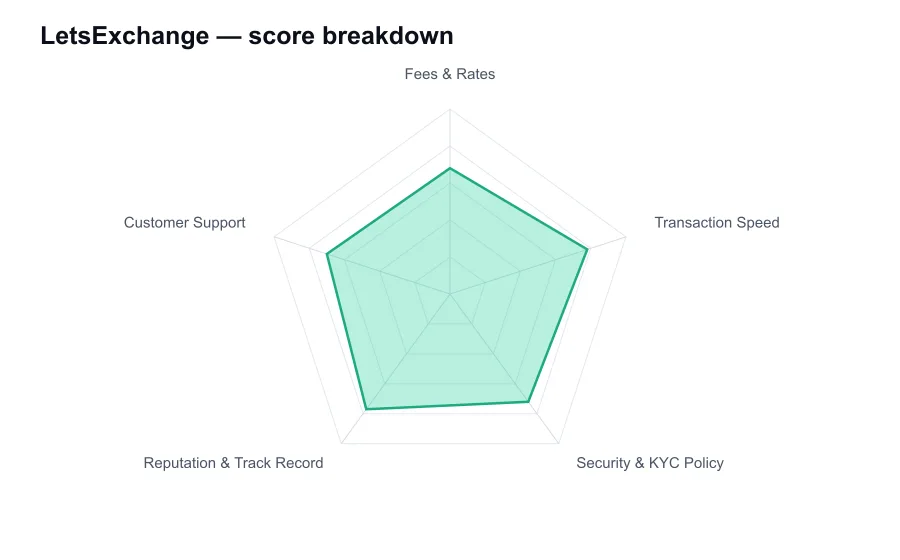
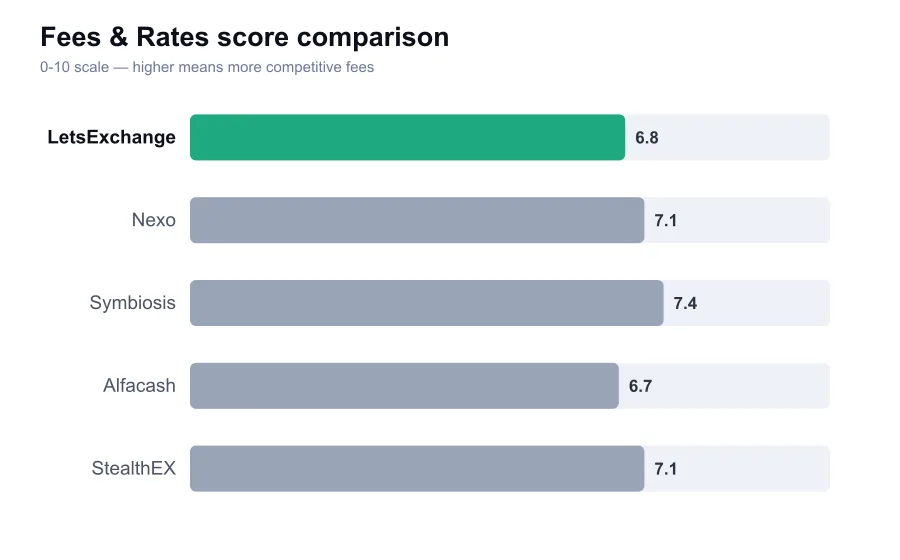
LetsExchange scores 7.3/10 overall in our independent review, measured against every other provider we've compared, strongest on Transaction Speed (7.8/10) and weakest on Fees & Rates (6.8/10).
Score: 7.3/10 How we score →| Best for | Not for |
|---|---|
| Very broad asset and network coverage | Final cost depends on route-specific spread |
Editorial independence: our scores and rankings are produced using the fixed criteria above and are not influenced by advertisers. This is an independent ranking site and is not operated by, or affiliated with, any provider we list.
Affiliate disclosure: some links on this page may earn us a commission at no extra cost to you. This does not affect our rankings.
Criteria Breakdown
| Criterion | Score | Notes |
|---|---|---|
| Fees & Rates | 6.8 | Competitive routes exist, but spread is quote-dependent. |
| Transaction Speed | 7.8 | Quick routing after deposits confirm on-chain. |
| Security & KYC Policy | 7.2 | Noncustodial flow with AML checks on flagged orders. |
| Reputation & Track Record | 7.7 | A visible, established name in instant exchanges. |
| Customer Support | 7.0 | Accessible support, but partner delays can limit fixes. |
LetsExchange is one of the better known exchange aggregators in the instant-swap market. It is not a conventional order-book exchange where you park funds and trade against other users. Instead, it connects users to liquidity providers and exchange partners, then presents a route for converting one cryptocurrency into another. That puts it closer to ChangeNOW and SwapSpace than to Coinbase or Kraken, although its asset catalog is usually much broader than a typical retail exchange.
The main reason people use LetsExchange is range. It supports a large selection of coins and tokens, including assets that aren't available on every regulated centralized platform. That breadth is genuinely useful if you hold a niche token in a private wallet. It also creates a problem that experienced users understand well. A listed asset is not necessarily a deeply liquid asset, and a supported route is not automatically a cheap or fast route.
The exchange screen is uncomplicated. Select a pair, enter the receive address, choose a floating or fixed rate where available, and send the deposit. It is an easy process for someone comfortable with wallets. New users should pay special attention to memo tags, destination tags, and network selections. LetsExchange can process a swap correctly while a user still loses funds by supplying an incompatible receiving address or omitting a required tag.
Pricing deserves careful scrutiny. LetsExchange does not operate with the clean maker and taker fee table that makes a spot exchange easy to evaluate. The quoted outcome includes partner liquidity, exchange spread, and network costs. Its floating-rate offers can be competitive, particularly on liquid routes, but that is a transaction-specific fact rather than a permanent advantage. The only honest way to assess the fee is to compare the exact final amount with alternatives at the same moment.
Fixed-rate swaps are useful if you need certainty during a sharp move. LetsExchange locks a quoted rate for a limited period and asks you to send the exact required amount promptly. That protection normally comes at a cost, either through a less favorable quote or a tighter timing condition. I prefer fixed quotes for a transfer with a specific destination obligation. For a casual conversion in a calm market, a floating rate may offer better value.
The service advertises no hidden fees, which should be interpreted sensibly. It means you see the amount expected before sending, not that the embedded spread is zero. This distinction is important. A platform can be transparent about the final receive amount and still charge more than an order-book exchange. LetsExchange is transparent enough for a consumer exchange flow, but it is not the place to expect institutional-grade price discovery.
Execution speed is solid on ordinary routes. After the deposit receives the necessary confirmations, the platform can route and release the outgoing asset quickly. Fast chains such as Tron, Solana, or Polygon can make the experience feel nearly immediate. Bitcoin, Ethereum at periods of congestion, and cross-network routes involving several operational steps will naturally take longer. A user who needs a hard deadline should avoid sending with a minimal network fee.
LetsExchange has a stronger public presence than many small instant exchangers. It has operated for years, built partnerships, and appears widely in crypto comparison content and user-review channels. That does not make every complaint invalid, and instant-swap businesses attract complaints whenever a volatile market changes a floating quote. Still, it is a more established name than a newly launched anonymous swap site with no visible history.
The KYC posture is one of its biggest selling points, but it needs a footnote in bold. LetsExchange generally lets users initiate swaps without creating an account or completing routine identity verification. It also states that transactions can be subject to AML procedures and that additional information may be requested. This is standard across the sector. If a transfer is flagged, an exchange can be paused while the user supplies documents, even if the service was marketed as registration-free.
That conditional compliance model is less intrusive than a fully verified exchange account, but it is not ideal for users who cannot tolerate a delay. If you are moving funds to meet a time-sensitive payment, a compliance hold is a serious operational risk. It is also why I would never send an entire portfolio through any instant exchanger in one transaction. Break up activity where sensible, retain proof of source of funds, and test the route first.
Security is helped by the platform's noncustodial transaction design. LetsExchange does not ask customers to keep a standing trading balance on the site. You deposit for a specific conversion and receive funds at your own wallet. Yet the service still handles assets mid-swap, so domain security is essential. Bookmark the official site, verify the TLS connection, and do not use sponsored search links or unsolicited support contacts.
Customer support is available through live chat and email channels, and the transaction ID is the key piece of information to preserve. Support can be helpful with a delayed order, an underpaid deposit, or a network confirmation issue. It cannot rescue a transaction sent to the wrong chain, and it may have limited discretion once a liquidity partner or compliance process is involved. That is the frustrating reality of an aggregator model.
LetsExchange has also put effort into API and partner integrations, which helps explain why it is visible inside third-party wallets and services. For regular consumers, that matters less than the quote and successful delivery. For developers and businesses, though, the breadth of routes and integration options are meaningful strengths. A business should still perform its own compliance, liquidity, and support testing before making an aggregator part of a customer-facing payment flow.
I like LetsExchange more than the average instant-swap site because it has real market presence, broad coverage, and a usable product rather than just glossy claims. I don't like the idea of treating it as the default venue for expensive, frequent trading. Its best role is as a flexible bridge between wallet assets, especially when a coin is unavailable at your usual exchange. Compare outputs, understand the KYC exception, and it can be a very handy tool.
Pros and Cons
| Pros | Cons |
|---|---|
| Very broad asset and network coverage | — |
| No routine account registration | — |
| Fixed and floating rate choices | — |
| Useful API and partner integrations | — |
Suitability
Does LetsExchange require account verification?
Most swaps can be initiated without creating an account. LetsExchange can request KYC or source-of-funds information if an order triggers AML or risk controls.
What is the difference between fixed and floating rates?
A fixed rate aims to preserve the quoted outcome for a short payment window. A floating rate follows market movement during processing and may result in more or less received.
How can I find the real LetsExchange cost?
Use the final receive amount, not a headline percentage. Compare the same pair, amount, and network against another instant exchanger and a liquid spot-market reference.