Tiendacrypto
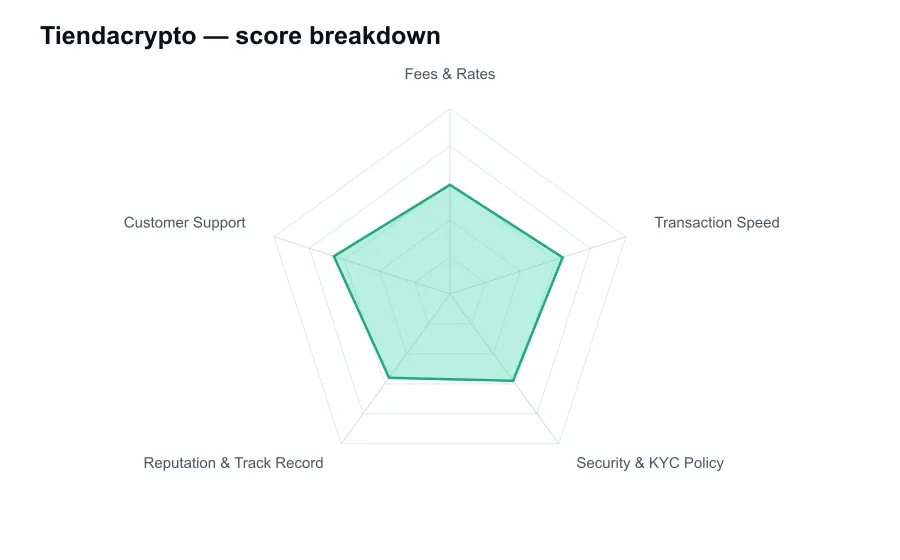
Tiendacrypto scores 6.0/10 overall in our independent review, measured against every other provider we've compared, strongest on Customer Support (6.6/10) and weakest on Reputation & Track Record (5.6/10).
Score: 6.0/10 How we score →| Best for | Not for |
|---|---|
| Accessible retail-focused crypto buying flow | Quoted spreads may exceed major exchange pricing |
Editorial independence: our scores and rankings are produced using the fixed criteria above and are not influenced by advertisers. This is an independent ranking site and is not operated by, or affiliated with, any provider we list.
Affiliate disclosure: some links on this page may earn us a commission at no extra cost to you. This does not affect our rankings.
Criteria Breakdown
| Criterion | Score | Notes |
|---|---|---|
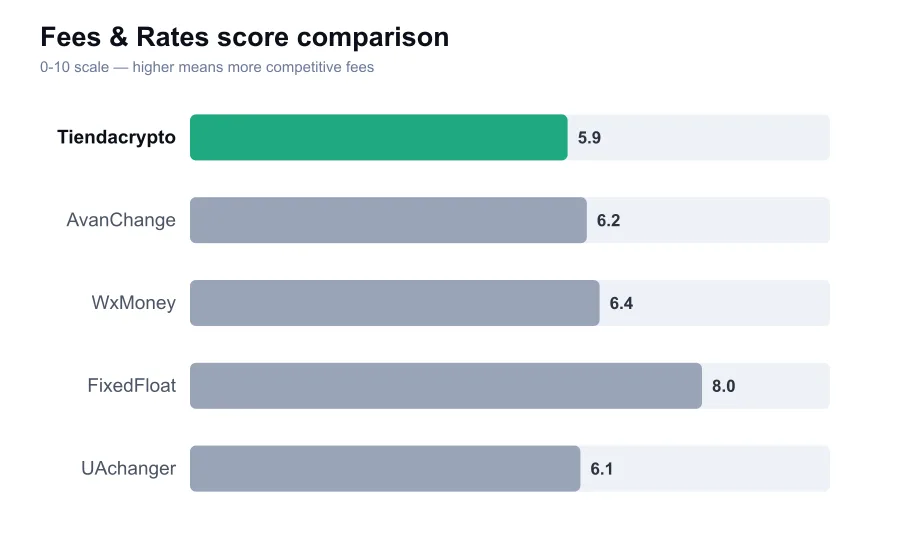
| Fees & Rates | 5.9 | Convenient retail quotes, but spread comparison is essential |
| Transaction Speed | 6.4 | Fast after setup, with fiat and verification delays possible |
| Security & KYC Policy | 5.8 | KYC-based service, but limited public custody transparency |
| Reputation & Track Record | 5.6 | Useful regional presence, with a smaller public track record |
| Customer Support | 6.6 | Local-language support is a practical advantage for retail users |
Tiendacrypto is a Latin American oriented crypto service that aims to make buying, selling, and exchanging digital assets feel more accessible than using an international trading platform. Its appeal is not a massive derivatives market or a sophisticated order book. It is the practical bridge between local payment habits and crypto, especially for people who want a simpler route into Bitcoin, stablecoins, or a limited group of mainstream coins. That narrower role defines both its usefulness and its limitations.
The first thing to understand is that Tiendacrypto should not be judged as if it were Binance or Kraken. It is closer to a retail purchase desk than a global liquidity venue. That can be a strength for users who care about local language support and familiar payment rails. It becomes a weakness for active traders who expect deep markets, advanced orders, margin products, and institutional-grade reporting. The service is designed for access and convenience, not for squeezing every basis point from a trade.
Pricing needs careful attention. Retail crypto providers commonly build part of their compensation into the buy and sell quote rather than showing a clean maker and taker schedule. Tiendacrypto's practical cost is therefore the price displayed against a broad market reference, plus any payment-method or network withdrawal costs. This is not automatically dishonest, but it does make comparison shopping essential. A simple checkout is only cheap if the quoted final amount holds up against alternatives.
For a small purchase, the spread may be an acceptable trade-off for convenience. For larger conversions, it can become expensive quickly. Someone moving a few hundred dollars into USDT may reasonably value a local payment option and an uncomplicated workflow. Someone converting several thousand dollars should compare the quoted rate with a major exchange, a local competitor, and the live market price before clicking buy. The difference is often more meaningful than the service fee language on a website.
Tiendacrypto's speed depends far more on the payment rail and compliance review than on blockchain technology. A crypto-to-crypto exchange can be quick once funds are available. Fiat-linked purchases can take longer if a bank transfer is pending, a payment processor needs confirmation, or the account is awaiting verification. Claims of fast buying are fair only after the account and payment method are ready. New users should not assume their first transaction will be immediate.
Withdrawals bring another layer of timing. Crypto transfers leave the platform only after internal processing and then depend on the selected network's confirmations. A Bitcoin withdrawal is not comparable with a transfer on a low-fee network, and users should not confuse a platform marking a withdrawal as sent with final receipt at the destination. The right habit is to check the withdrawal network, fee, minimum amount, and destination address before submission. Those details matter more than a generic promise of rapid service.
Identity verification is a central part of the product rather than an optional inconvenience. A fiat-facing provider operating in Latin American markets has anti-money-laundering obligations, so account verification and transaction monitoring are expected. That makes Tiendacrypto a poor fit for users whose priority is no-KYC swapping. It can be a positive for buyers who prefer dealing with a service that has a visible compliance process instead of an anonymous counterparty, but verification can add delay and frustration.
Security is difficult to evaluate from the outside because smaller regional providers rarely disclose the same depth of custody architecture, proof of reserves, insurance detail, or audit information that major global exchanges now face pressure to publish. Tiendacrypto may use standard account protections and operational controls, but customers should not invent assurances that have not been publicly demonstrated. Use a unique password, enable every available second factor, and withdraw long-term holdings to a personal wallet rather than treating any retail platform as a vault.
The company also carries ordinary centralized custody risk. If the provider controls the private keys before withdrawal, a customer is relying on its treasury management, internal controls, banking relationships, and ability to handle a crisis. That is true even if the interface looks polished and the purchase succeeds in seconds. For short-term conversion, this may be perfectly reasonable. For a long-term Bitcoin position, it is a poor reason to avoid learning basic self-custody.
Reputation is where Tiendacrypto has less margin for error than the giants. A local service can build loyalty through responsive support and familiar payment methods, but it does not have the global operating history, regulatory footprint, or publicly visible liquidity of Coinbase, Bitso, Mercado Bitcoin, or Kraken. That does not make it suspect. It does mean users should do a little more homework, including checking current local reviews, legal entity details, withdrawal reports, and the platform's communication quality during busy periods.
I would be particularly cautious about relying on promotional social posts as evidence of trustworthiness. Look for clear terms, supported countries, fee disclosures, withdrawal rules, and a realistic explanation of how support can be reached. A provider earns confidence slowly by processing deposits and withdrawals consistently, not by publishing attractive exchange-rate graphics. Tiendacrypto's smaller profile means its customer experience can matter more than its branding. One unresolved withdrawal complaint carries more weight at a niche operator than at a huge exchange with millions of users.
Customer support is likely one of the reasons somebody would pick a regional provider in the first place. Spanish-language help and a support team familiar with local bank processes can beat a global exchange's generic ticket response. Still, users should expect digital support channels rather than a full-service banking experience. Response quality can vary, particularly during verification queues or volatile market conditions, precisely when people are most anxious to receive an answer.
The product is most defensible as a gateway. Buy an asset, make a straightforward conversion, or cash out through a locally relevant method, then decide whether the funds belong in a personal wallet or a more feature-rich exchange. It is much less persuasive as a home for high-frequency trading, complex portfolio management, or very large balances. The lack of a broad, transparent institutional footprint limits the confidence I would place in it for those jobs.
My view is measured but clear. Tiendacrypto can solve a real local access problem and may be convenient for users who value Spanish-language service and familiar payment methods more than professional trading tools. It should not be selected on convenience alone. Compare the live quote, understand the KYC process before sending money, and test the withdrawal route with a small amount. For routine retail purchases it can be practical, but serious traders and long-term holders have better specialized options.
Pros and Cons
| Pros | Cons |
|---|---|
| Accessible retail-focused crypto buying flow | — |
| Local payment and Spanish-language orientation | — |
| Suitable for straightforward conversions | — |
| Compliance process may reassure fiat users | — |
Suitability
Does Tiendacrypto require identity verification?
Users should expect identity checks for fiat-related activity and account compliance. Requirements can depend on country, payment method, and transaction size.
How can I tell whether Tiendacrypto's price is competitive?
Compare the final amount of crypto received, or fiat received on sale, against a live market price and at least one alternative provider. Include payment and withdrawal charges.
Should I leave crypto on Tiendacrypto long term?
For long-term holdings, self-custody is usually the safer approach if you can manage private keys responsibly. Keep only funds needed for near-term transactions on a centralized service.