1inch
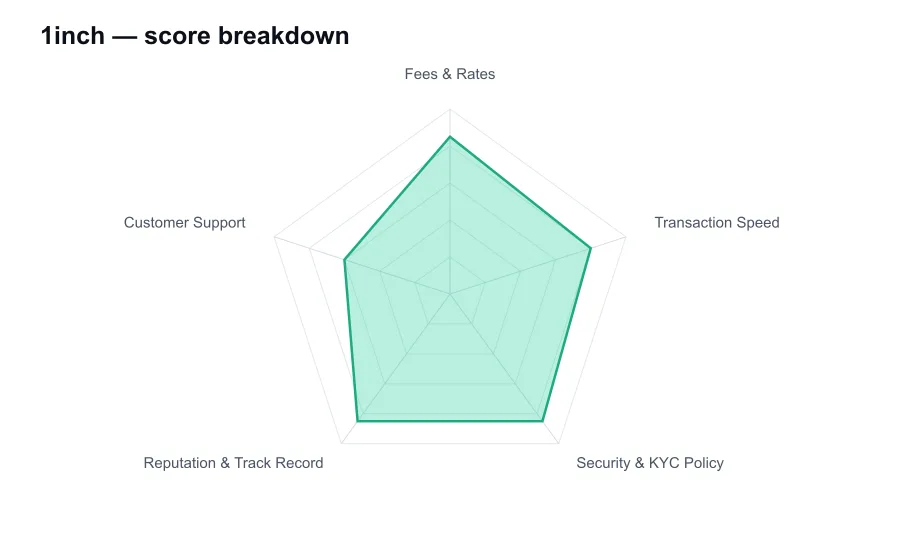
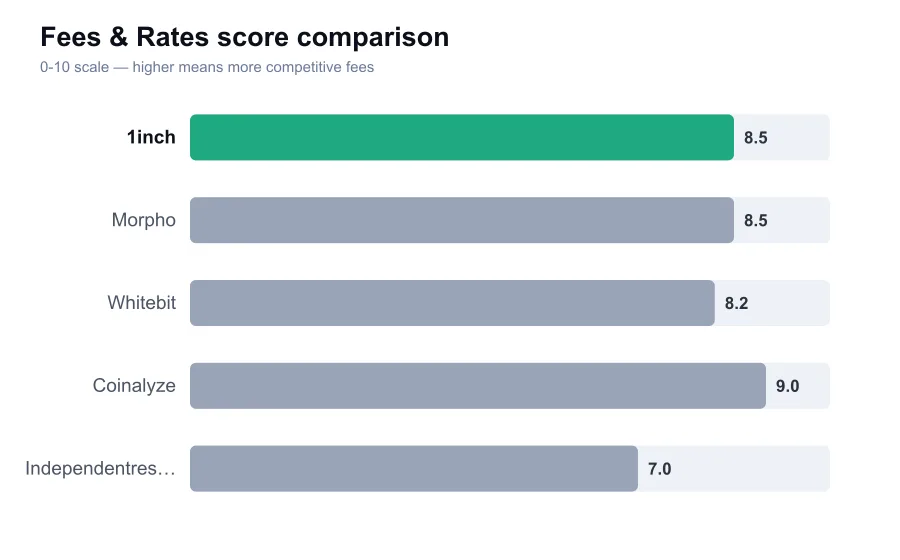
1inch scores 8.2/10 overall in our independent review, measured against every other provider we've compared, strongest on Fees & Rates (8.5/10) and weakest on Customer Support (6.0/10).
Score: 8.2/10 How we score →| Best for | Not for |
|---|---|
| Noncustodial wallet-to-wallet swaps | Ethereum gas can make small swaps uneconomic |
Editorial independence: our scores and rankings are produced using the fixed criteria above and are not influenced by advertisers. This is an independent ranking site and is not operated by, or affiliated with, any provider we list.
Affiliate disclosure: some links on this page may earn us a commission at no extra cost to you. This does not affect our rankings.
Criteria Breakdown
| Criterion | Score | Notes |
|---|---|---|
| Fees & Rates | 8.5 | Strong routing, but gas can dominate small trades |
| Transaction Speed | 8.0 | Settlement follows the selected blockchain |
| Security & KYC Policy | 8.5 | Noncustodial design with mature security tooling |
| Reputation & Track Record | 8.5 | Established DeFi brand since 2019 |
| Customer Support | 6.0 | Good resources, no reversal desk for on-chain errors |
1inch is not a conventional crypto exchange in the Coinbase or Kraken sense. It is primarily a decentralized finance aggregation ecosystem that searches liquidity across decentralized exchanges and routes a trade through smart contracts. That distinction matters. You do not deposit money with 1inch and wait for its trading desk to process an order. You connect a self-custodial wallet, approve a transaction, and trade directly on a supported blockchain.
That model has made 1inch one of the best-known names in decentralized swapping. Founded in 2019, it grew by solving a real problem: swapping through a single automated market maker can produce poor pricing, especially for larger orders. Its Pathfinder routing can split a trade across sources and paths in pursuit of a better net result. For active DeFi users, that is more useful than a simple token-swap widget.
Fees need a careful explanation because people often ask whether 1inch charges a percentage. In many ordinary swap flows, 1inch's interface does not add a standard platform fee to every user trade. The effective cost instead includes liquidity-provider fees from the underlying venues, price impact, gas, and sometimes a route-specific integrator or protocol charge. The only honest way to judge cost is by the final minimum received, not by hunting for one headline fee.
On Ethereum mainnet, gas can overwhelm any routing advantage for a modest swap. A user exchanging $50 of tokens during congestion may pay more in network fees than they save through better execution. 1inch becomes more compelling for larger swaps or on lower-cost networks where gas is modest. Supported networks and available routes change over time, so users should check the live interface rather than relying on an old list.
The interface generally does a good job of exposing the practical ingredients of a trade. It shows the route, estimated gas, minimum received, and price impact. That is better than the opaque quote model used by many instant exchangers. Still, users must read the confirmation screen. A low quoted price impact does not guarantee a good outcome if the token has a transfer tax, thin liquidity, or unusual smart-contract behavior.
Speed is mostly the speed of the chain you choose. On a fast layer 2 or sidechain, an ordinary swap may complete within seconds or a few minutes after wallet confirmation. On Ethereum, it can sit pending if the selected gas fee is too low, then settle only after block inclusion. 1inch cannot make a blockchain final faster than the network permits, but it removes the separate operator-processing delay found at custodial swap services.
Fusion is one of 1inch's more interesting ideas. Rather than making every user swap a conventional on-chain transaction, Fusion uses signed intents that resolvers can fill, with settlement mechanics designed to reduce the user's gas burden in supported cases. It can be attractive for users who dislike paying gas directly. It isn't magic, though. The cost and execution conditions are still reflected in the quote, and availability depends on the asset pair and network.
Security is a relative strength, with an important caveat. 1inch is noncustodial, so it does not normally hold a user's assets the way a centralized exchange does. That sharply reduces the risk of an exchange insolvency locking up a wallet balance. But DeFi replaces that risk with others: wallet-drainer phishing, bad token approvals, malicious token contracts, transaction-signing mistakes, and smart-contract risk.
The 1inch ecosystem has invested in security tooling and has a meaningful history of audits and bug-bounty activity. Its hardware wallet integration and approval-management features are useful practical defenses. I particularly like the fact that users can review and revoke token allowances instead of forgetting about unlimited approvals indefinitely. Yet no audit makes a complex DeFi stack risk-free, and users should only interact through the official domain or a verified wallet link.
KYC is not ordinarily required for a wallet-to-wallet decentralized swap through the protocol interface. That is a major attraction for users who value self-custody and privacy. The boundary becomes less clean when a person uses a third-party fiat on-ramp, card purchase service, or other integrated partner. Those providers can request identification under their own compliance rules, and that is outside the normal decentralized swap flow.
1inch's reputation is strong within DeFi, though it has also had the ordinary growing pains of a major protocol. Its longevity, broad name recognition, public development, and continued product expansion place it in a very different category from anonymous instant exchangers. It is not a bank, and it is not a regulated brokerage. But its public profile gives users more material to assess than a small operation with little visible history.
Support is the area where newcomers can feel less comfortable. There is documentation, community support, social channels, and help resources, but there is no traditional exchange support desk that can reverse a completed on-chain trade. That limitation is inherent to self-custody. If you approve a bad transaction or send funds to the wrong address, a support representative cannot simply retrieve them.
For a normal ERC-20 swap, I find 1inch excellent for users who understand wallets, gas, slippage, and token approvals. It is often more sophisticated than a simple swap service and can produce strong execution, particularly where route competition matters. It is not ideal for someone who wants customer service to hold their hand, deposit dollars by bank transfer, and fix a mistaken transaction.
The best way to use 1inch is with discipline. Verify the token contract, start with a small amount if a token is unfamiliar, set sensible slippage, and do not sign prompts you don't understand. Hardware-wallet users should inspect the transaction details there too. A clean-looking web page can still be a phishing clone, and a legitimate aggregator can still route an economically bad trade if the market itself is illiquid.
1inch earns its strong standing because it offers real execution technology, not just a glossy interface. Fees are transparent in outcome even if they are not reducible to one simple percentage, and self-custody is a genuine advantage. The trade-off is responsibility. For capable DeFi users, that is a fair bargain. For everyone else, a regulated centralized exchange may feel safer because the operational burden is lower.
Pros and Cons
| Pros | Cons |
|---|---|
| Noncustodial wallet-to-wallet swaps | — |
| Smart routing across decentralized liquidity | — |
| Detailed route, gas, and slippage information | — |
| Fusion can reduce direct gas friction | — |
| Useful approval-management tooling | — |
Suitability
Does 1inch charge a trading fee?
There is no single universal 1inch swap fee. Your effective cost includes underlying liquidity fees, gas, price impact, and any route-specific charges shown in the live quote.
Does 1inch require KYC?
A standard decentralized wallet swap generally does not require account KYC. Fiat on-ramps and other third-party partner services can apply their own identity checks.
Why did my 1inch swap cost more than expected?
Gas, price impact, liquidity-provider fees, slippage settings, and token transfer taxes can affect results. Review the minimum received and estimated gas before confirming.
Can 1inch recover a transaction sent to the wrong address?
No. Blockchain transfers and signed swaps are generally irreversible. Check wallet addresses, token contracts, and transaction prompts before approving.