Whitebit
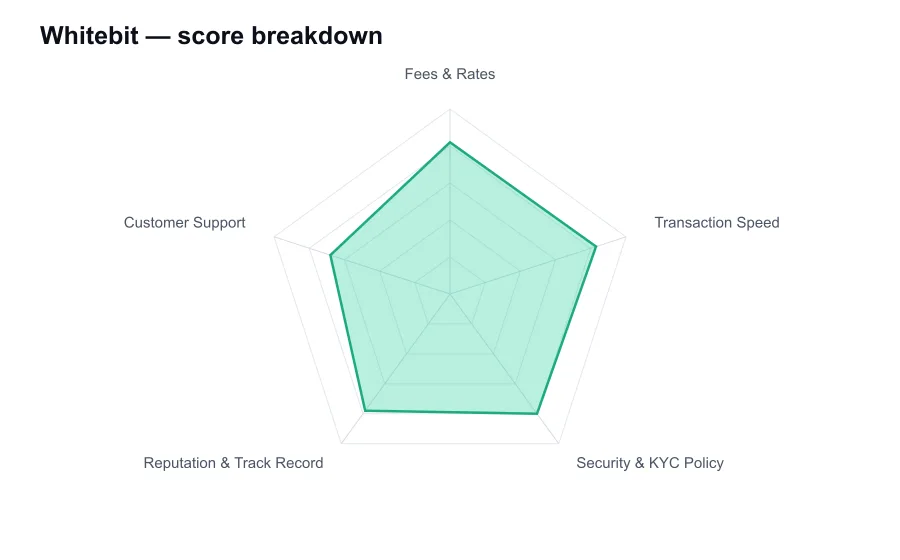
Whitebit scores 8.0/10 overall in our independent review, measured against every other provider we've compared, strongest on Transaction Speed (8.3/10) and weakest on Customer Support (6.8/10).
Score: 8.0/10 How we score →| Best for | Not for |
|---|---|
| Competitive spot fees around the published 0.1% level | KYC is integral to full platform access |
Editorial independence: our scores and rankings are produced using the fixed criteria above and are not influenced by advertisers. This is an independent ranking site and is not operated by, or affiliated with, any provider we list.
Affiliate disclosure: some links on this page may earn us a commission at no extra cost to you. This does not affect our rankings.
Criteria Breakdown
| Criterion | Score | Notes |
|---|---|---|
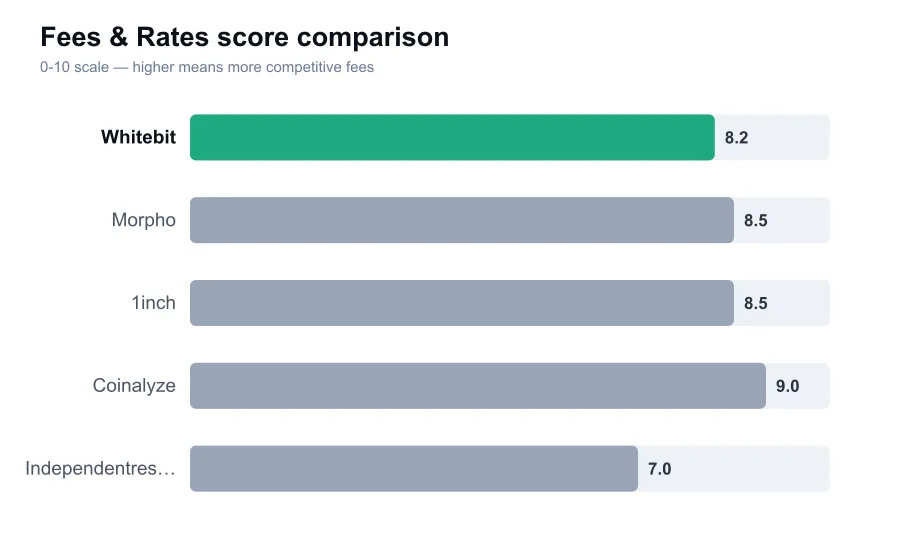
| Fees & Rates | 8.2 | Spot fees commonly reach 0.1%, with transparent trading costs. |
| Transaction Speed | 8.3 | Liquid order books execute quickly, network withdrawals vary. |
| Security & KYC Policy | 8.0 | 2FA, custody controls and KYC are strong, but custody is centralized. |
| Reputation & Track Record | 7.8 | Established regional major with years of visible operation. |
| Customer Support | 6.8 | Capable for routine issues, slower during compliance cases. |
WhiteBIT is a centralized cryptocurrency exchange with roots in Ukraine and a much broader ambition than the local exchange bureau model. It offers spot trading, margin related products in some jurisdictions, earn products, launchpad activity, card and fiat features, and a polished interface for both beginners and active traders. It is one of the better known Eastern European exchange brands, and it competes more directly with Binance, Bybit, OKX, and KuCoin than with simple swap services.
The platform's strongest quality is that it feels like a real exchange. Users get order books, market and limit orders, charting, API access, account controls, internal transfers, and a reasonably broad asset list. That makes price discovery far cleaner than a quote based exchanger. If you want to sell BTC or USDT at a visible market price rather than accept an opaque conversion margin, WhiteBIT is the more appropriate tool.
Its base spot trading fees have commonly been advertised at up to 0.1 percent for maker and taker orders, with discounts and specific conditions possible through loyalty or volume programs. That is competitive. It is not uniquely cheap, but it is in the same broad range as serious centralized venues. The key advantage is transparency: a trader can see the quoted market, the fee schedule, and the final order result instead of trying to infer a spread from a one page swap form.
The advertised 0.1 percent figure is not the entire cost of using WhiteBIT. Deposit, withdrawal, and blockchain network charges vary by asset and network. Fiat payments can introduce bank, card issuer, payment processor, or conversion charges that do not look like trading fees. A cheap spot trade followed by an expensive withdrawal is not cheap in any meaningful sense, so users should inspect the withdrawal page before they buy.
For high frequency or larger traders, WhiteBIT's fee structure is a genuine positive. Limit orders, deeper markets, and tiered conditions are simply more efficient than repeatedly swapping through a retail broker. For a small user buying a little crypto by card, the difference may be less impressive after payment processing costs. Card purchases are convenient, but convenience is rarely the bargain route in crypto.
Execution speed is generally one of WhiteBIT's better areas. Orders on liquid spot pairs execute quickly because they match against an order book rather than wait for a human operator. Internal platform transfers are also typically fast. Deposits and withdrawals, however, remain subject to blockchain confirmations, wallet maintenance, risk checks, and the specific network selected. No exchange can make a congested Bitcoin transaction instant.
The platform provides the kind of account infrastructure users should expect from a large centralized exchange. Two factor authentication, anti phishing measures, login notifications, address management, and withdrawal security settings are valuable practical protections. They do not eliminate risk, particularly phishing and account takeover risk, but they are a substantial step above a basic no account exchange form.
WhiteBIT also promotes a cold storage approach for the majority of customer assets and has publicized security certifications and compliance efforts. Those are positive signals. Still, users should keep their language precise. A centralized exchange retains control of private keys, and claims about asset protection are not the same thing as a government deposit guarantee. FTX demonstrated why brand scale and polished security pages should never replace personal custody discipline.
KYC is central to the WhiteBIT experience. Full access to fiat functions and many account capabilities requires identity verification, and the exchange applies anti money laundering and sanctions controls. That will be a drawback for privacy focused users, but it is also part of why WhiteBIT is better positioned than an anonymous exchanger to operate payment relationships and respond to fraud. It is not a no KYC platform, and users should not choose it expecting one.
The verification process can be smooth for straightforward cases but frustrating if documents, residency details, source of funds questions, or name mismatches arise. This is not unique to WhiteBIT. It is a reality across regulated centralized exchanges. The sensible move is to complete verification before depositing a significant amount, not after a trade is already urgent.
WhiteBIT's reputation is stronger than that of most regional services. It has operated for years, built a substantial user base, pursued partnerships, and maintained a prominent presence in Ukraine and Europe. That history matters. It gives the company more public accountability and operational experience than a small monitoring site listed exchanger. Yet it is still not in the same regulatory or reputational category as the oldest publicly listed financial groups.
There are also legitimate caution flags. WhiteBIT has faced the normal mix of online complaints about withdrawals, account checks, support delays, and promotional conditions that follows any large exchange. A complaint alone does not prove misconduct, but users should not dismiss patterns either. The exchange's terms, jurisdictional restrictions, and product eligibility deserve reading, especially before using derivatives, lending style products, or promotional campaigns.
Customer support is decent by large exchange standards but not exceptional. WhiteBIT offers help centre material and support channels, and routine questions can often be answered without much trouble. The hard cases are where big exchanges reveal their limits. A compliance hold or withdrawal review may involve several days of back and forth, and frontline staff cannot always give the immediate answer a worried customer wants.
For basic trading, the app and web platform are more accessible than many professional venues. The interface does not force a newcomer to understand advanced order types immediately, yet it gives experienced users enough control to avoid a simplistic instant buy screen. I like that balance. It is more useful to grow into an exchange than to outgrow one after a month.
WhiteBIT is best used as a trading and conversion venue, not as a permanent vault. Keep only working balances on the exchange, enable two factor authentication with an authenticator rather than SMS where possible, set a unique password, and whitelist withdrawal addresses if the feature is available. Those steps matter more than obsessing over a tiny fee difference.
My view is that WhiteBIT is one of the more credible choices for users in its core European and Ukrainian markets who want a proper centralized exchange without jumping immediately to the largest global brand. Its fee schedule and trading mechanics are solid, its security controls are meaningful, and its track record is real. The weak points are familiar centralized exchange problems: mandatory KYC, support friction in difficult cases, and counterparty risk. For active spot trading it is a strong option. For anonymity or self custody, it is the wrong product.
Pros and Cons
| Pros | Cons |
|---|---|
| Competitive spot fees around the published 0.1% level | — |
| Real order books and advanced trading tools | — |
| Strong account security controls | — |
| Established brand in Ukraine and Europe | — |
| Broad crypto trading functionality | — |
Suitability
What are WhiteBIT spot trading fees?
WhiteBIT has commonly advertised spot maker and taker fees of up to 0.1 percent, though pair specific conditions, discounts, and current schedules should be checked on the platform.
Does WhiteBIT require identity verification?
Yes. KYC is a core part of using the full exchange, particularly fiat services and broader account functionality.
Is WhiteBIT safe for long term storage?
It has meaningful security controls, but it remains a custodial exchange. Keep trading balances there and use self custody for long term holdings where appropriate.
Why is my WhiteBIT withdrawal pending?
Pending withdrawals may result from security checks, wallet maintenance, blockchain congestion, address verification, or compliance review. Check the asset status and contact support with the withdrawal details.