Independentreserve
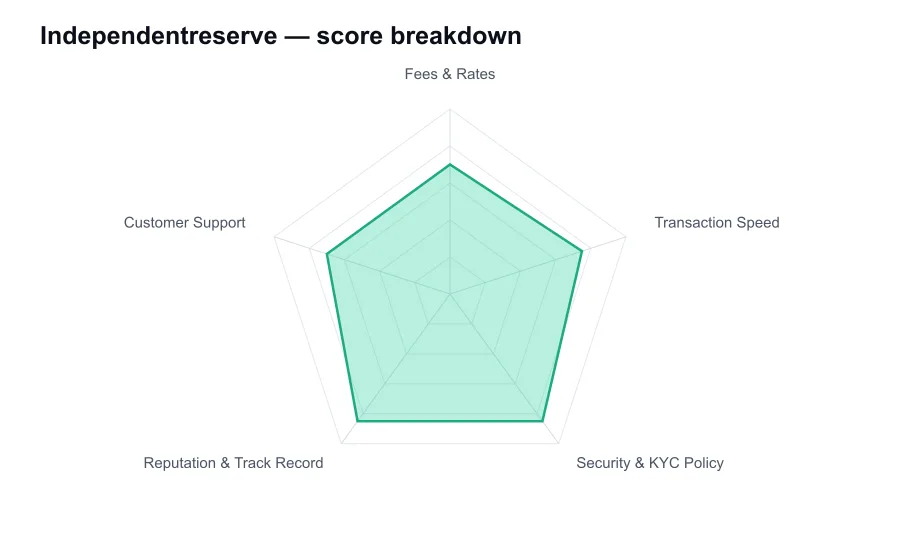
Independentreserve scores 7.8/10 overall in our independent review, measured against every other provider we've compared, strongest on Security & KYC Policy (8.5/10) and weakest on Customer Support (7.0/10).
Score: 7.8/10 How we score →| Best for | Not for |
|---|---|
| Established Australian exchange since 2013 | Smaller asset range than global exchanges |
Editorial independence: our scores and rankings are produced using the fixed criteria above and are not influenced by advertisers. This is an independent ranking site and is not operated by, or affiliated with, any provider we list.
Affiliate disclosure: some links on this page may earn us a commission at no extra cost to you. This does not affect our rankings.
Criteria Breakdown
| Criterion | Score | Notes |
|---|---|---|
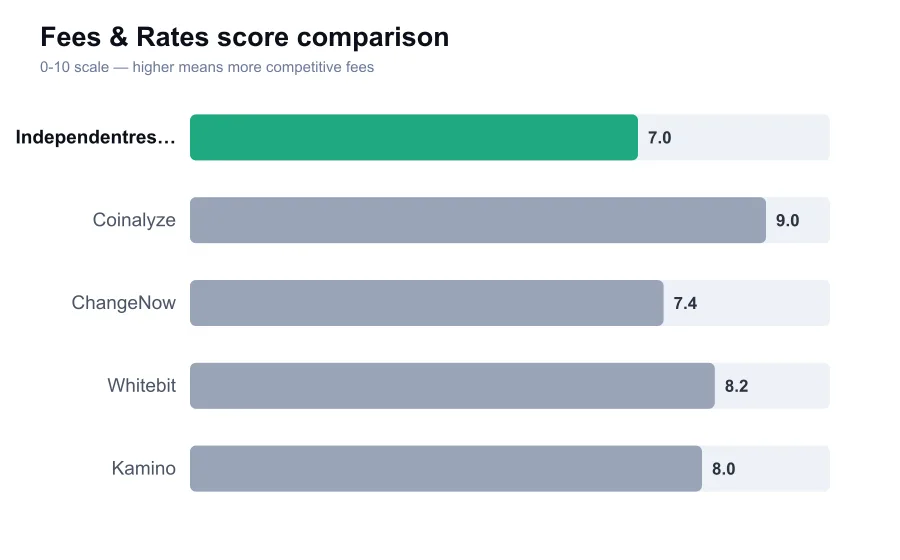
| Fees & Rates | 7.0 | Volume-based trading fees, around 0.5% at entry |
| Transaction Speed | 7.5 | Fast AUD rails, normal chain confirmation delays |
| Security & KYC Policy | 8.5 | AUSTRAC registration and mature security controls |
| Reputation & Track Record | 8.5 | Australian operator established in 2013 |
| Customer Support | 7.0 | Established local support and help resources |
Independent Reserve is one of the more credible names in the Australian crypto market. Founded in 2013, it has survived periods that eliminated many competitors, including the long bear markets, repeated exchange failures and the post-FTX demand for better custody practices. It is not trying to be the loudest global exchange. Its pitch is more conservative: a locally focused platform with fiat access, a serious compliance posture and tools that range from straightforward buying to more deliberate trading.
That positioning matters. Independent Reserve is better compared with Australian providers such as CoinSpot, Swyftx and BTC Markets than with a giant offshore derivatives venue. It offers a practical bridge between Australian dollars and crypto assets, and it has built relationships and operating processes around that job. Users seeking hundreds of speculative tokens, eye-catching leverage or memecoin launches will find more excitement elsewhere. That restraint is part of its appeal.
Its standard trading fees are competitive without being rock-bottom. Independent Reserve uses a volume-based maker and taker schedule, with entry-level fees historically around 0.5 percent and lower rates for customers who trade more. The exact tier and product matter, so users should check the live schedule rather than relying on an old review. For a casual investor making occasional purchases, 0.5 percent is reasonable. For a very active trader, it is less compelling than the deepest global venues.
The platform's Auto-Pay style purchase features and simple buy functions can be convenient, but convenience always needs a pricing check. A simple purchase screen may reflect a different spread or fee presentation from an order-book trade. If you know how to use limit orders, the trading interface is usually the better place to understand the price you are accepting. New investors shouldn't be embarrassed by that extra step. It can save money over repeated purchases.
AUD deposits by bank transfer have been a real strength for Australian users, particularly compared with offshore exchanges that depend on card processors or third-party payment rails. Bank transfer timing still depends on the sending bank and the payment method. PayID and New Payments Platform transfers can be fast, while some transfers take longer or undergo bank checks. Once cleared, a fiat balance gives a much cleaner route into the market than paying high card fees.
Crypto withdrawal cost is not a simple fixed number because it depends on the asset and its network. That is normal. What matters is that the platform displays withdrawal conditions before you act and processes ordinary requests reliably. Independent Reserve has the advantage of being an established custodian with routine operational procedures, rather than an instant-swap intermediary sourcing a one-off transaction through unknown partners.
Trade execution is generally suitable for the assets it actively supports, although it isn't a global liquidity monster. Major markets such as Bitcoin and Ethereum are where the platform makes the most sense. Smaller assets can have thinner books and larger spreads, especially outside Australian trading hours. A disciplined user should use limit orders for anything beyond a modest market buy. That is good advice everywhere, but it is especially relevant on a regional exchange.
Speed is solid for normal use. Deposits credited through fast Australian payment channels can allow a customer to trade quickly, while crypto deposits are dependent on the confirmation rules of the relevant chain. Withdrawals may be delayed by security checks, address verification or network congestion. Those controls can be irritating in the moment, yet they are preferable to an exchange that sends everything instantly without meaningful fraud safeguards.
The strongest part of Independent Reserve's proposition is its compliance and security posture. It operates as an Australian digital currency exchange registered with AUSTRAC, and it has long emphasized identity verification, anti-money-laundering controls and accountable corporate operations. That means it isn't for people looking for anonymous crypto access. Verification is expected, and in a regulated Australian context that is a feature, not a bug.
Its security offering includes two-factor authentication and account protections, while its custody model has been presented as emphasizing offline storage for customer assets. No centralized exchange should be mistaken for a personal hardware wallet, however. Customers still carry platform risk, operational risk and the risk of account compromise if they reuse passwords or fall for phishing. Enable strong 2FA, secure email access and withdrawal safeguards from day one.
Independent Reserve's long history helps its reputation, but it shouldn't produce blind loyalty. The exchange has operated through difficult market conditions without the spectacular implosion associated with several offshore rivals. That is meaningful. Still, a customer should distinguish between a reputable local exchange and a government guarantee. Crypto balances are not the same as insured bank deposits, and self-custody remains appropriate for long-term holdings that are not actively being traded.
Support is generally a better prospect here than at an anonymous global platform because there is a clear Australian business presence and a mature help-center structure. The service can still be slower during market surges, compliance reviews or banking disruptions. Users who need immediate phone-style reassurance may be disappointed, as crypto support is usually ticket-led. But there is a meaningful difference between a support queue at an accountable local operator and a contact form attached to an obscure website.
Independent Reserve also makes sense for self-managed super fund investors and more serious local users because it has historically offered features tailored to SMSF administration and tax reporting needs. Those users should verify the current service terms and get professional tax advice. The point is that the company understands a more formal investor base, not just casual mobile-app speculation.
The limitations are easy to identify. The asset selection is restrained, trading volume is smaller than the world's biggest exchanges and entry-level fees aren't the cheapest available. If you are a high-frequency trader, a derivatives specialist or someone chasing every new token, you will outgrow it. If you want an AUD gateway with a mature compliance culture, those shortcomings may be exactly the trade-off you want.
Independent Reserve is one of the few centralized exchanges I would describe as sensible rather than thrilling. It has earned trust through longevity, local regulation and a relatively sober operating style. I would use it for Australian dollar onramps, major-asset purchases and orderly portfolio management. I would not use any exchange, including this one, as permanent cold storage. That distinction keeps an otherwise solid choice in the right role.
Pros and Cons
| Pros | Cons |
|---|---|
| Established Australian exchange since 2013 | — |
| AUSTRAC-registered digital currency exchange | — |
| AUD bank transfer access | — |
| Competitive volume-based trading fees | — |
| Useful features for SMSF investors | — |
Suitability
Is Independent Reserve regulated in Australia?
It operates as an Australian digital currency exchange registered with AUSTRAC. Registration does not make crypto prices safe or turn exchange balances into bank deposits, but it does place the business within Australian AML and counter-terrorism financing rules.
What are Independent Reserve trading fees?
Fees use a rolling-volume maker and taker schedule. Entry-level trading fees have commonly been around 0.5 percent, with lower rates at higher volumes. Check the current schedule for the exact market and tier.
Does Independent Reserve require identity verification?
Yes. It is a compliance-led Australian exchange, so customers should expect KYC verification and possible additional checks depending on activity and account requirements.
Should I keep crypto on Independent Reserve long term?
For active trading, exchange custody can be practical. For long-term holdings, a hardware wallet or another self-custody arrangement reduces exposure to exchange and account-access risk.