Baltex
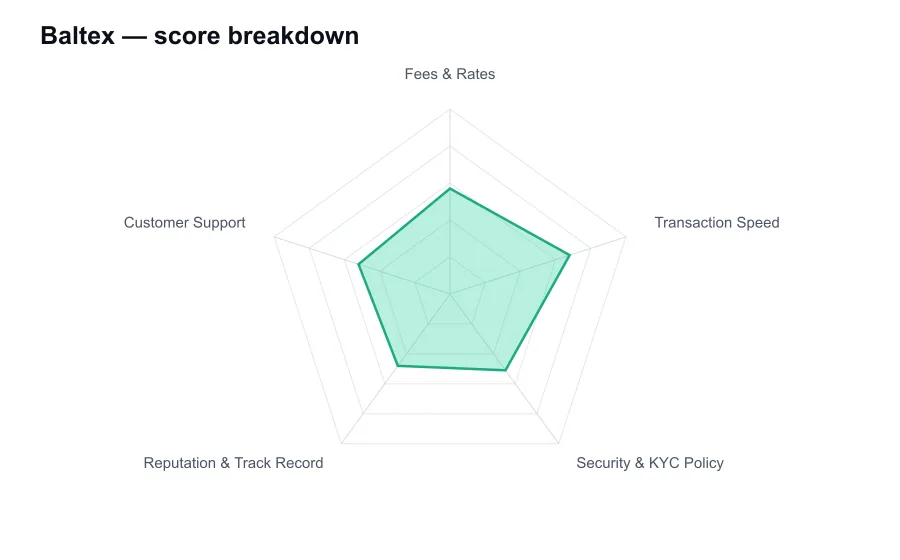
Baltex scores 5.5/10 overall in our independent review, measured against every other provider we've compared, strongest on Transaction Speed (6.8/10) and weakest on Reputation & Track Record (4.8/10).
Score: 5.5/10 How we score →| Best for | Not for |
|---|---|
| Simple asset-to-asset conversion flow | No transparent order-book pricing |
Editorial independence: our scores and rankings are produced using the fixed criteria above and are not influenced by advertisers. This is an independent ranking site and is not operated by, or affiliated with, any provider we list.
Affiliate disclosure: some links on this page may earn us a commission at no extra cost to you. This does not affect our rankings.
Criteria Breakdown
| Criterion | Score | Notes |
|---|---|---|
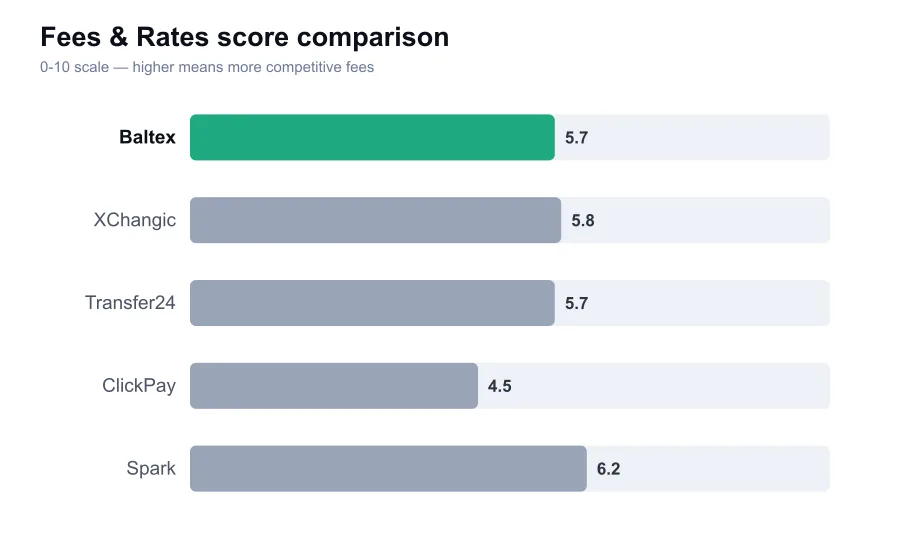
| Fees & Rates | 5.7 | Convenient quotes, but all-in spreads need comparison |
| Transaction Speed | 6.8 | Quick on routine network-supported swaps |
| Security & KYC Policy | 5.1 | Conditional verification and limited public assurance |
| Reputation & Track Record | 4.8 | Small public footprint and limited track record |
| Customer Support | 5.2 | Ticket support matters greatly on exceptions |
Baltex is a compact crypto exchange service built around quick conversions rather than a full professional trading venue. It belongs to the same broad market as instant-swap providers such as ChangeNOW, LetsExchange, and a long list of smaller exchange offices. The promise is attractive: skip charts, choose assets, and receive coins at a destination wallet. The reality needs a more demanding reading than the marketing copy suggests.
A quick conversion service is not necessarily a bad choice. For someone moving one asset into another before transferring to self-custody, it can be less intimidating than using a spot exchange. But the trade-off is price discovery. You aren't seeing a live order book and selecting a limit price. You are accepting Baltex's quoted conversion, with its liquidity sourcing, spread, network assumptions, and risk margin bundled into the result.
That bundled quote is the core of the fee question. Baltex does not feel cheap simply because it avoids a line item called commission. The meaningful number is how much crypto reaches your wallet compared with the market rate at the time you initiated the exchange. On common pairs, the all-in gap may be acceptable for convenience. On thin assets, volatile conditions, or small transactions with large fixed network costs, it can become poor value.
The fixed-rate versus floating-rate distinction deserves attention. A floating quote can change while the service waits for your deposit and confirmations. That is normal, but a volatile coin can move enough to make the eventual result disappointing. A fixed quote offers more certainty but may include a wider buffer and a limited payment window. Read the selected order terms before sending, because the customer rarely has leverage after an irreversible deposit is made.
Baltex is more credible for swapping a modest amount than for executing a trading strategy. Active traders will usually find a liquid exchange cheaper because maker and taker fees are visible and the bid-ask spread is measurable. A 0.1 percent to 0.5 percent exchange fee plus a transparent withdrawal fee can beat an instant service by a wide margin. Baltex sells speed and simplicity, not execution quality.
Speed can be quite good on supported networks. A USDT transfer on a fast chain, followed by an automated payout, may reach a wallet within minutes once the incoming transaction is accepted. That experience is what makes these services popular. Yet the phrase instant exchange is often used too loosely. The service cannot send funds it has not received, and it cannot make a congested blockchain confirm faster.
Some delays are operational rather than technical. A provider may wait for more confirmations on a high-risk asset, source liquidity for a less common token, or pause an order that does not match the displayed amount. Those are reasonable controls, but users deserve clear status updates. Baltex's suitability falls sharply for deadline-sensitive payments, because the customer remains exposed to both market movement and the provider's exception queue.
The security picture calls for restraint. Baltex is not a bank and should not be treated as a wallet. Send from a wallet you control, receive to a wallet you control, and keep custody time as short as possible. A swap service's security includes its website and internal systems, but its biggest practical risk to a customer is often a bad address, an imitation domain, or an unsupported token sent over the wrong network.
KYC expectations should be treated as conditional, not nonexistent. Many exchange services permit ordinary orders without account registration, but reserve the right to request identity documents or transaction-source information under anti-money-laundering rules. That can be frustrating, especially if funds are already in flight. It is also a standard risk across the sector, and anyone requiring guaranteed anonymity should not rely on a commercial intermediary.
Baltex does not have the deep regulatory profile, audited reporting history, or broad independent coverage that supports confidence in major established exchanges. Its public presence is much smaller. That should affect position sizing. A clean website and a few favorable mentions are not equivalent to years of transparent operations, external security audits, proven withdrawal reliability, and a clearly identifiable legal structure.
Reputation research is not optional here. Check current domain information, recent user reports, service terms, and whether support channels are active before you transact. Give little weight to generic five-star comments with no pair, date, or transaction detail. The reviews that matter describe a problem and show whether it was solved. Fast routine swaps prove that automation works. They say less about how a service behaves after an error.
Customer support is likely to be the decisive test if a transaction needs help. A small service can offer attentive chat support, but it may not have multilingual teams, phone escalation, or the response capacity of a global company. Save screenshots of the quote, deposit transaction, receiving address, and order reference. Those records turn a vague complaint into a solvable ticket if the payout is delayed.
I wouldn't call Baltex a default recommendation for buying crypto or converting a large portfolio. It has a place for users who already know wallet mechanics and need a direct asset-to-asset swap. Keep the transaction narrow and controlled. Check the network twice, don't chase an unusually favorable quote on an obscure pair, and avoid sending more than you can afford to have delayed.
My final view is that Baltex offers convenience with the normal costs and trust demands of the instant-swap model. It may be efficient for a modest, routine conversion, especially where a normal exchange withdrawal would add friction. Its pricing is less transparent than a spot market, its reputation is less developed than leading competitors, and support is most likely to be tested at the exact moment a user has the least patience. Use it deliberately, not casually.
Pros and Cons
| Pros | Cons |
|---|---|
| Simple asset-to-asset conversion flow | — |
| No trading interface required | — |
| Fast settlement possible on supported chains | — |
| Useful for self-custody wallet swaps | — |
Suitability
Are Baltex rates fixed?
That depends on the quote type and order terms. Floating orders can change with the market before settlement, while fixed-rate orders usually have a short payment window and may include a wider buffer.
Can a Baltex swap require identity verification?
It can. Services in this category may process ordinary orders without registration but request documents if an order triggers compliance or transaction-risk checks.
Why has my Baltex order not arrived yet?
Check the incoming transaction confirmations, the exact sent amount, the selected network, and the order status. If those are correct, contact support with the transaction hash and order reference.