Spark
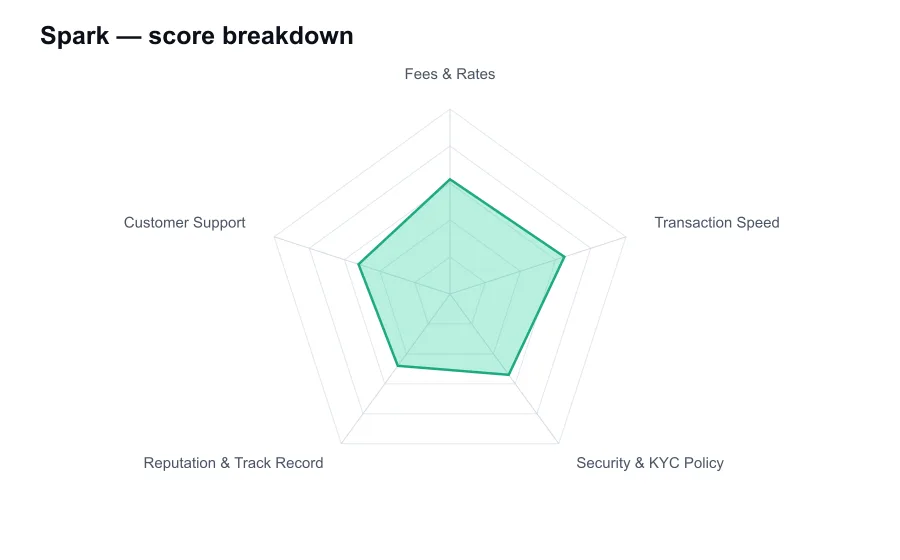
Spark scores 5.7/10 overall in our independent review, measured against every other provider we've compared, strongest on Transaction Speed (6.5/10) and weakest on Reputation & Track Record (4.8/10).
Score: 5.7/10 How we score →| Best for | Not for |
|---|---|
| Simple instant-swap workflow | Limited independently verifiable history |
Editorial independence: our scores and rankings are produced using the fixed criteria above and are not influenced by advertisers. This is an independent ranking site and is not operated by, or affiliated with, any provider we list.
Affiliate disclosure: some links on this page may earn us a commission at no extra cost to you. This does not affect our rankings.
Criteria Breakdown
| Criterion | Score | Notes |
|---|---|---|
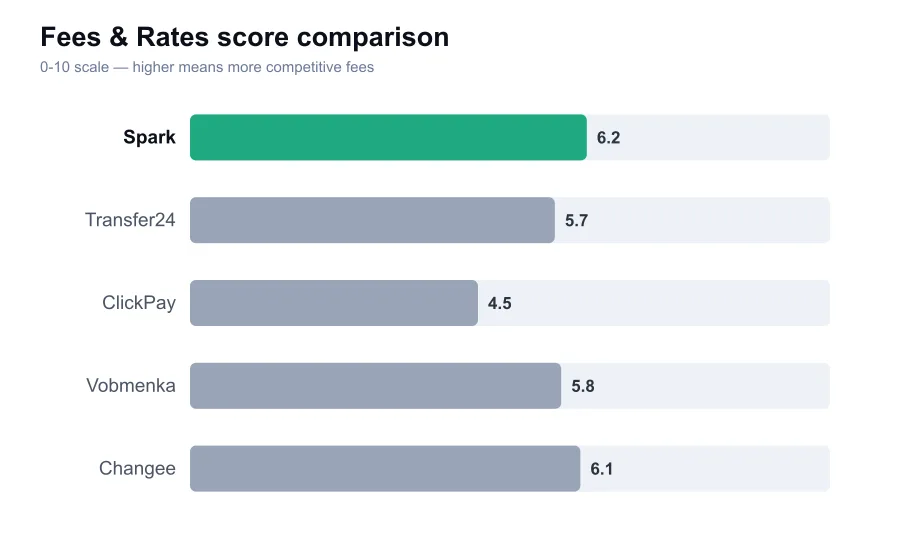
| Fees & Rates | 6.2 | Compare the final quote closely, fee disclosure is limited. |
| Transaction Speed | 6.5 | Network confirmations and partner routing drive completion time. |
| Security & KYC Policy | 5.4 | Non-custodial model, but limited public transparency. |
| Reputation & Track Record | 4.8 | Thin independent track record versus established rivals. |
| Customer Support | 5.2 | Test support with a small order before relying on it. |
Spark sits in the crowded instant-swap end of crypto, where users exchange one asset for another without opening a traditional trading account or learning an order book. Its appeal is straightforward: pick a pair, send coins, and receive the destination asset. That can be useful for a one-off conversion, especially for people who value a clean interface more than a full trading terminal. The problem is that Spark is a difficult brand to assess with the confidence afforded to better documented names. Its public identity and operating history aren't nearly as clear as those of established exchange services.
That lack of a sharply defined public profile matters. Crypto users are not just choosing a website design, they are selecting a route for funds that may pass through several liquidity providers before landing in a receiving wallet. A provider with limited corporate detail, sparse independent discussion, and an unclear history deserves more scrutiny than a familiar name. Spark may work as intended, but it has not yet earned the presumption of reliability that larger instant exchanges get from years of visible operation.
The service is designed around swaps rather than custody. You supply a receiving address, deposit the asset requested by the quote, and Spark or its liquidity partner delivers the return currency. That arrangement is better than leaving a long-term balance on a small centralized exchange. Still, non-custodial is often used too loosely in this market. During an active swap, the service does control the transaction flow, and a wrong address, a network mismatch, or a compliance hold can create a real problem.
Spark's quoted rate should be treated as the price, not merely as a market rate with a small fee attached. Instant exchanges commonly blend a service margin, network cost, partner spread, and market movement into one number. That isn't automatically deceptive, but it makes direct fee comparisons difficult. If a site cannot show a simple, durable fee schedule, the practical test is to compare the final amount against two or three competitors at the same moment. Small swaps can hide a weak rate. Larger swaps expose it quickly.
For modest conversions, the price gap may be tolerable if Spark finds liquidity smoothly. For anything substantial, I would compare its final quote with StealthEX, ChangeNOW, SimpleSwap, and a liquid centralized venue. A visible fee of zero means very little if the exchange rate is one or two percent worse than the market. Spark does not strike me as a venue to use blindly on repeat just because the screen looks simple. It needs to win each transaction on the actual amount received.
Fixed-rate swaps are particularly important in volatile markets, and users should verify exactly what Spark is offering before sending funds. A floating quote can move between the time you create an order and the time your deposit receives enough confirmations. Bitcoin and Ethereum congestion can make that difference material. If Spark labels an order fixed, read the conditions carefully, including the deposit window and the permitted amount deviation. Fixed pricing is only useful if the protection survives ordinary wallet and network delays.
Speed is usually governed less by the webpage than by the asset being sent. A swap involving fast networks can finish in minutes once the inbound payment is detected. Bitcoin, Ethereum during congestion, and assets requiring multiple confirmations can take far longer. Spark should not be judged harshly for blockchain confirmation time, but it should provide clear order status and explain what stage is causing the wait. Vague processing messages are where customer anxiety turns into distrust.
I would keep a first Spark transaction small. Send the exact requested amount, retain the transaction ID, and wait for completion before assuming a new chain or token variant is supported as expected. That advice sounds conservative, but it is the sensible way to approach any lesser-known swap provider. A $20 test tells you more about deposit detection, support responsiveness, and payout execution than a glossy home page ever will. It also limits the cost of a bad operational surprise.
The KYC question needs a more realistic answer than a simplistic yes or no. Instant swap services often let users create ordinary orders without account registration, yet retain the right to request identity documents when transaction monitoring flags an address, jurisdiction, amount, or source-of-funds concern. Spark should be approached on that basis. No routine sign-up requirement is not a promise that every swap will remain document-free. Users who cannot tolerate a compliance review should not send funds they urgently need.
That policy creates a security trade-off. Limited data collection is attractive for privacy-minded users and reduces the risk of an account database breach. It also means there may be less of the formal account protection and escalation structure found at regulated exchanges. A user whose order is stopped will want a named legal entity, a clear terms page, and a support trail that leads somewhere beyond a chat widget. Spark does not yet project that degree of institutional reassurance.
Wallet hygiene is especially important here. Confirm the domain manually, bookmark it after checking it, and never rely on paid search advertisements or messages claiming to be Spark support. Instant exchange impersonation is common because a copied page can harvest a deposit address or redirect a user to a fraudulent wallet. Use a self-custody wallet you control, double-check the destination network, and avoid sending privacy-sensitive or unusually large funds before you understand the service's compliance terms.
Spark's reputation is its weakest category, not because every lesser-known service is bad, but because independent evidence is thin compared with mature competitors. A long public track record gives reviewers material to examine: downtime, payout disputes, communication during market stress, and how complaints are resolved. With Spark, there is simply less history to lean on. That is not a conviction against it. It is a reason to keep trust proportional to what the provider has actually demonstrated.
Support is another area where small operators can look fine until something unusual happens. A normal completed order requires no help. The meaningful test is a delayed deposit, an incorrect tag, a token contract issue, or a compliance request. Before using Spark for a meaningful amount, I would check whether there is a live contact channel, whether order-specific help can be reached with an ID, and whether the site states realistic response expectations. Anonymous support promises are cheap.
Spark is best viewed as a convenience option for careful users, not as a default home for large conversions. It may suit someone making an occasional small swap who understands blockchain transfers and checks the quote against alternatives. It is a weaker choice for a first-time buyer, a user needing guaranteed regulated recourse, or anyone moving money that cannot be delayed. In this part of crypto, trust is built through boring consistency over time. Spark still has work to do on that front.
My final view is guarded rather than hostile. The basic instant-swap model is useful, and avoiding a standing custodial balance is a genuine advantage. But limited public transparency, an underdeveloped independent reputation, and uncertainty around operational support put a ceiling on my recommendation. Use Spark only after a small test and only if its final quote is clearly better than better-known alternatives. For larger trades, I would pay a little more for a provider with a deeper record and clearer accountability.
Pros and Cons
| Pros | Cons |
|---|---|
| Simple instant-swap workflow | — |
| No standing custodial balance | — |
| Useful for small one-off conversions | — |
Suitability
Does Spark require KYC?
Routine registration may not be required for a standard swap, but instant exchanges can request verification under transaction-monitoring or compliance rules. Do not assume every order will be KYC-free.
How long does a Spark swap take?
Fast-network swaps may complete in minutes after the deposit is detected. Bitcoin, Ethereum congestion, and additional confirmation requirements can extend the process substantially.
Should I use Spark for a large transaction?
I would not make it a first choice for a large first transaction. Test a small amount, compare the final quote, and use a provider with a longer public record for money you cannot afford to delay.