Changee
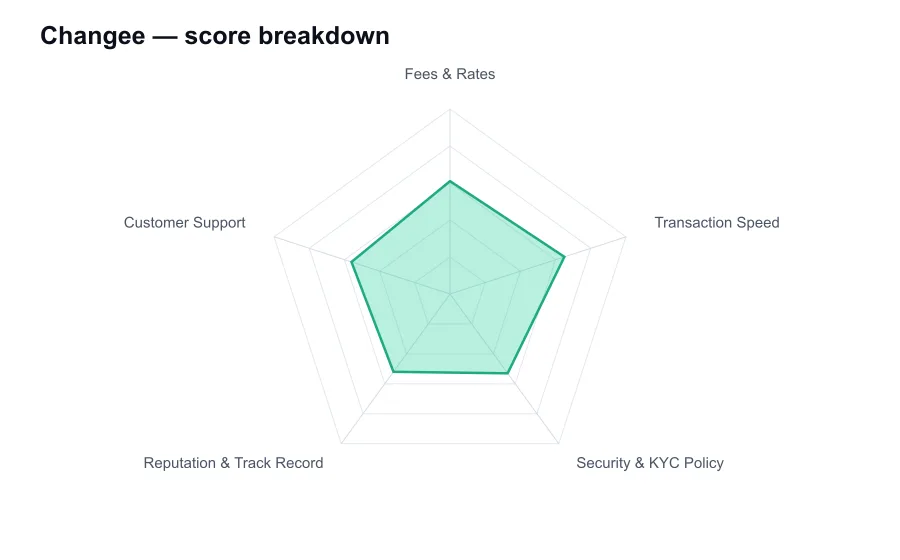
Changee scores 5.8/10 overall in our independent review, measured against every other provider we've compared, strongest on Transaction Speed (6.5/10) and weakest on Reputation & Track Record (5.2/10).
Score: 5.8/10 How we score →| Best for | Not for |
|---|---|
| Purpose-built for straightforward crypto swaps | Costs can be embedded in the quoted rate |
Editorial independence: our scores and rankings are produced using the fixed criteria above and are not influenced by advertisers. This is an independent ranking site and is not operated by, or affiliated with, any provider we list.
Affiliate disclosure: some links on this page may earn us a commission at no extra cost to you. This does not affect our rankings.
Criteria Breakdown
| Criterion | Score | Notes |
|---|---|---|
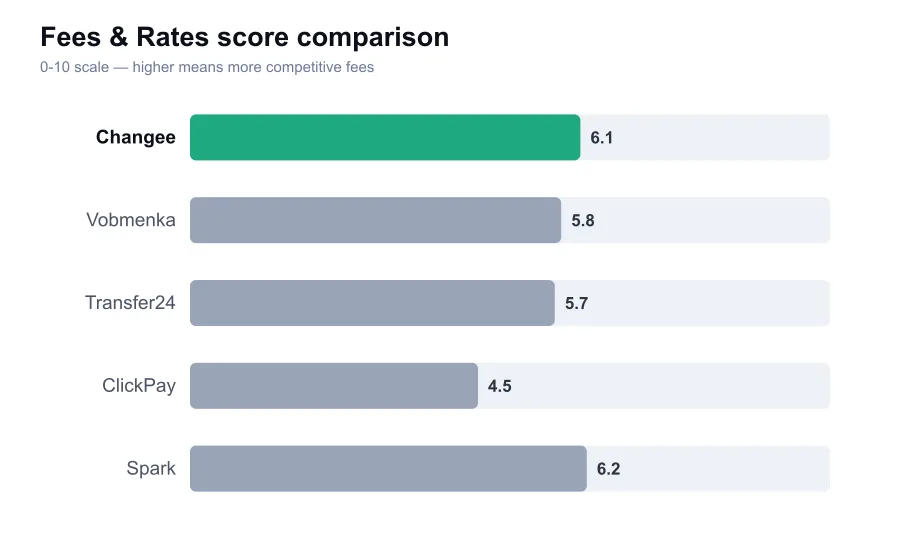
| Fees & Rates | 6.1 | Competitive value depends on the final live quote and network route. |
| Transaction Speed | 6.5 | Designed for quick swaps, subject to confirmations and liquidity. |
| Security & KYC Policy | 5.3 | Short-term execution custody still requires careful risk management. |
| Reputation & Track Record | 5.2 | More credible than the weakest small exchangers, still not deeply proven. |
| Customer Support | 5.6 | Order-specific support should be tested before a major transaction. |
Changee is positioned as a lightweight cryptocurrency exchange service rather than a traditional trading venue. Its intended user is easy to picture: someone who already has crypto, wants to exchange it, and has no interest in creating an account at a large centralized platform just to make one transaction. That approach can be attractive. It removes clutter and can keep a user in control of their own wallets. It also places a great deal of trust in the operator during the short period between deposit and payout.
Among the four services reviewed here, Changee makes the most coherent case as an everyday small-swap tool, though that is not the same as calling it a high-trust financial institution. The user experience and quote-driven format are aligned with what instant-exchange customers expect. Still, the public record is not deep enough to make due diligence optional. A simple service should not be confused with a risk-free one.
The sensible way to use Changee is transaction by transaction. Generate an order, verify the receiving asset, chain, and address, send the required amount, then move on once the payout arrives. Do not treat an exchange service as a wallet. There is no good reason to leave an idle balance in the custody of an intermediary whose central purpose is execution rather than storage.
Fees are the most important practical variable, and the final quote is more useful than any broad marketing claim. Changee's cost will normally be reflected in the conversion rate and may be affected by asset liquidity, order size, route, and network withdrawal cost. I would like to see more consistently granular public explanation of the spread and network component. Users should know whether they are paying for a fixed rate, a floating rate, or simply accepting the provider's quoted output.
That said, quote-based pricing can work well if the rate is competitive. Changee should be compared with named alternatives such as ChangeNOW, SimpleSwap, StealthEX, and a liquid spot exchange for common pairs. Do this at the same moment and look only at the amount arriving at your destination. A low advertised percentage is irrelevant if the final output is weaker. Conversely, a slightly higher all-in cost can be reasonable if the route is faster or the payout network is more practical.
For ordinary transactions, Changee's speed is likely to be governed more by the underlying chain than by the front end. A quick order creation process is helpful, but inbound confirmations, liquidity sourcing, and outbound network conditions determine when the customer actually receives funds. Popular assets on healthy networks can often be processed in minutes after deposit confirmation. Bitcoin congestion, token-chain issues, and less liquid assets can stretch that considerably.
Changee earns a better speed score than the smallest services here because its product framing is more clearly geared toward this use case, but users should remain skeptical of any unconditional instant promise. The best exchanges set expectations per order. They identify whether a rate is fixed, indicate confirmation requirements, and show meaningful status updates. If the platform's order page is vague, the customer is left guessing whether a delay is normal or whether action is needed.
A good first test is not merely a tiny amount. It should also be a normal pair on a network you understand, such as a mainstream asset and a clearly selected chain. Avoid making your first Changee order an exotic token, a cross-chain stablecoin transfer, or a payment due in twenty minutes. Those scenarios multiply the chance of an expensive mistake and make it harder to identify whether the issue came from the service, the blockchain, or the sender.
Changee's KYC position deserves a precise reading. Account-light instant exchanges often allow many orders to begin without standard onboarding, but compliance checks can still occur. This is normal across the industry. Automated screening may flag a deposit, and the provider or a liquidity partner may then ask for documents or additional information. The important consumer-protection issue is whether that possibility is disclosed honestly and whether the policy explains what happens during a review.
Users who require certainty that no information will ever be requested should not use centralized exchange services. That expectation is no longer realistic. Users who care about privacy in a lawful sense should instead minimize what they share, use secure personal wallets, avoid reusing addresses where appropriate, and choose providers with transparent policies. Changee is more attractive as a convenience service than as a privacy guarantee.
On security, I would give Changee credit for fitting the noncustodial exchange pattern better than a service that encourages users to park funds. But noncustodial is often used too loosely. During execution, the provider still receives the deposit and controls the outgoing settlement process. That is counterparty exposure, even if it lasts minutes. The platform should therefore be judged on transparency, secure order handling, phishing resistance, and clear channels for reporting an issue.
I could not verify the sort of public security disclosures, independently audited controls, or institutional accountability that would justify a top score. This is where Changee remains well behind regulated exchanges with long operating histories. The difference matters more as transaction size rises. A user exchanging fifty dollars may accept some opacity for convenience. A user exchanging five figures should not.
Reputation is middling rather than disastrous. Changee has a more plausible consumer-facing exchange proposition than the weakest providers in this group, but it lacks the deep, independently corroborated track record that lets a reviewer recommend it without reservation. Public reviews can be useful as leads, particularly repeated reports about delayed orders or communication failures, but they should never be treated as conclusive proof. Look for patterns, dates, and responses from the company.
Support is a relative positive if Changee provides accessible order assistance, but response quality matters far more than a visible chat icon. Support should be able to identify an order, explain confirmation status, distinguish a blockchain delay from a review, and give an actionable next step. Before a major transaction, ask a narrow question through the official channel. A concise, informed answer is a better sign than a generic claim of round-the-clock availability.
Changee suits a particular kind of crypto user: someone who understands wallet operations, wants a quick conversion, and is prepared to compare live rates. It is less suitable for first-time buyers who need fiat rails, recurring traders seeking advanced order types, or businesses that need invoices and formal service commitments. Those users will be better served by a mainstream exchange or specialist payment provider, even if the onboarding is less convenient.
My final take is cautiously favorable for small and medium, nonurgent swaps, with the emphasis on cautious. Changee appears more usable and more purpose-built than some obscure instant exchangers, but its public transparency and institutional depth do not warrant complacency. Compare the final quote, test the full route with a manageable amount, and don't send funds you cannot afford to have delayed. Used that way, it can be a practical tool. Used as a blind trust exercise, it is not.
Pros and Cons
| Pros | Cons |
|---|---|
| Purpose-built for straightforward crypto swaps | — |
| Useful wallet-to-wallet workflow | — |
| Live quotes enable direct comparison | — |
| Better fit for small nonurgent conversions than obscure peers | — |
Suitability
Does Changee require identity verification?
An order may begin without full account onboarding, but compliance checks can still be triggered. Read the current policy before sending funds.
How fast are Changee swaps?
Timing depends on inbound confirmations, the selected assets, liquidity, and the outgoing network. Common pairs can be quick, but no on-chain swap is truly guaranteed to be instant.
How should I compare Changee fees?
Compare the final amount delivered to your exact destination network with other providers at the same time. That captures spread and network costs better than a headline fee.