ClickPay
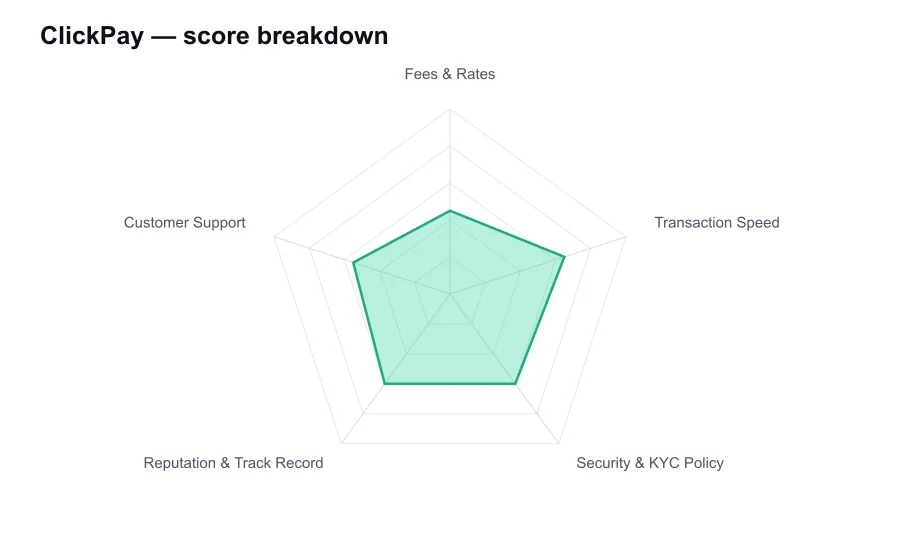
ClickPay scores 5.7/10 overall in our independent review, measured against every other provider we've compared, strongest on Transaction Speed (6.5/10) and weakest on Fees & Rates (4.5/10).
Score: 5.7/10 How we score →| Best for | Not for |
|---|---|
| Built for merchant checkout and payment links | Not a conventional crypto exchange |
Editorial independence: our scores and rankings are produced using the fixed criteria above and are not influenced by advertisers. This is an independent ranking site and is not operated by, or affiliated with, any provider we list.
Affiliate disclosure: some links on this page may earn us a commission at no extra cost to you. This does not affect our rankings.
Criteria Breakdown
| Criterion | Score | Notes |
|---|---|---|
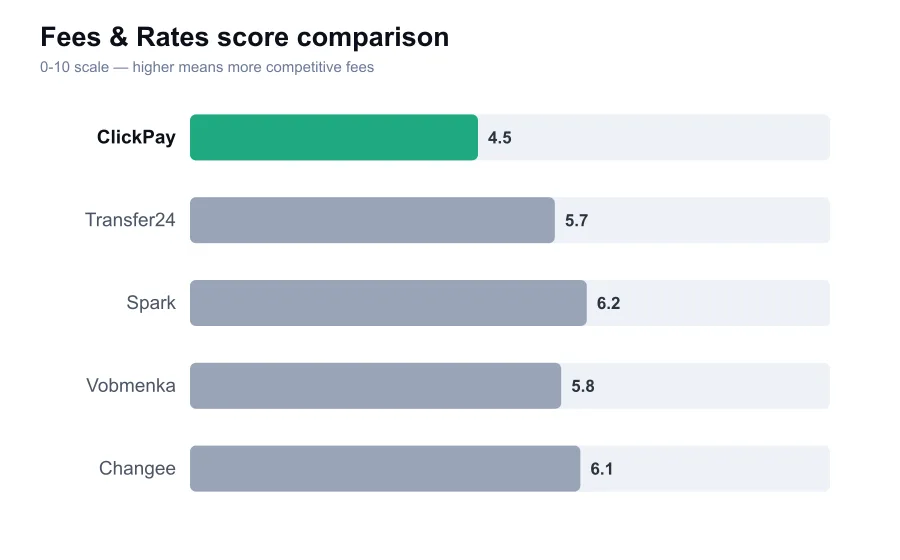
| Fees & Rates | 4.5 | Merchant pricing is contract based and not fully public. |
| Transaction Speed | 6.5 | Fast checkout flow, settlement depends on rails and contract. |
| Security & KYC Policy | 6.0 | Payment controls, but not exchange-style custody disclosure. |
| Reputation & Track Record | 6.0 | Established payments focus, limited exchange track record. |
| Customer Support | 5.5 | Integration support matters, public support evidence is limited. |
ClickPay occupies an awkward place in a crypto exchange comparison because it is primarily a payments infrastructure company, not a consumer cryptocurrency exchange in the mould of Kraken, Coinbase, or Bitstamp. Its public identity is built around helping merchants accept and manage payments, particularly across the Middle East and North Africa. That distinction matters. A buyer looking for a venue to trade Bitcoin, hold altcoins, or move assets between wallets will find the ClickPay proposition incomplete.
The brand does have relevance to crypto users where crypto acceptance intersects with merchant checkout. But a payment processor should not get credit for exchange capabilities it does not publicly present. ClickPay's merchant tools, payment links, APIs, invoicing options, hosted payment pages, and checkout integrations are the core product. Crypto, where it is available through a merchant's chosen arrangement, is a payment acceptance question rather than a full retail trading service.
That makes the fee discussion less straightforward than it is at an exchange with a published maker and taker table. ClickPay does not present a universal retail crypto trading fee schedule comparable to Binance's 0.1 percent spot fee or Coinbase Advanced's tiered trading fees. Merchant pricing can depend on geography, transaction method, business category, processing volume, settlement currency, and a directly negotiated agreement. That may be normal for payment acquiring, but it is poor transparency for anyone trying to estimate the cost of a crypto transaction before signing up.
Merchants should insist on a written breakdown before integrating. Ask for the card processing rate, any crypto conversion charge, currency-conversion spread, chargeback fee, refund fee, payout fee, rolling reserve terms, and minimum monthly commitments. A headline payment-processing rate can look reasonable until foreign-currency conversion and settlement costs are added. The absence of an easy public comparison table is not automatically a red flag, but it means ClickPay cannot earn a high fees score from a reviewer who values verifiable pricing.
Speed is more promising, though it needs to be described accurately. A hosted checkout or payment link can authorize a payment in seconds, and that is what merchants care about at the point of sale. Crypto settlement itself is governed by the relevant blockchain, required confirmations, any conversion provider involved, and the merchant's payout schedule. Calling all of that instant would be misleading. A customer may receive a quick checkout confirmation while the merchant's final settlement follows the provider's normal risk and banking timetable.
For an online retailer, ClickPay's practical speed advantage is operational rather than blockchain-specific. It can centralize checkout flow and spare a merchant from building its own payments stack. That is valuable. It is not the same as fast execution on a crypto order book, instant self-custody withdrawals, or transparent on-chain settlement tracking. Businesses that specifically need those things should use a dedicated exchange or payment processor that publishes its crypto settlement rules in detail.
Security is also best assessed as payments security, not as exchange custody. ClickPay publicly markets payment-security and compliance capabilities, and its business model naturally requires controls around fraud, customer authentication, merchant onboarding, and payment data. Those are meaningful safeguards for a merchant accepting card payments. They do not answer the questions a crypto customer should ask of an exchange, such as whether assets are held in segregated wallets, what percentage sits in cold storage, whether proof of reserves is available, or how withdrawal-address whitelisting works.
Expect business onboarding and identity verification. Payment companies have anti-money-laundering, sanctions-screening, and merchant due-diligence obligations, especially where card acquiring and cross-border payments are involved. That makes ClickPay a poor fit for people whose main priority is no-KYC crypto activity. It is far more suitable for a registered business that is prepared to provide ownership documents, banking information, website details, and evidence of its commercial activity.
The public track record is respectable within regional payment processing, but it is not the long, independently scrutinized exchange history of a global crypto venue. ClickPay has a real commercial presence and a product range that looks like a serious payment platform rather than a throwaway checkout page. Still, exchange customers should not assume that a payments brand has endured the same kinds of stress tests as an exchange that has handled volatile markets, large withdrawals, custody incidents, and years of trading-volume scrutiny.
I would be particularly cautious with the word crypto in marketing material. It can mean very different things. A processor may let a merchant accept a crypto-funded payment while settling the merchant in fiat, use a third party for conversion, or provide only a narrow set of supported assets and countries. Those models can work well for commerce, but they do not give a business direct exposure to digital assets or the same control as accepting wallet-to-wallet payments into its own address.
Support is likely to feel most useful during onboarding and integration, where a merchant needs API documentation, plugin help, test credentials, or checkout troubleshooting. Larger merchants may receive account-management attention that small applicants do not. The experience can vary considerably by market and contract. There is not enough consistently public evidence to treat support as a standout strength, particularly for a small business that needs urgent help resolving a payout hold or failed payment flow.
ClickPay's strongest use case is a legitimate regional merchant that already needs a payment gateway and wants to evaluate crypto as one additional checkout method. In that setting, consolidated reporting and a localised acquiring relationship can be more useful than opening several unrelated payment accounts. The business should still run a live sandbox test, read the service agreement closely, and model refunds and payouts before putting a high-volume checkout through the platform.
It is a weak choice for the typical crypto buyer. There is no compelling reason to approach ClickPay instead of a regulated exchange if the goal is purchasing assets, recurring buys, active trading, self-custody withdrawals, or portfolio management. Likewise, a merchant that needs transparent cryptocurrency settlement should compare specialist providers such as BitPay, CoinGate, and Triple-A, then compare their supported jurisdictions and payout mechanics against ClickPay's commercial proposal.
My view is that ClickPay should be judged as a payments provider with possible crypto adjacency, not sold as a crypto exchange. The underlying merchant proposition can make sense, particularly for businesses operating in markets where local payment coverage is difficult to assemble. Its weak point is the limited public clarity around crypto-specific economics and settlement. If its sales team can document those terms clearly and the merchant's geographic needs match the platform, it deserves a serious pilot. For retail crypto users, look elsewhere.
Pros and Cons
| Pros | Cons |
|---|---|
| Built for merchant checkout and payment links | — |
| Potentially useful regional payment coverage | — |
| Business-oriented API and integration tools | — |
| Suitable for merchants exploring crypto acceptance | — |
Suitability
Is ClickPay a cryptocurrency exchange?
No. ClickPay is primarily a merchant payments platform. Any crypto-related option should be treated as a payment acceptance feature, not as a full trading and custody service.
Does ClickPay publish crypto processing fees?
It does not provide a simple universal retail crypto fee table comparable to major exchanges. Merchants should request a written quote covering processing, conversion, payouts, refunds, and reserves.
How quickly do ClickPay payments settle?
Checkout authorization can be quick, but final settlement depends on payment method, blockchain confirmation rules, conversion arrangements, risk review, and the merchant payout schedule.