1WM
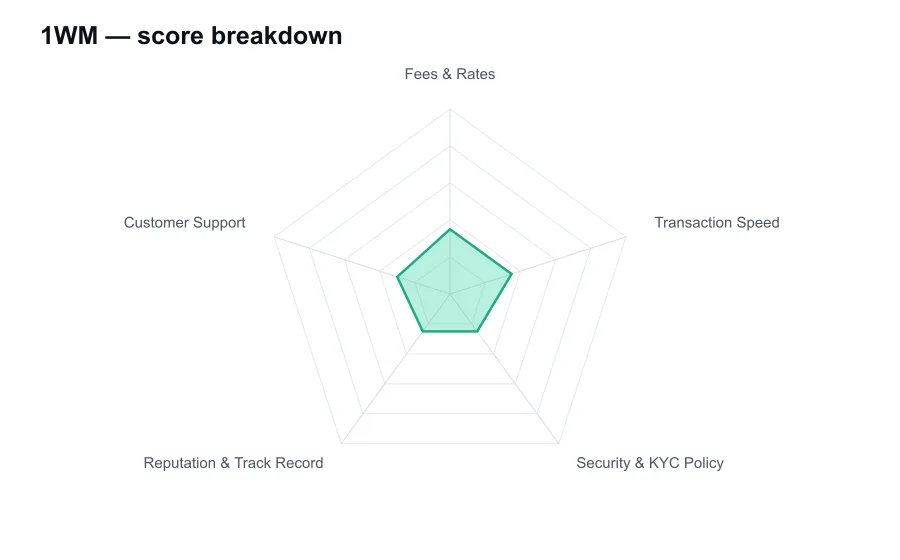
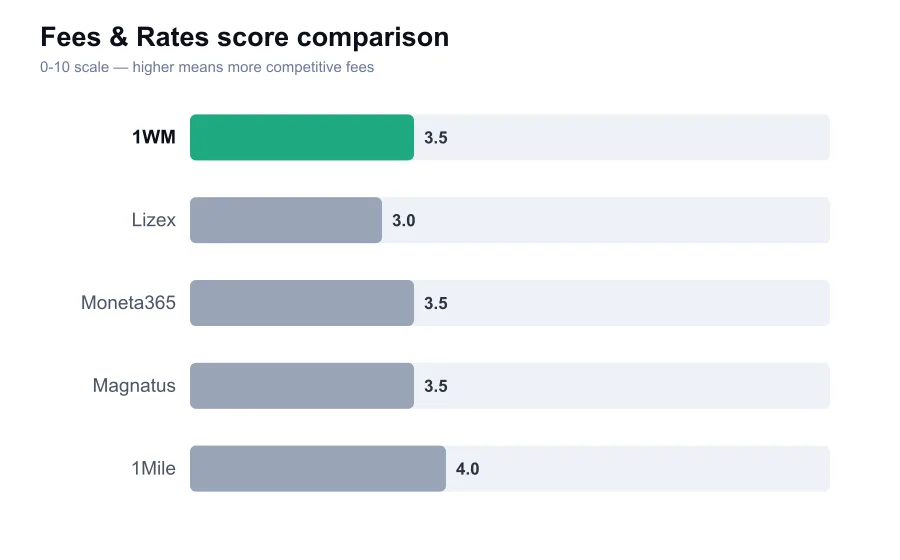
1WM scores 3.0/10 overall in our independent review, measured against every other provider we've compared, strongest on Fees & Rates (3.5/10) and weakest on Reputation & Track Record (2.5/10).
Score: 3.0/10 How we score →| Best for | Not for |
|---|---|
| May offer a simple conversion option | Unproven public reputation |
Editorial independence: our scores and rankings are produced using the fixed criteria above and are not influenced by advertisers. This is an independent ranking site and is not operated by, or affiliated with, any provider we list.
Affiliate disclosure: some links on this page may earn us a commission at no extra cost to you. This does not affect our rankings.
Criteria Breakdown
| Criterion | Score | Notes |
|---|---|---|
| Fees & Rates | 3.5 | Quote spread and final payout need close checking |
| Transaction Speed | 3.5 | Settlement reliability is not well demonstrated publicly |
| Security & KYC Policy | 2.5 | Insufficient verifiable security and custody detail |
| Reputation & Track Record | 2.5 | Limited public evidence for a trust-heavy service |
| Customer Support | 3.0 | Test policy knowledge before sending funds |
1WM is another provider that demands more skepticism than a familiar exchange brand because its public identity and operating record are not widely established. In crypto, obscurity is not a crime. Plenty of legitimate companies begin small. But a customer is still being asked to transfer an irreversible asset to an operator they may know very little about, so the review standard has to be tougher than it would be for a mainstream consumer app.
The first question is basic: what exactly is 1WM offering? A spot exchange, manual swap desk, wallet service, payment intermediary, and brokerage each carry different risks. If the answer is not plainly set out in the current service documentation, users cannot properly judge custody, settlement timing, pricing, or their rights in a dispute. That lack of clarity is itself a meaningful negative.
I would not treat a brand name, an HTTPS lock icon, or a social-media profile as due diligence. A credible provider should identify its operating entity, jurisdiction, contact information, terms, privacy policy, prohibited jurisdictions, and compliance process. It should also tell customers whether a trade is automated, passed to a liquidity partner, or manually processed. These are not luxuries. They are the baseline for a service taking custody of crypto even briefly.
Pricing deserves close attention because smaller conversion providers rarely compete on transparent exchange-style schedules. The cost can be hidden in the quoted rate, a network-fee estimate, a minimum order requirement, or a later recalculation if the market moves. That model can work for users who value convenience, but it is not automatically cheap. The final output amount is the number that matters.
A disciplined user should open quotes from 1WM and several better-known alternatives at the same time. For liquid assets, compare against a major centralized exchange's market price after its withdrawal fee, plus a noncustodial aggregator where applicable. If 1WM is only marginally cheaper, the lower counterparty confidence is hard to justify. An exceptional quote can also be a reason to investigate more carefully, not less.
Speed claims need similar restraint. A crypto conversion has at least two clocks: the blockchain deposit confirmation and the provider's payout process. Fast networks reduce the first clock, but they do not guarantee that the operator will release the destination asset promptly. Without a documented service-level target or a substantial body of recent independent reports, I cannot rank 1WM highly for speed.
The operational edge cases matter far more than an uncomplicated successful swap. What happens if an incoming transfer has no memo, arrives below the stated amount, comes from a flagged address, or is sent on the wrong network? Does 1WM offer a recovery procedure and charge? How long can a compliance review last? The answers should be in writing before a user sends funds, because support agents cannot reliably undo blockchain mistakes.
Security is the weakest area in any assessment where the provider has not made credible, independently verifiable controls public. A service can claim cold storage, encryption, or automated protection, but those phrases tell us little without evidence. For custodial activity, I look for responsible disclosure, meaningful account-security controls, clear custody statements, and a track record that survives scrutiny. I would not assume those protections from 1WM's name alone.
No-KYC marketing can also be misunderstood. Some crypto services allow a first order with no account registration but retain broad rights to halt a transaction and request documents. That can leave a user stuck between a privacy expectation and a compliance demand after their deposit is already under the provider's control. Users should read the current anti-money-laundering terms, particularly the rules around refunds and rejected verification.
The safest approach is to avoid sending funds that cannot tolerate delay. If you must test 1WM, use a modest amount, a straightforward asset pair, and a network whose address requirements you understand. Do not combine an untested counterparty with an unfamiliar token, a complex cross-chain route, or a deadline. Each extra moving part makes it harder to establish what went wrong.
Reputation is not simply a count of positive reviews. It is the ability to find dated, specific, independent evidence that a business has processed orders consistently and handled difficult incidents fairly. Look for complaints about missing payouts, changing rates, and document requests. Then check whether the provider has publicly answered those complaints with useful facts. Silence or generic replies are poor signs for a financial service.
Customer support should be evaluated before money moves. Send a pre-sale question about confirmation requirements, KYC triggers, refund treatment, or a particular network. A good response should be specific and consistent with the written terms. If support cannot answer a basic question before receiving a deposit, it is unreasonable to expect first-class help after a transaction is trapped.
For many users, 1WM's potential convenience will not outweigh the uncertainty. There are mature exchanges for people who need fiat access, reporting, and formal support. There are mature decentralized tools for people who want self-custody and on-chain transparency. A small provider must offer a clear reason to bridge that gap, and the publicly visible case for 1WM is not strong enough.
I would score 1WM slightly more harshly on security and reputation than a proven swap service, not because a particular failure is established here, but because financial trust cannot be awarded without evidence. The customer bears the loss if the service proves unreliable. That is precisely why the standard should be high. In crypto, the absence of information is not neutral.
My final take is that 1WM should be approached as an unproven counterparty. It may complete a small conversion without incident, but that is a very different claim from calling it a dependable exchange. Until users can verify stronger ownership, security, and reputation signals, the sensible move is to use established alternatives and keep any experiment tiny.
Pros and Cons
| Pros | Cons |
|---|---|
| May offer a simple conversion option | — |
| Live quotes can be compared before payment | — |
| Small test orders can limit exposure | — |
Suitability
Is 1WM safe for a large crypto transfer?
I would not recommend it for a large transfer because its publicly verifiable reputation and security detail are limited. Use an established provider for material amounts.
How should I test 1WM?
Use a small amount, confirm the exact network and address requirements, capture the quote and order details, then assess completion and support before considering another transaction.
Can 1WM request identity documents after I send funds?
Potentially. Many exchange services reserve compliance-review rights even where account registration is light. Read the current terms and refund rules before depositing.