Moneta365
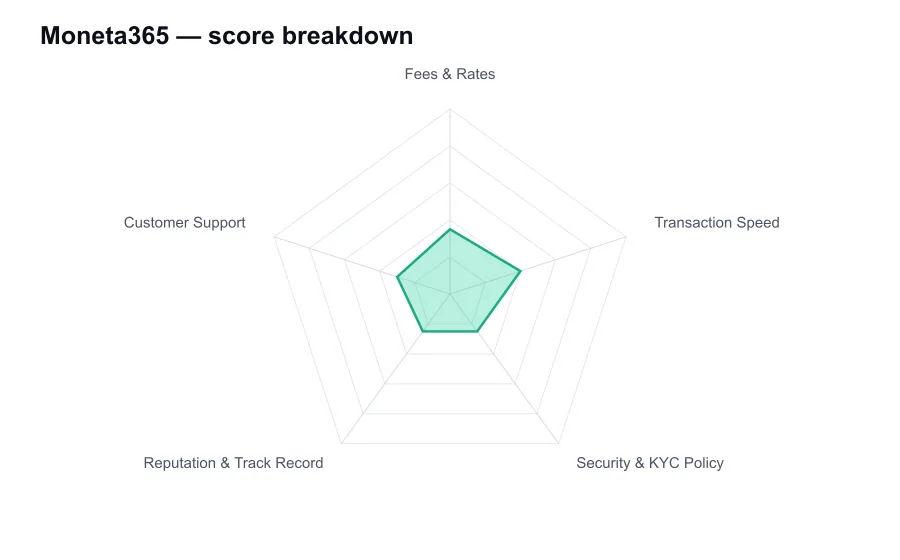
Moneta365 scores 3.1/10 overall in our independent review, measured against every other provider we've compared, strongest on Transaction Speed (4.0/10) and weakest on Reputation & Track Record (2.5/10).
Score: 3.1/10 How we score →| Best for | Not for |
|---|---|
| Potentially simple conversion interface | Limited independently verifiable reputation |
Editorial independence: our scores and rankings are produced using the fixed criteria above and are not influenced by advertisers. This is an independent ranking site and is not operated by, or affiliated with, any provider we list.
Affiliate disclosure: some links on this page may earn us a commission at no extra cost to you. This does not affect our rankings.
Criteria Breakdown
| Criterion | Score | Notes |
|---|---|---|
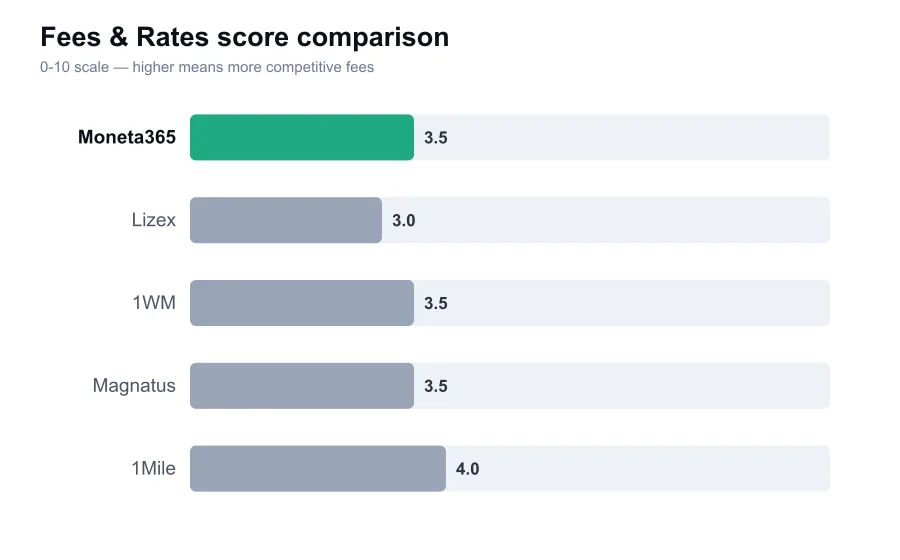
| Fees & Rates | 3.5 | Fee and spread transparency is insufficiently clear. |
| Transaction Speed | 4.0 | Published processing and withdrawal evidence is limited. |
| Security & KYC Policy | 2.5 | Public custody and security control detail is weak. |
| Reputation & Track Record | 2.5 | No strong long term independent track record. |
| Customer Support | 3.0 | Robust escalation and support history are unproven. |
Moneta365 appears in searches and comparison lists as a crypto exchange or conversion provider, but it is not a provider with the kind of transparent market presence that lets a reviewer give it an uncomplicated endorsement. That distinction matters. Crypto is full of polished websites that can collect deposits long before users learn whether there is a real company, a meaningful support desk, or a viable dispute process behind the interface.
A credible exchange should make basic facts easy to find. Readers should be able to identify its legal entity, operating jurisdiction, registration or licensing claims, terms of service, risk disclosures, fee schedule, privacy policy, and a support route that works. If those essentials are incomplete, difficult to locate, inconsistent, or unsupported by official records, the customer is being asked to take an avoidable leap of faith.
Moneta365 does not have the broad public footprint I would expect before recommending a financial provider. It lacks the durable brand recognition and extensive independent coverage enjoyed by names such as Kraken, Coinbase, Bitstamp, Binance, or even newer regulated regional platforms. That does not prove it is illegitimate. It does mean the burden of proof should sit with Moneta365, not with the customer sending irreversible funds.
Fees are particularly difficult to evaluate where public information is thin. An exchange can charge a visible trading fee, a deposit fee, a withdrawal fee, a conversion spread, and a payment processor surcharge. A service that only displays a final quote may technically disclose its price, but it deprives users of a clean way to compare costs. That is a poor standard for a platform handling customer money.
Before depositing, a prospective Moneta365 user should calculate the full round trip. Check the amount paid, the crypto credited, the spread versus a liquid market price, the withdrawal fee, any minimum withdrawal threshold, and the actual amount received in an external wallet. Do not assume a low advertised percentage means a cheap transaction. A wide spread can cost much more than an explicit maker and taker fee.
Speed claims deserve the same skepticism. Card payments can be approved quickly while crypto withdrawals remain delayed for fraud review. Bank transfers may take business days. Swaps can settle only after network confirmations. A reliable provider publishes processing windows and explains the difference between an order being accepted, funds being credited, and a withdrawal being broadcast. Vague claims of fast service are not a service level commitment.
For a lesser known platform, the first withdrawal is more informative than the deposit experience. Deposits are easy for almost every exchange to process. The question is whether a customer can withdraw promptly, receive an on chain transaction ID, and get an intelligible answer if a review occurs. A user should never lock significant capital into a platform before proving that withdrawal path with a small test amount.
Security cannot be inferred from a padlock icon or a claim that a site uses encryption. HTTPS is the minimum expected standard, not evidence of competent custody. Strong exchanges explain whether assets are held with institutional custodians, whether the majority is in cold storage, how withdrawal whitelists work, whether two factor authentication is available, and how they handle suspicious account activity. Publicly verifiable detail around Moneta365 is not strong enough to award confidence.
KYC is another point that needs clarity, not marketing language. Fiat access, card payments, and larger withdrawals almost always create identity and anti money laundering obligations. A provider that implies anonymity and later freezes funds for documents creates a bad customer experience, even if the request is legally permitted. Users should know before depositing what documents may be requested, which countries are supported, and how long a compliance review can last.
Reputation is not just a star rating. It is the accumulated record of operating through volatile markets, supporting customers during outages, responding to complaints, and honoring withdrawals when business conditions are unpleasant. New platforms have not had time to prove all of that. Moneta365's limited independent record leaves too many unanswered questions for it to compete credibly with established alternatives.
Customer support is where unknown providers often fail. A generic contact form and an email inbox might be adequate for a minor website issue, but they are inadequate reassurance for a stalled withdrawal or a locked account. Look for documented service hours, a ticket system, clear escalation, and responses that identify the transaction rather than sending scripted reassurance. I could not establish a robust public support reputation here.
That uncertainty does not mean every user must avoid the service at any price. A technically capable person might decide that a tiny test transaction is an acceptable experiment. They should use a fresh receiving wallet, enable every available account security control, avoid storing a balance, and keep records of each page and message. The test amount should be small enough that a total loss would be annoying, not damaging.
For most people, though, Moneta365 offers too little compensating advantage. A newcomer can use a recognized exchange with transparent fee tiers, clear identity rules, security controls, and a long history of successful withdrawals. An advanced trader can use a liquid venue with published order books and lower measurable execution costs. Moneta365 lands in an uncomfortable middle ground where its risks are clearer than its differentiators.
My final assessment is cautious because the evidence calls for caution. Financial providers do not earn confidence solely by existing online or by presenting a smooth purchase flow. They earn it with disclosure, reliable withdrawals, accountable ownership, tested security, and a visible history of resolving problems. Until Moneta365 can demonstrate those qualities more clearly, I would keep it off any list of recommended places to hold or convert meaningful crypto value.
Pros and Cons
| Pros | Cons |
|---|---|
| Potentially simple conversion interface | — |
| Could suit a tiny test transaction | — |
| May offer straightforward account access | — |
Suitability
Should I keep crypto on Moneta365?
I would not keep a material balance there. Limited public information about custody, security practice, and withdrawal reliability makes self custody or a better established platform the safer route.
Are Moneta365 fees easy to verify?
Do not rely on a headline percentage alone. Compare the final crypto amount, market price, withdrawal charge, and any payment method surcharge before committing funds.
Can I test Moneta365 safely?
No test removes provider risk, but a very small deposit followed by an immediate withdrawal is far safer than funding a large balance. Save all transaction records.