HotExchange
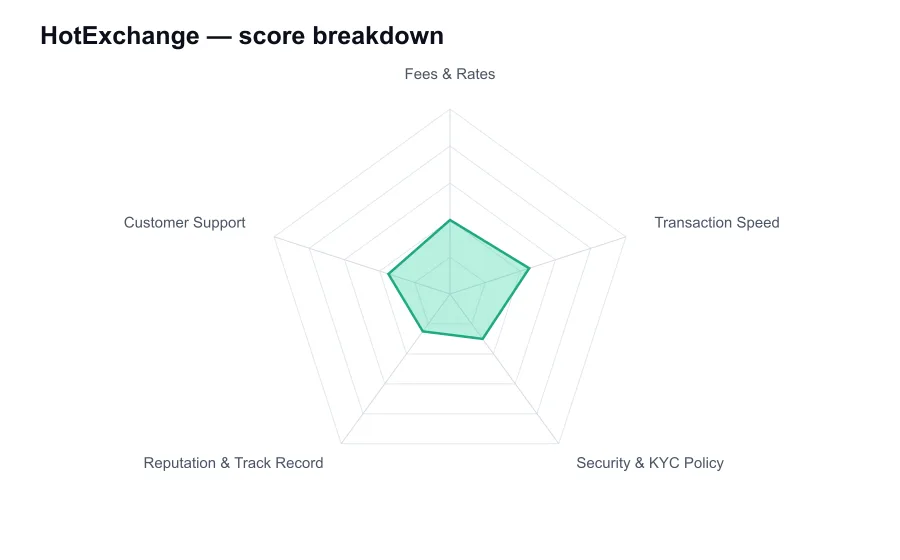
HotExchange scores 3.5/10 overall in our independent review, measured against every other provider we've compared, strongest on Transaction Speed (4.5/10) and weakest on Reputation & Track Record (2.5/10).
Score: 3.5/10 How we score →| Best for | Not for |
|---|---|
| Potentially simple conversion access | Very limited public reputation |
Editorial independence: our scores and rankings are produced using the fixed criteria above and are not influenced by advertisers. This is an independent ranking site and is not operated by, or affiliated with, any provider we list.
Affiliate disclosure: some links on this page may earn us a commission at no extra cost to you. This does not affect our rankings.
Criteria Breakdown
| Criterion | Score | Notes |
|---|---|---|
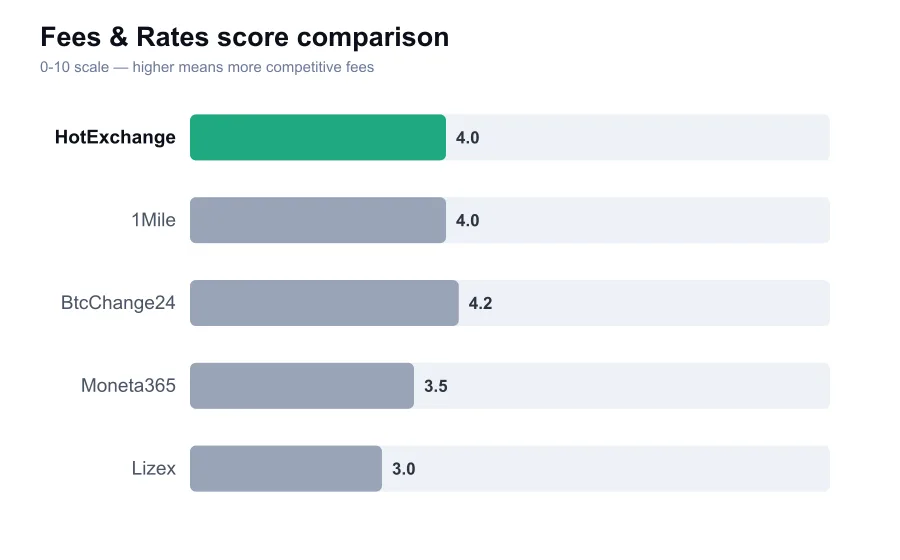
| Fees & Rates | 4.0 | Real execution cost needs close comparison |
| Transaction Speed | 4.5 | Processing reliability is not well documented |
| Security & KYC Policy | 3.0 | Public custody and security evidence is limited |
| Reputation & Track Record | 2.5 | Sparse independently verifiable track record |
| Customer Support | 3.5 | Escalation quality is difficult to establish |
HotExchange is a small-name crypto exchange brand operating in a market where presentation can be misleadingly easy to build. A clean trading page, a long asset list and attractive rates do not establish that an operator has deep liquidity, robust custody controls or the financial strength to survive a stressed market. Compared with established exchanges, HotExchange is difficult to place because its public profile and independently verifiable history are thin.
That lack of visibility is the central issue, not a cosmetic flaw. Crypto users are asked to make irreversible transfers, often without chargeback rights. Before using a lesser-known exchange, I want to know the legal entity, operating jurisdiction, licensing position, leadership, banking arrangements and security record. If those facts are vague or hard to find, the customer is being asked to take a leap of faith that a serious platform should not require.
HotExchange may appeal to users looking for quick conversions or a less cumbersome trading route than the large centralized exchanges. There is a real market for that. Plenty of people don't want to upload documents merely to trade a modest amount of crypto. But a frictionless entry point can turn into friction at withdrawal time, particularly if a platform applies automated risk checks after receiving a deposit.
The fee question is especially important with small exchanges. A platform can advertise low or zero trading fees while earning from wide spreads, thin internal order books, withdrawal charges and unfavorable conversion rates. A zero-fee label is meaningless if the execution price is one or two percent worse than the market. The only number a customer should judge is the amount received after every fee, spread and network cost has been applied.
I would be cautious about sending a large market order through any venue without independently visible depth. Thin liquidity causes slippage. That is true even if the screen displays a familiar coin pair. A $200 conversion may look fine while a $10,000 order receives a much weaker fill. On a reputable exchange, traders can inspect order-book depth and use limit orders. With opaque conversion services, users often get less control.
Withdrawal fees deserve scrutiny as well. These fees can change with network conditions, but a legitimate provider should show them clearly before the user commits. A platform that makes deposits effortless but presents withdrawal restrictions, unexplained minimums or changing charges afterwards deserves little confidence. The ability to withdraw promptly is more important than any promotional trading discount.
Speed is impossible to assess purely from a website claim. A crypto transfer has at least two clocks: the blockchain's confirmation time and the platform's internal processing time. HotExchange can only control the second part. Good operators process routine withdrawals quickly and explain security holds. Weak ones leave requests queued with generic status messages, creating anxiety because the customer cannot tell whether the issue is network congestion or an internal problem.
The sensible approach is a deposit and withdrawal test. Start with a small amount, trade if that is your purpose, then withdraw to a wallet you control. Check whether the address confirmation, processing stage, transaction ID and final delivery are communicated clearly. That test won't prove the exchange is safe, but it reveals more than marketing copy ever will.
Security is another area where HotExchange lacks the public evidence expected from a trusted custodian. The minimum technical protections should include two-factor authentication, withdrawal address controls, email confirmations, encryption and cold-storage practices. Yet customers also need evidence that those systems are operated well. Published security documentation, audits, responsible-disclosure processes and transparent incident reports all help. A provider without that record should receive a lower trust rating.
KYC policies can be a particular source of conflict. Exchanges have legal obligations to screen suspicious activity, and no responsible review should criticize a provider simply for complying with sanctions or anti-money-laundering rules. The criticism applies when the rules are unclear. Users should know whether verification is mandatory, what limits apply before it is requested, what documents may be needed and how long a review normally takes.
HotExchange does not have the reputation buffer enjoyed by Coinbase, Kraken, Bitstamp or Independent Reserve. Those firms are not perfect, and customer complaints exist for all of them, but they have years of regulatory interaction, public reporting and a much larger base of market observers. With HotExchange, a user has less outside information to lean on. That makes every unresolved complaint and every vague policy more significant.
Support is where lesser-known exchanges often fail their first serious test. An FAQ can handle forgotten passwords, but not a deposit sent on the wrong network, a flagged wallet or a withdrawal pending for days. I would expect an accessible ticket channel, clear escalation and replies that address the transaction rather than recycle a script. If support cannot answer basic questions before a deposit, there is no reason to expect better treatment after one.
There is also a psychological trap with small platforms. A user completes one or two successful swaps and assumes the exchange has been validated. It hasn't. The real test arrives during market volatility, a wallet-screening alert, a chain outage or a significant withdrawal. That is why a small successful test is useful, but it should not become an excuse to leave a meaningful balance behind.
HotExchange may be usable for technically capable users making limited experiments with funds they can monitor closely. I would not recommend it as a primary exchange, payroll route, business treasury venue or savings account. A provider needs far more public credibility before it earns those roles.
My final judgment is cautious to the point of skepticism. HotExchange's possible convenience does not compensate for a sparse public track record and insufficiently verifiable security and operating information. The market offers plenty of established alternatives where pricing, identity requirements and support channels are better understood. If you still choose HotExchange, keep the amount small, document every step and withdraw promptly after the transaction is complete.
Pros and Cons
| Pros | Cons |
|---|---|
| Potentially simple conversion access | — |
| May suit small test transactions | — |
| Avoids complexity of advanced trading screens | — |
Suitability
Is HotExchange safe for large deposits?
I would not treat it as suitable for large deposits. Its public reputation and independently verifiable custody information are too limited compared with established regulated exchanges.
How can I check HotExchange fees?
Compare the final amount received against live quotes from multiple providers. Include the displayed rate, spread, network charge and any withdrawal fee, not just a headline trading-fee claim.
Should I complete a test withdrawal first?
Yes. A small deposit, trade and withdrawal to your own wallet is a sensible minimum test. Keep records of addresses, order IDs and transaction hashes.