Lizex
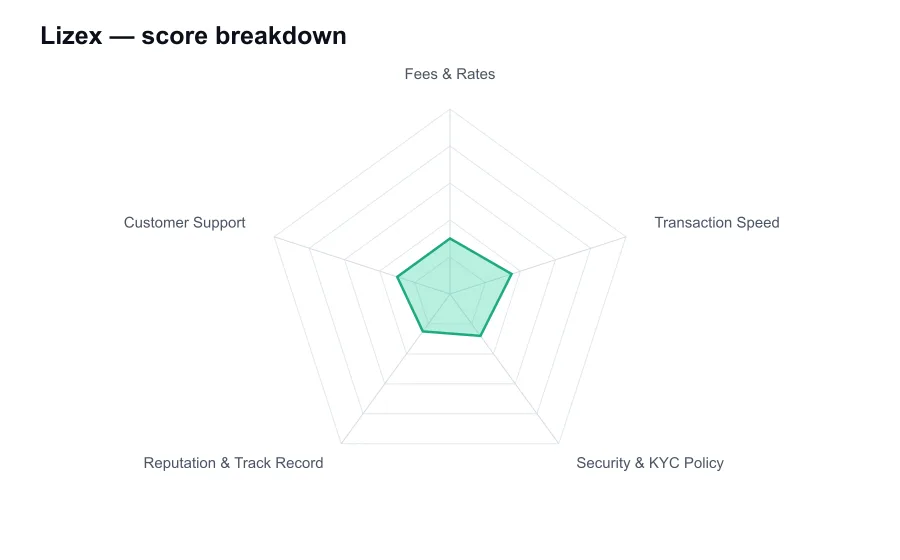
Lizex scores 3.0/10 overall in our independent review, measured against every other provider we've compared, strongest on Transaction Speed (3.5/10) and weakest on Reputation & Track Record (2.5/10).
Score: 3.0/10 How we score →| Best for | Not for |
|---|---|
| May offer a simple interface | Limited independently verifiable track record |
Editorial independence: our scores and rankings are produced using the fixed criteria above and are not influenced by advertisers. This is an independent ranking site and is not operated by, or affiliated with, any provider we list.
Affiliate disclosure: some links on this page may earn us a commission at no extra cost to you. This does not affect our rankings.
Criteria Breakdown
| Criterion | Score | Notes |
|---|---|---|
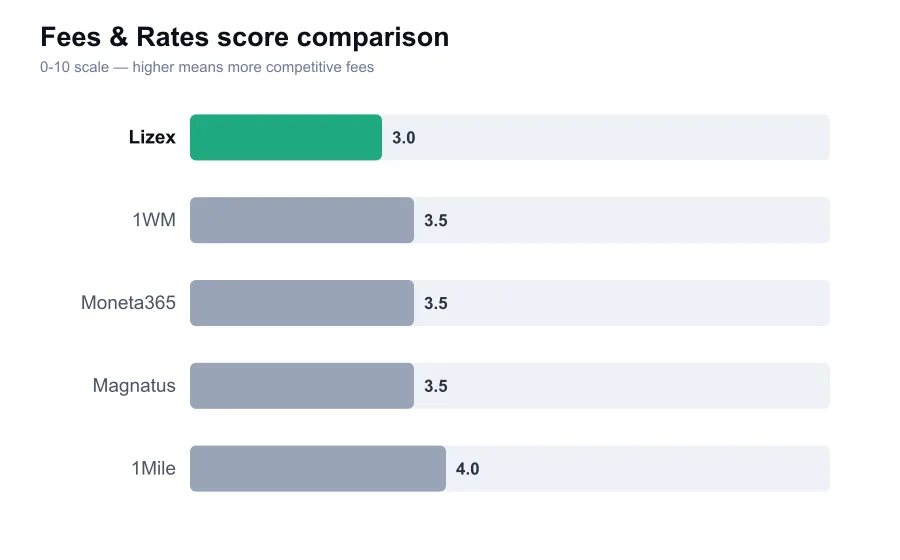
| Fees & Rates | 3.0 | Fee and withdrawal terms need stronger public verification. |
| Transaction Speed | 3.5 | Withdrawal reliability is not independently well established. |
| Security & KYC Policy | 2.8 | Public security evidence is too limited for confidence. |
| Reputation & Track Record | 2.5 | Insufficient independently documented track record. |
| Customer Support | 3.0 | Support quality is difficult to verify under real disputes. |
Lizex is a name that requires more caution than recognition. It does not have the widely documented public profile of major exchanges, established instant-swap brands, or mature DeFi protocols. That does not automatically prove bad intent, but it changes the review standard. In crypto, a service handling deposits has to earn trust with verifiable operating history, clear ownership, transparent terms, security disclosures, and responsive support. Sparse public evidence is a material risk, not a minor branding issue.
The first problem for a prospective user is basic identification. A reliable exchange should make its official domain, legal entity, registration details, terms, privacy policy, supported jurisdictions, and contact methods easy to confirm. If any of those details are inconsistent across advertisements, app listings, social media accounts, or search results, stop before sending funds. Lookalike names and cloned exchange pages are common enough that ambiguity itself is dangerous.
Lizex should not be evaluated by the polish of an interface alone. Scam operations can produce attractive dashboards, fake profit charts, and convincing chat widgets at very little cost. The relevant question is whether users can deposit, trade, withdraw, and obtain support under documented rules over time. I could not place Lizex in the same trust category as Kraken, Coinbase, Bitstamp, or even well-established noncustodial swap providers on the basis of a thin public footprint.
Fee transparency is especially important for a lesser known provider. A legitimate venue should show trading charges, withdrawal fees, minimum amounts, network fee treatment, conversion spreads, and any conditions for promotional rates. If Lizex presents unusually cheap trading, guaranteed returns, or zero-fee withdrawals without a clear commercial explanation, treat that as a warning rather than a bargain. Revenue has to come from somewhere, and vague terms leave a user with no way to challenge a surprise charge.
The most concerning fee pattern is not a visible trading commission. It is the withdrawal obstacle that appears after a deposit or apparent profit. Requests for an extra tax payment, verification deposit, account-unlock fee, liquidity charge, or advance commission before funds can be released are classic danger signals. Legitimate exchanges may require identity verification, but they do not normally demand a fresh cryptocurrency payment to unlock a withdrawal. Never send more money to solve a withdrawal problem.
Speed claims should be treated similarly. A platform can show an instant internal balance update while the important transaction, a blockchain withdrawal, has not happened. The only meaningful test is a small withdrawal to an address you control, followed by independent confirmation on the relevant blockchain explorer. A dashboard message saying completed is not enough. Neither is a customer-service screenshot. On-chain evidence is the standard that matters.
There is not enough independently established operating history to award Lizex a strong reputation score. A service can be new and honest, but newness should lead to conservative use, not blind trust. Check whether there are credible long-term user reports, whether company representatives are identifiable, and whether terms have a consistent revision history. Be suspicious of reviews that use identical wording, focus only on easy deposits, or claim dramatic profits without discussing ordinary withdrawals.
Security claims need proof. Two-factor authentication, encryption, cold storage, and monitoring are phrases any website can display. A stronger case would include documented security practices, transparent incident communication, clear account-protection tools, and evidence of how the company handles breaches or withdrawal disputes. For Lizex, I would not assume that an advertised security feature has the same operational maturity as comparable tools at a regulated, long-running exchange.
KYC policy can also reveal a lot. A legitimate platform should say whether verification is required, what documents are requested, why they are collected, who processes them, and how personal data is retained. A service that says no KYC until after it has received a deposit, then demands intrusive documents or additional payment before withdrawal, creates an unacceptable power imbalance. Do not provide identity documents to a platform whose entity and data-handling practices you cannot independently verify.
Customer support is where uncertain services often fail their real-world test. Fast replies before a deposit are not evidence of good support. The meaningful test is how support handles a delayed withdrawal, a disputed fee, or a request to close an account. If communication happens only through Telegram, WhatsApp, or direct messages, the risk rises sharply. Those channels are easy to impersonate and provide very little accountability.
Lizex may be encountered through social-media promotions, referral pitches, unsolicited investment contacts, or claims that a trading assistant can operate the account for you. These are situations where users need to be unusually firm. Do not let a promoter control your screen, create a wallet for you, or tell you which address to withdraw to. If someone pressures you to act quickly, promises guaranteed gains, or discourages an independent withdrawal test, walk away.
A prudent due-diligence process starts outside the platform. Search for the legal entity in the jurisdiction it claims, read its terms without relying on promotional summaries, inspect domain age and contact consistency, and find discussion that predates current marketing campaigns. Then test only an amount you can afford to lose. Deposit a small amount, make a trade if necessary, withdraw to your own wallet, and wait for independent confirmation before considering further use.
Even a successful small withdrawal should not be treated as a full endorsement. Some fraudulent operations allow early withdrawals to build confidence, then impose barriers after larger deposits. Keep balances off any exchange you have not thoroughly vetted. Do not store long-term holdings there, do not share seed phrases, and do not install remote-access software at the request of support. Those rules are basic, but they prevent a surprising number of losses.
My opinion is blunt: Lizex has not demonstrated enough verifiable public standing for me to recommend it as a primary place to buy, trade, or store crypto. There are too many established alternatives with clearer fee schedules, known operators, stronger security records, and a meaningful history of successful withdrawals. A curious, technically competent user can conduct a tiny independent test, but that is the outer limit of what I would consider sensible. For most people, the right decision is to choose a better documented provider.
Pros and Cons
| Pros | Cons |
|---|---|
| May offer a simple interface | — |
| Small independent withdrawal tests are possible | — |
| Could suit users conducting strict due diligence | — |
Suitability
Is Lizex safe to use?
There is not enough independently verifiable public information to support a strong safety recommendation. Do not deposit meaningful funds without confirming ownership, terms, and a successful small withdrawal.
How should I test a crypto platform such as Lizex?
Verify the official domain independently, use a small amount only, withdraw to a wallet you control, and confirm the transaction on a blockchain explorer before adding funds.
Should I pay a fee to unlock a Lizex withdrawal?
Be extremely cautious. Requests for extra crypto payments labeled tax, unlock, verification, or release fees are major warning signs. Seek independent advice before sending anything.