1Mile
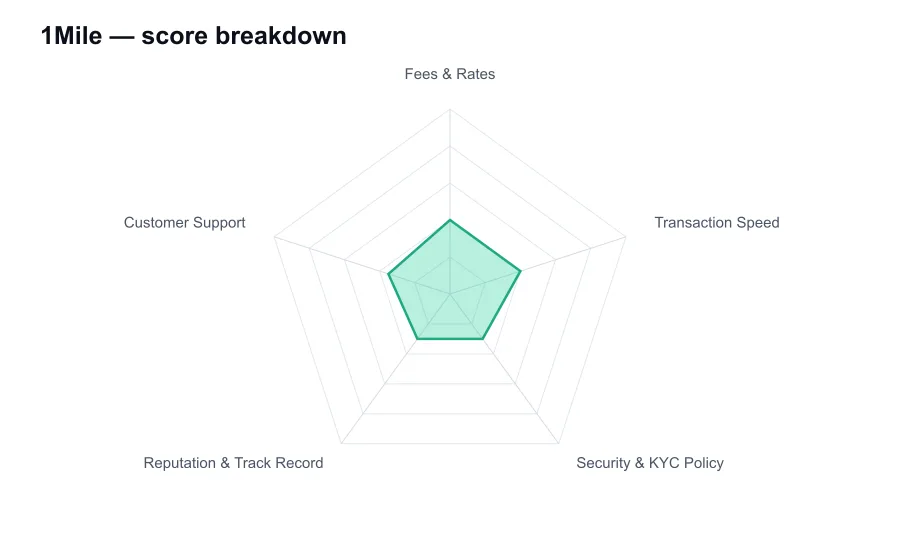
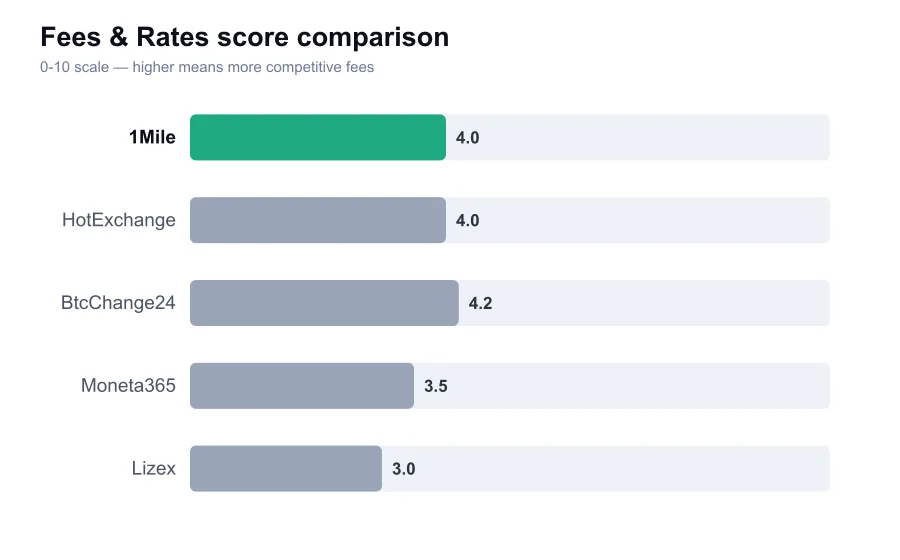
1Mile scores 3.5/10 overall in our independent review, measured against every other provider we've compared, strongest on Fees & Rates (4.0/10) and weakest on Reputation & Track Record (3.0/10).
Score: 3.5/10 How we score →| Best for | Not for |
|---|---|
| Potentially simple conversion flow | Limited public operating history to assess |
Editorial independence: our scores and rankings are produced using the fixed criteria above and are not influenced by advertisers. This is an independent ranking site and is not operated by, or affiliated with, any provider we list.
Affiliate disclosure: some links on this page may earn us a commission at no extra cost to you. This does not affect our rankings.
Criteria Breakdown
| Criterion | Score | Notes |
|---|---|---|
| Fees & Rates | 4.0 | Verify the final payout against live alternatives |
| Transaction Speed | 4.0 | No strong public evidence of consistent execution |
| Security & KYC Policy | 3.0 | Publicly verifiable controls appear limited |
| Reputation & Track Record | 3.0 | Thin independently assessable track record |
| Customer Support | 3.5 | Test responsiveness before trusting larger sums |
1Mile sits in a difficult part of the crypto market to review because the name does not carry the public recognition, documentation depth, or independently visible operating history of a major exchange. It appears to be presented as an exchange or conversion provider rather than a widely used spot market. That alone should alter a buyer's behavior. Unknown financial counterparties deserve verification first and deposits second.
A polished interface is not evidence of a dependable exchange. The minimum standard I expect from a provider handling customer cryptocurrency is clear ownership information, usable terms of service, a defined jurisdiction, risk disclosures, a support route, and a transparent explanation of how orders are processed. If a customer cannot independently establish who operates the service, who holds funds during conversion, and how disputes are handled, confidence should remain low.
The biggest issue with 1Mile is not necessarily a specific bad feature. It is the lack of a deep, easily auditable public record compared with established competitors. That makes it hard to validate claims about reserves, security practices, completion rates, or service-level performance. A reviewer should not fill those gaps with optimistic assumptions, especially in crypto, where thinly documented services can disappear quickly.
Fee analysis is therefore limited to what a user can verify in a live quote. Providers in this category often advertise an attractive rate and earn their margin through the spread between market price and final payout. That is not inherently unfair. It becomes a problem when the rate changes after a deposit arrives, when network fees are unclear, or when the service gives no reliable estimate of the received amount.
Before using 1Mile, compare the payout against a liquid exchange and at least two instant-swap alternatives. Do this immediately before placing the order, not hours earlier. The right comparison is simple: how much of the destination asset reaches your wallet after every cost? A service can advertise zero commission while still delivering a poor conversion because the spread is wide.
Transaction speed should also be approached cautiously. A small exchange provider can automate a straightforward transaction, but blockchain confirmation requirements still apply. Bitcoin deposits can take from tens of minutes to longer during congestion. Token transfers may be fast on a low-cost network, yet the operator's own processing queue can still introduce delay. There is no meaningful evidence base for treating 1Mile as a speed leader.
An order that appears stalled is where thin operational disclosure becomes expensive. Users need to know whether the service has received the deposit, how many confirmations it requires, whether it has placed the order under review, and when a human can intervene. A major exchange usually exposes account records, status pages, and formal tickets. A lightly documented provider may give users far less leverage when something goes wrong.
Security cannot be scored generously on assertions alone. The relevant questions are whether the service has published a credible security program, whether its infrastructure or smart contracts have undergone independent assessment where applicable, whether it uses clear account protections, and whether it openly describes custody practices. Without strong, verifiable answers, users should assume they are making a temporary unsecured counterparty bet.
The KYC situation is another point where crypto users can make dangerous assumptions. A provider may permit a customer to begin an order without opening a full account, then request documents after a compliance trigger. That can be lawful and common, but it should be stated plainly. Anyone unwilling or unable to provide identity documentation should not deposit first and investigate the policy later.
Privacy is not just about KYC. It includes how long personal data, IP data, transaction records, and submitted documents are retained, and who can access them. Bigger firms are not automatically better on privacy, but they at least tend to publish fuller policies. With 1Mile, I would want to read the live privacy policy closely and avoid sending identity documents unless the company behind the service can be independently established.
Reputation should be built from more than testimonials displayed by the business itself. Search for dated third-party feedback, review how complaints are handled, and distinguish genuine transaction-specific discussion from vague praise. One should also check whether the provider has a history on reputable monitoring platforms and whether that history is continuous. A fresh cluster of positive comments is weak evidence.
Customer support is where an unknown service must overperform to compensate for its smaller reputation. It needs responsive channels, clear escalation, and staff who can discuss a transaction hash and order record intelligently. If support only repeats that an order is being processed, that is not enough. Save evidence at every stage, including the initial quote, payment instructions, transaction ID, and correspondence.
I would only consider 1Mile for a very small test transaction, and even then only after checking the current site, ownership disclosures, live terms, and independent reputation. It is not the place for an emergency conversion, a six-figure trade, or funds borrowed for trading. The downside of a frozen or disputed order is too high relative to the benefit of trying an obscure provider.
This may sound severe, but the burden of proof belongs to the service, not the customer. Crypto has no shortage of alternatives with established brands, regulated operations, published security practices, or noncustodial execution. A lesser-known operator needs a compelling advantage in price, local payment methods, or support to justify the added trust requirement. I do not see enough public evidence to assume that advantage.
My recommendation is simple. Keep 1Mile on a watchlist rather than treating it as a default exchange. If its quote is exceptional, test it with an amount small enough to lose and document every step. For ordinary users, established exchanges and well-known noncustodial aggregators offer a more sensible balance of price, transparency, and recourse.
Pros and Cons
| Pros | Cons |
|---|---|
| Potentially simple conversion flow | — |
| May be useful for a tiny test order | — |
| Can be compared through a live final quote | — |
Suitability
Should I use 1Mile for a large crypto exchange?
No. Its limited independently verifiable track record makes it unsuitable for a large or time-sensitive transfer. If you use it at all, begin with a small test amount.
How can I check 1Mile's real fee?
Compare the final destination amount, including network costs, with quotes from multiple established services at the same time. A displayed zero fee does not prove a competitive rate.
Will 1Mile ask for KYC?
Do not assume a low-friction order means no KYC. Read the current terms before depositing, because compliance checks can be requested after an order is submitted.