CoinCraddle
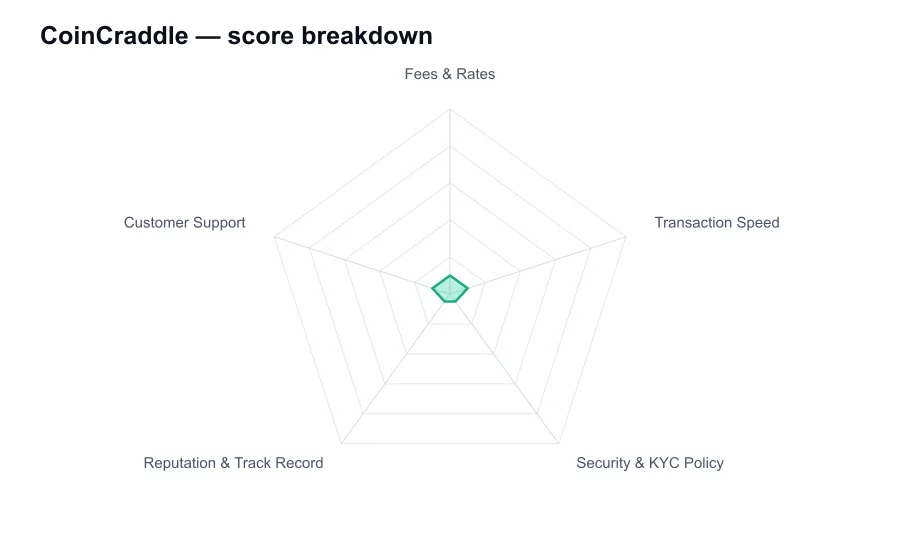
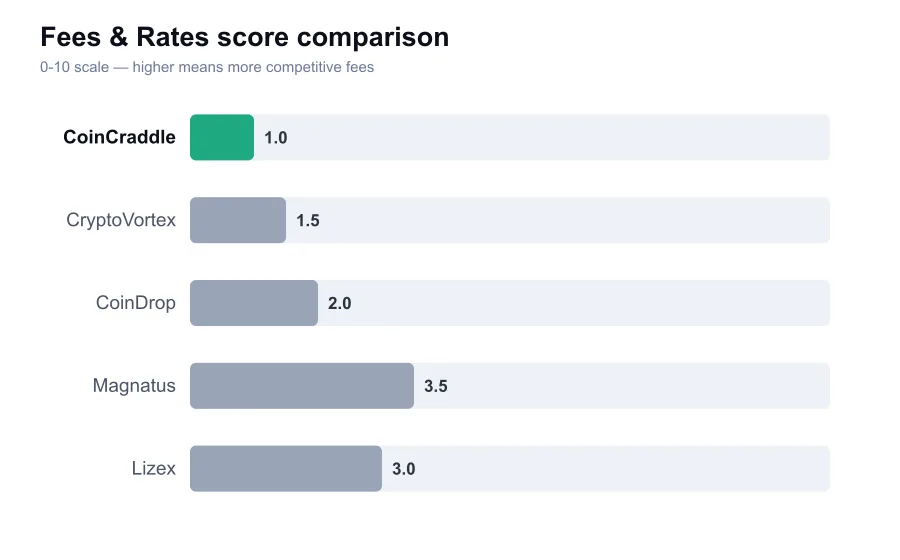
CoinCraddle scores 0.8/10 overall in our independent review, measured against every other provider we've compared, strongest on Fees & Rates (1.0/10) and weakest on Reputation & Track Record (0.5/10).
Score: 0.8/10 How we score →| Best for | Not for |
|---|---|
| No verified strengths sufficient for a recommendation | Operator and legal status are not sufficiently verifiable |
Editorial independence: our scores and rankings are produced using the fixed criteria above and are not influenced by advertisers. This is an independent ranking site and is not operated by, or affiliated with, any provider we list.
Affiliate disclosure: some links on this page may earn us a commission at no extra cost to you. This does not affect our rankings.
Criteria Breakdown
| Criterion | Score | Notes |
|---|---|---|
| Fees & Rates | 1.0 | No dependable public fee schedule could be verified. |
| Transaction Speed | 1.0 | No reliable evidence of normal withdrawal processing. |
| Security & KYC Policy | 0.5 | Custody, KYC, and security controls are not verifiable. |
| Reputation & Track Record | 0.5 | No sufficient independent operating track record found. |
| Customer Support | 1.0 | No accountable, independently tested support record. |
CoinCraddle presents a very different review problem from an established exchange or analytics provider. I could not verify a sufficiently clear, authoritative public identity, operating company, regulatory footprint, or reliable official website for a crypto service using this exact name. That is not a minor paperwork issue in this industry. It is the starting point for deciding whether a platform should receive customer deposits at all.
A crypto provider can be small and still be legitimate. New businesses begin somewhere. But a credible exchange or broker should make it easy to identify who operates it, where it is incorporated, what terms govern the customer relationship, how to contact it, and what licences or registrations apply in the jurisdictions it targets. Without those basics, a reviewer cannot responsibly present CoinCraddle as an established venue, and a prospective user should not fill the information gap with optimism.
The lack of verifiable public information also makes fee claims impossible to assess. I found no dependable published schedule showing spot trading commissions, spreads, deposit charges, network withdrawal fees, fiat conversion costs, minimums, or inactivity fees. A platform may advertise zero fees while recovering its margin through a wide spread, an inflated exchange rate, or a withdrawal charge that appears only after funds arrive. Until a customer can inspect the terms and compare a live quote against market price, the fee score must stay near the floor.
Do not send a test deposit merely to discover the pricing. That advice gets repeated too casually. A small deposit is safer than a large one, but it can still become inaccessible if withdrawal rules change, account review is triggered, or support goes silent. The right first test is documentary: identify the legal entity, read the fee schedule, inspect the withdrawal policy, search for independent reports, and confirm that the domain and support addresses are consistent across official materials.
Transaction speed cannot be evaluated honestly either. Many questionable crypto sites claim instant deposits, instant profits, or rapid withdrawals. Deposits can appear quickly because an operator wants a balance to be credited. The meaningful speed test is the reverse journey, from account balance to a wallet controlled by the customer, with a normal blockchain transaction identifier and no surprise payment, tax, insurance, or verification fee demanded before release. I found no reliable evidence establishing that CoinCraddle passes that test.
Any service handling cryptocurrency should explain its confirmation requirements, hot-wallet policy, cold-storage approach, withdrawal review process, supported networks, and expected processing windows. Established exchanges publish much of this information and display maintenance notices when networks are paused. Silence is not a competitive advantage. If CoinCraddle has such controls, it needs to document them plainly through an authoritative channel before users should consider trusting it with funds.
Security is where uncertainty becomes most serious. There is no verifiable basis here for saying whether CoinCraddle uses segregated custody, multi-signature storage, security audits, penetration testing, proof of reserves, insurance, address whitelisting, withdrawal delays, or meaningful account-protection controls. A glossy login page, a padlock in the browser, and a two-factor authentication prompt do not prove that the operator can safeguard customer assets. They only show that a website has basic web security features.
KYC policy is similarly unclear. A no-KYC promise can attract users, but unclear verification rules are dangerous because they can be applied selectively after money has been deposited. Legitimate providers state which countries they serve, what documents they may request, whether verification is required before deposits or withdrawals, and what happens if an account is restricted. Nobody should accept a platform that reserves the right to demand unspecified payments or documents as a condition of releasing a withdrawal.
The reputation picture is not merely thin, it is inadequate for a positive recommendation. I could not identify the sort of independent, sustained discussion that accompanies a real service with a meaningful customer base. That does not prove misconduct. It does mean there is no demonstrated track record to offset the inherent risks of sending irreversible cryptocurrency to an unknown counterparty. In crypto, the burden of proof belongs with the platform asking for trust.
Be careful with reviews that appear only on the platform's own pages, newly created social profiles, affiliate blogs with no disclosure, or messaging groups run by promoters. Those sources can be manufactured cheaply. More useful evidence includes verifiable company records, consistent long-term user discussion, identifiable leadership, reputable media coverage, transparent policies, and technically credible on-chain behaviour. CoinCraddle does not have enough readily verifiable material in those categories for me to recommend it.
Customer support cannot be graded as a strength without a tested, accountable channel. An email address or chat icon is not support quality. What matters is whether a user gets a clear answer about a delayed withdrawal, whether the company identifies itself, whether escalation exists, and whether disputes are handled under published terms. With CoinCraddle, the lack of independent evidence means a user should assume support may be unavailable precisely when it matters most.
If someone has already deposited with CoinCraddle, they should not send additional funds to unlock a withdrawal, pay a supposed tax in advance, buy an upgrade, or satisfy a claimed liquidity requirement without obtaining independent legal advice. Preserve screenshots, wallet addresses, transaction hashes, emails, and chat logs. Contact the receiving exchange or wallet provider quickly if funds were sent onward. Reporting suspected fraud to relevant financial-crime and consumer-protection authorities can also help build a record.
For people who have not deposited, the recommendation is simpler: do not use it until the operator can be independently verified and its terms can be examined. There is no shortage of alternatives with long public histories, transparent ownership disclosures, published fees, and observable withdrawal operations. Depending on jurisdiction, established options may include Kraken, Coinbase, Bitstamp, Gemini, or regulated local providers. Their flaws are visible, which is far preferable to an unknown platform's blank spaces.
My verdict on CoinCraddle is deliberately severe because the available evidence does not support a softer one. This is not a case of a service losing points for an untidy interface or average spreads. The basic facts needed to assess custody, pricing, support, and legal accountability are not sufficiently verifiable. Until that changes through clear official disclosures and credible independent validation, CoinCraddle should be treated as unsuitable for deposits, trading, or personal information submission.
Pros and Cons
| Pros | Cons |
|---|---|
| No verified strengths sufficient for a recommendation | — |
| Name does not establish legitimacy | — |
| Users can choose better documented alternatives | — |
Suitability
Is CoinCraddle a verified crypto exchange?
I could not verify enough authoritative public information about an operator, regulatory status, official domain, or established customer record to recommend it as a verified exchange.
Should I make a small deposit to test CoinCraddle?
No. First verify the legal entity, fees, withdrawal policy, domain ownership, and independent reputation. A small deposit can still be trapped or used to pressure users into sending more.
What if CoinCraddle asks for money to release a withdrawal?
Do not send extra funds without independent legal advice. Preserve transaction hashes, wallet addresses, screenshots, and communications, then contact relevant exchanges and consumer or financial-crime authorities.