CoinDrop
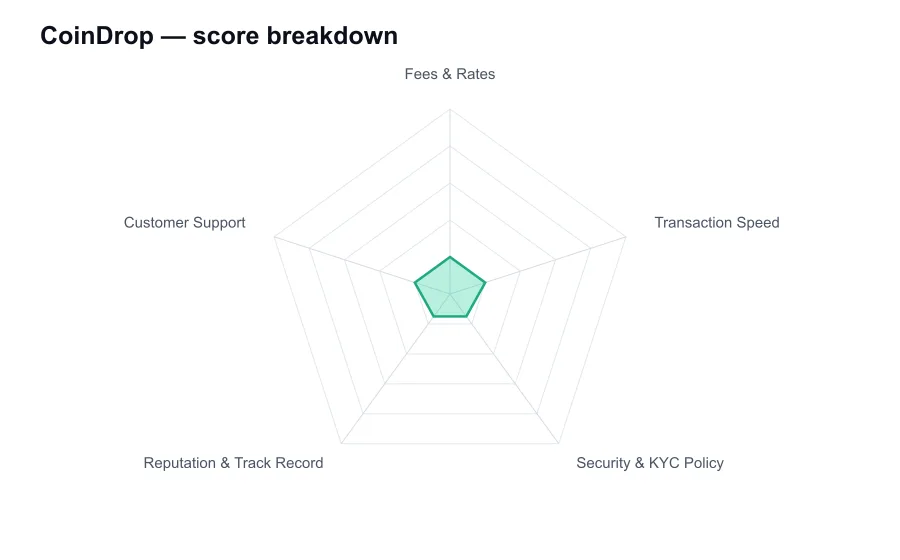
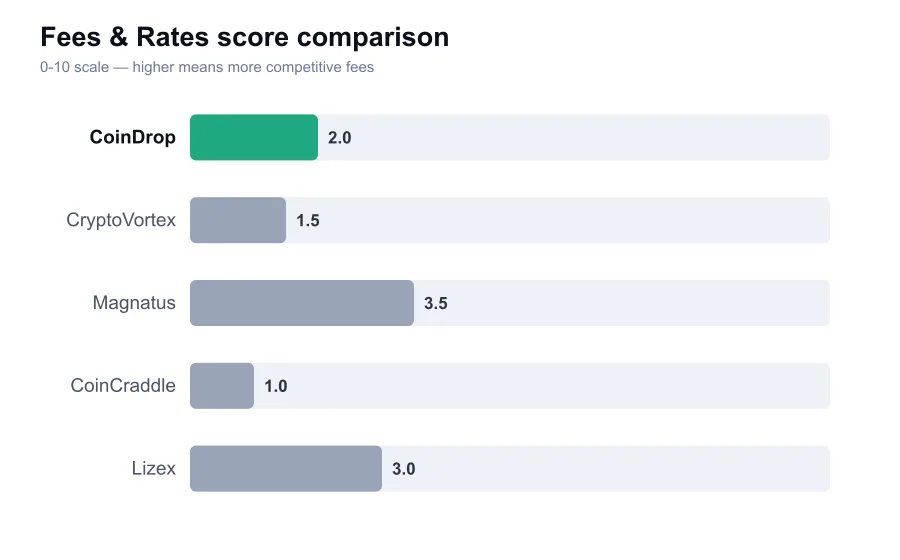
CoinDrop scores 1.8/10 overall in our independent review, measured against every other provider we've compared, strongest on Fees & Rates (2.0/10) and weakest on Reputation & Track Record (1.5/10).
Score: 1.8/10 How we score →| Best for | Not for |
|---|---|
| May offer simple promotional entry points | No clearly verifiable single operator |
Editorial independence: our scores and rankings are produced using the fixed criteria above and are not influenced by advertisers. This is an independent ranking site and is not operated by, or affiliated with, any provider we list.
Affiliate disclosure: some links on this page may earn us a commission at no extra cost to you. This does not affect our rankings.
Criteria Breakdown
| Criterion | Score | Notes |
|---|---|---|
| Fees & Rates | 2.0 | No consistently verifiable public fee schedule |
| Transaction Speed | 2.0 | No dependable withdrawal performance record |
| Security & KYC Policy | 1.5 | Operator and security controls are unclear |
| Reputation & Track Record | 1.5 | No established, verifiable market track record |
| Customer Support | 2.0 | Support structure cannot be reliably verified |
CoinDrop is a name that appears in several corners of the crypto internet, attached to reward campaigns, token promotions, faucet style offers, and small exchange related services. That is the first problem for anyone trying to assess it seriously. I could not establish a single, clearly documented CoinDrop trading platform with a transparent legal operator, published regulatory status, audited reserves, and a long public operating history. A crypto provider should never make customers work this hard to determine who is holding their money.
The branding is generic enough that search results can blend unrelated projects together. That might sound like a minor research inconvenience, but it has practical consequences. Users can easily land on lookalike domains, social accounts, or promotional pages that imply an association which may not exist. Established platforms such as Coinbase, Kraken, Bitstamp, and Coinmotion do not create this degree of identity confusion. Their corporate ownership and primary web presence are easy to identify.
I would not treat CoinDrop as a conventional exchange until the specific service in question can show its legal entity, jurisdiction, terms of service, and complete fee schedule. A polished landing page or active Telegram group doesn't answer those questions. Nor does a claim that withdrawals are fast, liquidity is deep, or a token is about to be listed. Those are marketing claims. The useful evidence is a named operator, a verifiable company registration, clear customer agreements, and a history that can be independently checked.
Fees are particularly difficult to evaluate because there is no consistent, reliable public schedule tied to one identifiable CoinDrop provider. Some services using similar language advertise zero fees, but that phrase often excludes the spread between the quoted buy and sell price, network charges, payment processor costs, or withdrawal deductions. A zero trading commission can still be an expensive transaction if the rate is materially worse than the market price. Without a visible quote comparison and a final settlement breakdown, a user cannot calculate the real cost.
That lack of fee transparency deserves a low score, not the benefit of the doubt. A good crypto service states the trading fee, withdrawal fee, minimum withdrawal, payment method cost, and the source of its exchange rate before an order is confirmed. Coinmotion, for example, publishes a tiered trading fee model. Larger exchanges also document maker and taker rates in detail. With CoinDrop, the buyer needs to assume that any cost not plainly disclosed could emerge at the moment it matters most, namely during purchase or withdrawal.
Speed claims should be viewed in the same light. A blockchain transaction can be broadcast quickly, but that tells you nothing about how long a provider takes to approve a withdrawal. The relevant clock starts when the customer requests funds and ends when the transaction appears on chain or the bank transfer lands. A service with weak operational disclosure gives no dependable basis for predicting either stage. There is no sufficiently established public service record from which I would promise same day payout or routine processing times.
A small provider can be fast, sometimes faster than a large exchange during quiet periods. It can also be unable to process a surge in withdrawals, delayed by manual checks, banking problems, or a thin support team. That is why anecdotal reports are a poor substitute for published service standards and a long history of fulfilled redemptions. If CoinDrop is offering unusually attractive rates or rewards, the appropriate response is caution, not excitement. High apparent returns have often been used to compensate for weak trust signals.
Security information is even more important here. I could not verify a mature public security program for a clearly defined CoinDrop platform, such as cold storage procedures, independent penetration testing, bug bounty coverage, insurance disclosures, proof of reserves, or a detailed incident response record. None of these measures guarantees safety, but their absence from public materials makes risk assessment much harder. A provider asking for identity documents or custody of crypto should be far more transparent than this.
KYC policy also cannot be responsibly summarized as either required or not required without knowing which CoinDrop entity a user means. This ambiguity is dangerous. A site may market easy access, then request documents at withdrawal time, or it may lack the compliance controls needed to operate responsibly in the first place. Neither scenario is attractive. Legitimate regulated services are often less convenient at account opening, but the compliance process is explained before money changes hands.
The reputation question is decisive. I found no equivalent of Coinmotion's Finnish regulatory footprint, no long running self custody reputation comparable with Coinomi, and no widely recognized exchange track record. A lack of public complaints is not proof of quality for a small or unclear brand. It may simply mean the customer base is tiny, the name is frequently changed, or discussions are fragmented across channels. Reputation is earned over years of ordinary withdrawals, support disputes, market stress, and transparent handling of mistakes.
Customer support cannot be given much credit where the verified support structure is unclear. A contact form, chat widget, or Telegram administrator is not the same as a documented support operation with a ticket trail, response commitments, escalation route, and legal complaints process. Crypto support is most important when an account is restricted or funds are missing. Those are precisely the moments when anonymous or loosely identified services tend to be least useful.
If you have already encountered a CoinDrop offer, verify the precise domain character by character, find the company named in the legal documents, and test any withdrawal process only with an amount you can afford to lose. Do not send funds to a wallet merely because a representative promises a bonus, recovery service, staking yield, or expedited verification. Never share a seed phrase, remote device access, or a one time authentication code. Those requests are disqualifying.
The fair reading is not that every project called CoinDrop is automatically fraudulent. It is that the available identity and operating information does not support the level of confidence required for an exchange review. There may be a legitimate niche product behind one version of the name, but a prospective customer should demand evidence before treating it as a financial counterparty. In crypto, uncertainty about who runs the service is itself a major risk factor.
My take is simple. CoinDrop does not currently clear the transparency threshold I would expect before recommending a provider for buying, selling, or storing meaningful amounts of crypto. The possible upside of a promotion or a seemingly cheap quote is small beside the downside of an unrecoverable deposit. Use an established regulated exchange for fiat transactions and a well supported self custody wallet for long term holdings. CoinDrop belongs in the watchlist category, not the trusted provider category.
Pros and Cons
| Pros | Cons |
|---|---|
| May offer simple promotional entry points | — |
| Generic name is easy to find | — |
| Small services can sometimes process requests quickly | — |
Suitability
Is CoinDrop a regulated crypto exchange?
I could not verify a clearly identified CoinDrop exchange with a published regulatory status and accountable legal operator. Check the exact domain's legal documents before sending any money.
Does CoinDrop charge trading fees?
There is no consistent public fee schedule that can be reliably attributed to one CoinDrop provider. Compare the final quoted price and withdrawal amount before proceeding.
Should I send crypto to CoinDrop for a bonus?
No bonus should override basic due diligence. Do not send funds until you have independently verified the operator, terms, and a successful small withdrawal.